Country Selector
Africa
Asia Pacific
Europe
Latin America and Caribbean
North America
Please enter a valid location
Agronomy
•
2026-02-13
Using Liberty Link® and Optimum® GLY Canola in Rotation
Key Points
- Rotating crop and herbicide systems supports sustainable weed and disease control and long-term profitability.
- Alternating herbicide tolerance technologies can help reduce herbicide resistance risk, improve volunteer canola control, and increase operational flexibility.
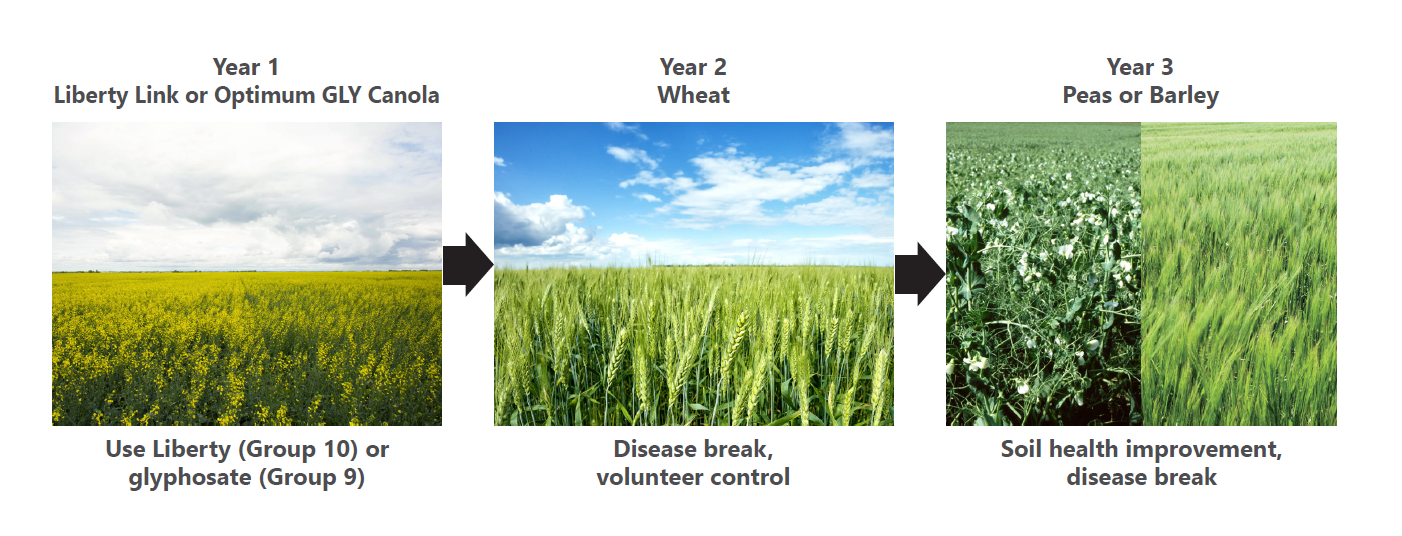
- A 2-3 year break between canola crops (with cereals and/or pulses in between) is essential to reduce clubroot, blackleg, verticillium stripe, and sclerotinia inoculum.
- Crop and Herbicide Rotation
- Herbicide Resistance Management
- Volunteer Canola Control
- Disease Management
- Operational Flexibility
- Stewardship and Market Access
- Best Practices for Rotation
- Bottom Line
- Reference
Crop and Herbicide Rotation
- Crop rotation is a cornerstone of sustainable canola production, helping growers manage weeds, diseases, and maintain longterm profitability.
- Incorporating both Liberty Link® and Optimum® GLY canola systems into a crop rotation offers advantages beyond simple trait diversity.
- Alternating herbicide tolerance technologies can help reduce herbicide resistance risk, improve volunteer canola control, and increase operational flexibility—all while protecting market premiums and supporting stewardship practices.
- This integrated approach ensures a resilient cropping system that meets both agronomic and economic goals for your farm.
- The following are considerations for utilizing both Liberty Link® and Optimum GLY® canola on your farm.
Herbicide Resistance Management
- Different modes of action: Liberty Link® uses glufosinate (Group 10) herbicides. Optimum GLY® uses glyphosate (Group 9) herbicides.
- Rotating these systems reduces selection pressure on weeds, slowing the development of herbicide resistance in species such as kochia, wild oats, and cleavers. This is a cornerstone of integrated weed management.
Volunteer Canola Control
- Alternating herbicide systems simplifies volunteer canola control.
- timing application 1-4 days prior to seeding (depending on annual or perennial weed targets) helps optimize weed control, maximizes yield potential, and sets up a clean start to the crop.
- A meta-analysis of 89 studies from 2003 to 2020 estimated an average of 30% canola yield loss due to weed interference in Canada (Geddes et al., 2022).
- Volunteer canola with stacked herbicide tolerance traits can become a major issue if the same system is used repeatedly.
- Effective rotations help maintain seed purity for specialty oil contracts and prevent contamination that could jeopardize premiums.
Disease Management
- A 2-3 year break between canola crops (with cereals and/or pulses in between) is essential to reduce clubroot, blackleg, verticillium stripe, and sclerotinia inoculum.
- Rotating crop and herbicide systems supports sustainable weed and disease control and long-term profitability.
Operational Flexibility
- Using both herbicide tolerance systems gives growers flexibility in weed spectrum management and herbicide timing.
- Liberty performs best in warm, sunny conditions on small weeds and is challenged by Group 1 resistant wild oats and green foxtail, as well as cleavers, etc.
- Glyphosate is effective on the previously listed weeds, however, Group 9 resistant kochia is a concern on a growing number of acres in western Canada.
- Using both herbicide tolerance traits (and herbicide actives) separately in a crop rotation is key to managing existing and future weed concerns.
Stewardship and Market Access
- Identity preservation is critical for high-value contracts (e.g. high oleic or omega-9 canola).
- Rotating systems, cleaning equipment between fields, and managing volunteer canola reduces contamination risk and protects market premiums.
- Customer feedback in 2025 revealed that Liberty Link volunteers from conventional hybrids in Liberty Link “specialty oil” canola crops created concerns for customers to meet contracted specifications.
Best Practices for Rotation
- Keep detailed records of canola hybrids (and their respective herbicide traits) to avoid herbicide misapplication.
- Use separate field blocks for different systems and clean equipment thoroughly.
- Scout and control canola volunteers aggressively to prevent competition with the crop and negative yield impact. Volunteer canola control should be a multi-year approach (year 2 and 3).
Bottom Line
- Using both Liberty Link and Optimum GLY canola in rotation is not just about weed control—it’s about whole farm profitability, resistance management, disease suppression, operational flexibility, and protecting market premiums.
- This integrated approach supports long-term sustainability and profitability in Western Canadian canola production.
Reference
Geddes, C.M., B.D. Tidemann, J.T. Ikley, J.A. Dille, N. Soltani, and P.H. Sikkema. 2022. Potential spring canola yield losses due to weeds in Canada and the United States Weed Technol. 36:884- 890.