
Country Selector
Please enter a valid location
6/17/2025
Northern Corn Leaf Blight
Crop Focus
Written by Mark Jeschke, Ph.D., Pioneer Agronomy Manager
Key Points
- Northern corn leaf blight (NCLB) is a foliar disease caused by the fungus Exserohilum turcicum, multiple races of which exist in North America.
- New lesions can produce spores in as little as one week, allowing northern corn leaf blight to spread faster than many other corn leaf diseases.
- Resistant hybrids and foliar fungicides are important tools for management of northern corn leaf blight.
- Causal Pathogen
- Identification
- Crop Damage
- Management Considerations
- Reference
Causal Pathogen
- Northern corn leaf blight (NCLB) is a foliar disease caused by the fungus Exserohilum turcicum.
- Disease development is favored by moderate temperatures (64-81 °F) and extended periods of leaf wetness (6-18 hours).
- Heavy dew, overcast days, or humid field margins near tree lines can create an environment conducive for disease.
- E. turcicum overwinters in corn residue, allowing inoculum to build up from year to year.
- Cropping systems with reduced- or no-till and/or continuous corn are at higher risk of northern corn leaf blight outbreaks.
- There are multiple races of E. turcicum documented in North America. These races can be region specific and can shift over time. This requires corn breeders to be mindful of the different races and tailor their breeding programs accordingly.
- The resistance genes available to corn breeders are named “Ht” based on the previous northern corn leaf blight fungal name Helminthosporium turcicum.
Identification
- Infections generally begin on lower leaves and progress up the plant, but infections may begin in the upper plant canopy when spores blow in from surrounding fields.
- Under optimum conditions, lesions can form 7 to 12 days after infection.
- Lesions are unrestricted by leaf veins, beginning with a elliptical shape and becoming long, narrow, and cigar shaped (Figure 1).
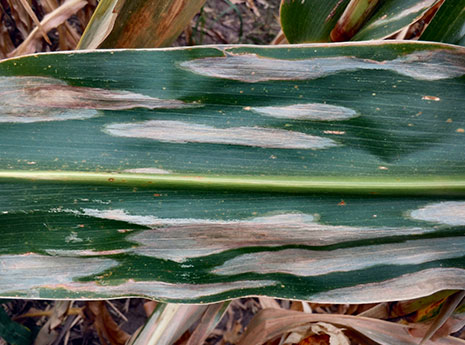
Figure 1. Corn leaf with characteristic symptoms of northern corn leaf blight — elongated, cigar-shaped, tan to grayish-green lesions.
- Coloration of lesions starts as tan or gray-green, and takes on a darker shade as E. turcicum sporulates.
- Spore coloration ranges from olive green to black, and can be visible with a hand lens.
- Lesions are often described as appearing “dirty” (Figure 2).
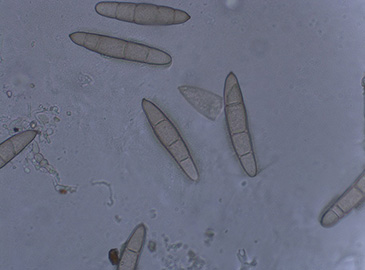
Figure 2. Spores of Exserohilum turcicum under a microscope.
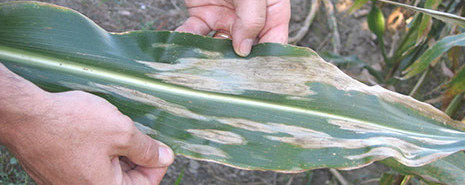
- Lesions can coalesce to form large areas of necrotic leaf tissue, making leaves appear gray/burned.
- New lesions can produce spores in as little as one week, allowing northern corn leaf blight to spread much faster than many other corn leaf diseases.
Crop Damage
- Lesions on corn leaves hinder photosynthetic activity, reducing the amount of carbohydrates allocated towards grain fill.
- If lesions progress to the ear leaf or higher two weeks before or after tasseling and pollination, yield loss can occur.
- Yield losses are most severe when northern corn leaf blight infects corn plants early and progresses to the upper plant leaves by pollination or early ear fill.
- Yield losses up to 30% have been reported.
- Because a decrease in functioning leaf area limits photosynthates dedicated towards grainfill, the plant may mobilize more carbohydrates from the stalk to fill kernels, which can make plants more susceptible to stalk rots and lodging.
Management Considerations
Cultural Practices
- E. turcicum overwinters in corn debris, so production practices such as tillage and crop rotation, that reduce the amount of corn residue on the surface, will decrease the amount of primary inoculum.
- However, reducing corn residue does not protect against spore showers carried into a field on wind currents.
Hybrid Resistance
- Planting hybrids with a high level of genetic resistance can help reduce the risk of yield loss due to northern corn leaf blight.
- Pioneer® brand hybrids and parent lines are improved through a screening process in areas with a high incidence of northern corn leaf blight and specialized disease nurseries.
- Pioneer hybrids are rated for northern corn leaf blight resistance. Most hybrids are rated from 3 to 7 on the Pioneer 1 to 9 scale, where 9 indicates highly resistant.
- Susceptible hybrids are more likely to benefit from a foliar fungicide application.
- Two types of resistance are available in hybrids (Table 1).
Table 1. Comparison between multigenetic and single Ht resistance.
Multigenic Resistance Single Gene “Ht” resistance Non-race-specific Race-specific More stable over time May be overcome in time Reduces number of lesions on a leaf Delays spore production, limits sporulation 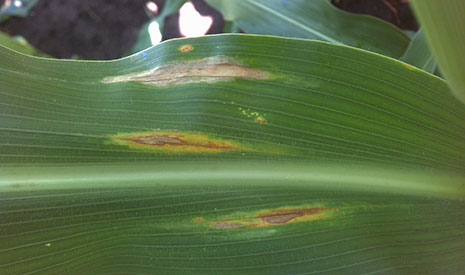
Figure 3. Corn leaf showing a mixed reaction to NCLB. This Ht1 hybrid shows resistance to Race 0 (yellow lesions in the center and bottom edge of the leaf) and susceptibility to race 1 (the susceptible lesion on the top edge of the leaf).
Fungicides
- Several foliar fungicides are labeled for control of northern corn leaf blight (Table 2).
Table 2. Foliar fungicide productstras rated very good to excellent for control of northern corn leaf blight. (Wise, 2025).
Trade Name Active Ingredients NCLB
RatingAproach® 2.08 SC Picoxystrobin VG Aproach® Prima 2.34 SC Cyproconazole + Picoxystrobin VG Delaro® 325 SC Prothioconazole + Trifloxystrobin VG Delaro® Complete
3.83 SCProthioconazole + Fluopyram + Trifloxystrobin VG Domark® 230 ME Tetraconazole VG Folicur® 3.6 F Tetraconazole VG Fortix® 3.22 SC
Preemptor™ 3.22 SCFlutriafol + Fluoxastrobin VG Headline® 2.09
EC/SCPyraclostrobin VG Headline AMP®
1.68 SCPyraclostrobin + Metconazole VG Lucento® 4.17 SC Flutriafol + Bixafen VG Miravis® Neo 2.5 SE Pydiflumetofen + Azoxystrobin + Propiconazole VG-E Priaxor® 4.17 SC Pyraclostrobin + Fluxapyroxad VG-E Proline® 480 SC Prothioconazole VG Quilt Xcel® 2.2 SE Azoxystrobin + Propiconazole VG Revytek® 4.44 SC Mefentrifluconazole + Fluxapyroxad + Pyraclostrobin VG-E Stratego® YLD
4.18 SCTrifloxystrobin + Prothioconazole VG Trivapro® 2.21 SE Benzovindiflupyr + Azoxystrobin + Propiconazole VG Veltyma® 3.34 SC Mefentrifluconazole + Pyraclostrobin VG-E - Northern corn leaf blight may not always be controlled as completely as some other diseases. This is due to the more rapid life cycle, which may be as short as one week under favorable conditions.
- Because northern corn leaf blight sporulates so rapidly, it is more difficult to time a single fungicide application.
- Weather conditions anticipated during ear fill are a primary factor for disease development and often have the most impact (along with hybrid disease rating) on the profitability of fungicide applications.
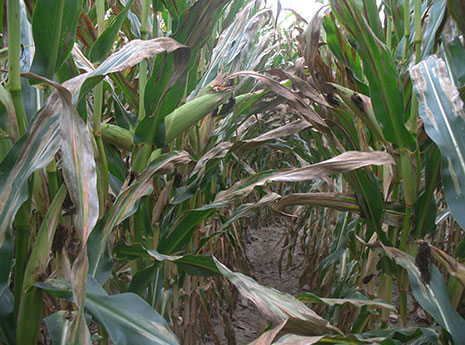
Figure 4. Corn leaves with large northern corn leaf blight lesions. Note how the coloration varies from gray-green to tan.
Reference
- Wise, K. 2025. Fungicide Efficacy for Control of Corn Foliar Diseases. Crop Protection Network CPN-2011-W.

Protect Your Field and Your Yield
Prevent against and defeat even the most resistant diseases with fungicide solutions from Corteva Agriscience.


The foregoing is provided for informational use only. Please contact your Pioneer sales professional for information and suggestions specific to your operation. Product performance is variable and depends on many factors such as moisture and heat stress, soil type, management practices and environmental stress as well as disease and pest pressures. Individual results may vary. Pioneer® brand products are provided subject to the terms and conditions of purchase which are part of the labeling and purchase documents.