
Country Selector
Please enter a valid location


Why Does Southern Rust Spread Quickly?
When conditions favorable for disease development persist for an extended period, severity of Southern Rust's impact can quickly reach epidemic levels. The Crop Doctor, Mark Jeschke, discusses Southern Rust symptoms, crop and yield impact, as well as how growers can better prevent the disease in future growing seasons.
Why Does Southern Rust Spread Quickly?
When conditions favorable for disease development persist for an extended period, severity of Southern Rust's impact can quickly reach epidemic levels. The Crop Doctor, Mark Jeschke, discusses Southern Rust symptoms, crop and yield impact, as well as how growers can better prevent the disease in future growing seasons.
- Key Points
- Pathogen Facts
- Crop Damage
- Life Cycle
- Identification
- Distribution
- Management Considerations
- References
- Corn and Soybean Scouting Calendar
Key Points
- Southern rust (Puccinia polysora) is a foliar disease of corn common to the Southeastern U.S. that is now occurring with increasing frequency in the Corn Belt.
- P. polysora requires a living host to survive, so it does not overwinter in the Corn Belt. Spores are carried north each year from tropical areas by prevailing winds.
- Southern rust has the potential to be much more damaging to corn than common rust due to its ability to rapidly develop and spread.
- Southern rust is favored by high temperatures (over 77 ºF, 25 ºC) and high relative humidity.
Pathogen Facts
- Southern rust is a foliar disease of corn caused by the fungal pathogen Puccinia polysora.
- Southern rust does not occur as frequently in the Corn Belt as common rust (P. sorghi), but can be more destructive when infection does take place.
- Unlike other major foliar diseases of corn in North America, the rusts do not overwinter in the Corn Belt.
- Rusts develop first in southern corn fields, and then may spread into primary corn-growing states.
- Movement is by windblown spores that travel northward with prevailing weather systems.
- Heavy rains during the summer can precipitate wind-blown spores out of the atmosphere, leading to infection.
- Southern rust is favored by high temperatures (over 77 ºF, 25 ºC) and high relative humidity, which is why it is more common in tropical and subtropical regions.
- When conditions favorable for disease development persist for an extended period, severity can quickly reach epidemic levels.
- Yield impact depends on timing of infection, amount of leaf area damaged and location of damaged leaves on the plant.
Crop Damage
- Photosynthesis is reduced as functional leaf area decreases, which can reduce kernel fill and yield.
- Corn stalk quality can also be negatively affected as plants remobilize carbohydrates from the stalk to compensate for reduced photosynthesis.
- Later-planted corn is generally at higher risk for yield loss due to leaf diseases.
- If damage is confined to lower leaves or occurs after corn is well-dented, yield impact will be low.

Figure 1. Southern rust (Puccinia polysora) pustules on a corn leaf.
Life Cycle
- Urediniospores are the primary infective propagule and are spread northward via the wind from living hosts in tropical areas.
- Spores will infect corn and cause symptoms within three to four days. Within six to 12 days, more urediniospores are produced and new infections continue to occur as long as conditions remain favorable, which can rapidly lead to an epidemic (Table 1).
Table 1. Southern rust has a shorter latent period (time between initial infection and the start of sporulation) than other common corn diseases.
Corn Disease Latent Period Southern rust (Puccinia polysora) 6-12 days Common rust (Puccinia sorghi) 7-14 days Northern leaf blight (Exserohilum turcicum) 7-14 days Tar spot (Phyllachora maydis) 14-20 days Gray leaf spot (Cercospora zeae-maydis) 14-28 days - In the U.S., southern rust usually appears later in the growing season and is more prevalent in the southeastern states.
- In seasons with higher than average temperatures, southern rust can spread further up into the Corn Belt where it can impact corn yield.
- P. polysora is not known to have an alternate host.
Southern Rust Disease Cycle
(Puccinea polysora)
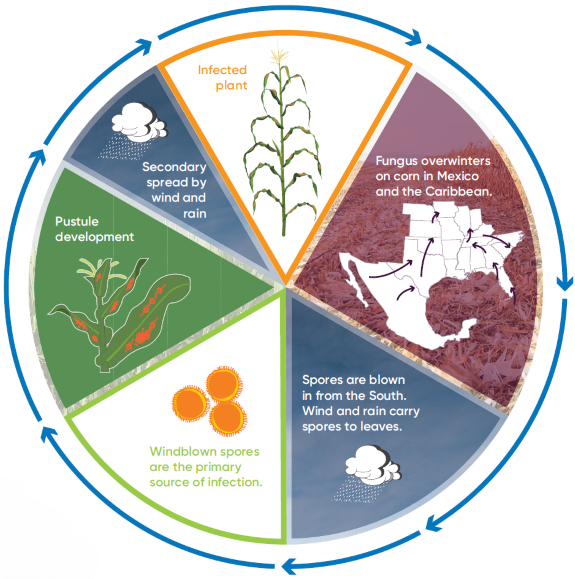
Figure 2. Life cycle of southern rust.
Southern Rust
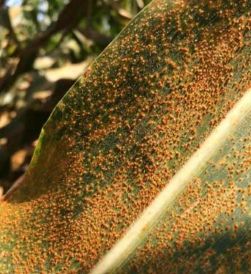
- Has small circular, pinhead-shaped pustules.
- Coloration of pustules/spores is reddish orange.
- Infects the upper leaf surface, as well as stalks and husks.
- Favored by higher temperatures (over 77 ºF, 25 ºC).
Common Rust
- Has larger pustules that are more elongate and blocky.
- Coloration of pustules/spores is brown to cinnamon-brown.

- Infects the upper and lower leaf surfaces.
- Favored by cooler temperatures (60-77 ºF, 15-25 ºC).
Identification
- Both rust diseases of corn can cause substantial yield losses under severe disease pressure; however, southern rust generally poses a greater risk to corn yield than common rust, making proper identification important.
- Southern rust looks very similar to common rust, but several characteristics distinguish the two, including the shape and color of pustules and their location on the plant.
Distribution
- In recent growing seasons, southern rust has occurred further north in the Midwestern U.S. earlier in the season than has been historically typical for this disease.
- Southern rust is now routinely observed in Indiana, Illinois, Iowa, Nebraska and Kansas and has been detected as far north as South Dakota, Minnesota and Wisconsin.
- The increased prevalence of southern rust in the Corn Belt makes awareness and proper identification of this disease especially important.

Figure 3. Southern rust on corn; Johnston, IA; August 2024. Southern rust outbreaks often begin with isolated patches of disease in the middle or upper canopy along field edges.

Figure 4. Later in the season, P. polysora forms darker pustules called telia that contain teliospores.
Management Considerations
Cultural Practices
- Cultural practices such as tillage and crop rotation do not influence southern rust development because it does not overwinter in crop residue.
Hybrid Resistance
- Pioneer® brand corn products grown in areas affected by southern rust are rated for their genetic resistance to southern rust on a one to nine scale.
- Most current products rated between three and five, indicating susceptibility (1-3), or moderate resistance (4-6).
Fungicides
- Several foliar fungicide products are labeled for control of southern rust (Table 2).
Table 2. Fungicide products rated very good to excellent for control of southern rust (Wise, 2026).
Trade Name Active Ingredients
(FRAC group 1)SR Rating Quadris® 2.08 SC Azoxystrobin (11) VG Headline® 2.09 EC/SC Pyraclostrobin (11) VG QuiltXcel® 2.2 SE Azoxystrobin (11) Propiconazole (3) VG Trivapro® 2.21 SE Propiconazole (3) Azoxystrobin (11) Benzovindiflupyr (7) E Fortix® 3.22 SC
Preemptor™ 3.22 SCFlutriafol (3) Fluoxastrobin (11) VG Revytek® 4.44 SC Pyraclostrobin (11) Mefentrifluconazole (3) Fluxapyroxad (7) VG Miravis® Neo 2.5 SE Propiconazole (3) Azoxystrobin (11) Pydiflumetofen (7) VG Priaxor® 4.17 SC Pyraclostrobin (11) Fluxapyroxad (7) VG Adastrio® 4.0 SC
Forcivo™ 4.0 SCFlutriafol (3) Azoxystrobin (11) Fluindapyr (7) VG ¹Fungicide Resistance Action Committee mode of action groups: Group 11 Qol Strobilurins, Group 3 DMI Triazoles, Group 7 SDHI.
- The rapid disease cycle of southern rust makes application timing very important. Treatment between the R1 and R3 stage is generally best for controlling southern rust disease.
- Pioneer foliar fungicide trials conducted in 2025 — a year with abnormally high southern rust pressure — showed an average yield benefit of 14.2 bu/A (McNinch, 2026).
References
- McNinch, S. 2026. Corn Hybrid Response to Foliar Fungicide Application - 2025 Pioneer Agronomy Research Update Vol 16 No. 1. Corteva Agriscience.
- Wise, K. 2026. Fungicide Efficacy for Control of Corn Foliar Diseases. Crop Protection Network CPN-2011-W.
Corn and Soybean Scouting Calendar
Download your copy of Pioneer's Corn and Soybean Scouting Calendar. It's your guide to the diseases and pests that threaten your yield and when to look for each one.
Protect Your Field and Your Yield
Prevent against and defeat even the most resistant diseases with fungicide solutions from Corteva Agriscience.


Forcivo™ is not registered for sale or use in all states. Contact your state pesticide regulatory agency to determine if a product is registered for sale or use in your state. Always read and follow label directions.
The foregoing is provided for informational use only. Please contact your Pioneer sales professional for information and suggestions specific to your operation. Product performance is variable and depends on many factors such as moisture and heat stress, soil type, management practices and environmental stress as well as disease and pest pressures. Individual results may vary. Pioneer® brand products are provided subject to the terms and conditions of purchase which are part of the labeling and purchase documents.