
Country Selector
Please enter a valid location
Sudden Death Syndrome of Soybeans
Crop Focus
Written by Mark Jeschke, Ph.D., Pioneer Agronomy Manager
Soybean Sudden Death Syndrome Explained
Soybean Sudden Death Syndrome Explained
- Key Points
- A Major Disease of Soybean
- Causal Pathogen
- Root and Stem Symptoms
- Leaf Symptoms
- Conditions Favoring Disease Development
- Management
Key Points
- Sudden death syndrome (SDS) is a fungal disease of soybeans that infects the roots early in the season.
- The fungus produces a toxin that is translocated up the plant and causes foliar symptoms, which typically appear later in the season.
- SDS-tolerant varieties, fungicide seed treatments, management of SCN and improved soil drainage can help minimize damage from SDS.
- Foliar fungicides have no effect since the infection is in the roots.
A Major Disease of Soybean
- Sudden death syndrome (SDS) is one of the most economically important yield-limiting diseases of soybean in North America.
- Since its initial discovery in Arkansas in the early 1970s, it has spread to infect soybean fields in almost all U.S. soybean-growing states and Ontario, Canada.
- SDS is capable of causing significant yield loss in soybeans, with reductions exceeding 50% in the most severe cases.
Causal Pathogen
- In North America, SDS is caused by the fungal pathogen Fusarium virguliforme, formerly known as F. solani f. sp. glycines.
- F. virguliforme is believed to be an invasive pathogen that originally evolved in South America.
- F. virguliforme survives in root debris and soil as chlamydospores, which are thick-walled, asexual fungal spores.
- As the soil warms up in the spring, chlamydospores germinate and can infect nearby soybean roots.
- Infection of soybean plants occurs early in the growing season, often as early as germination to just after crop emergence.
- The fungus colonizes cortical tissue of the roots. It has been isolated from both the taproots and lateral roots, but infection does not extend above the crown of the plant.
- Later in the season, the fungus will penetrate the xylem tissue in the roots and produce a toxin that is translocated up the plant and causes the characteristic foliar symptoms (Figure 1).
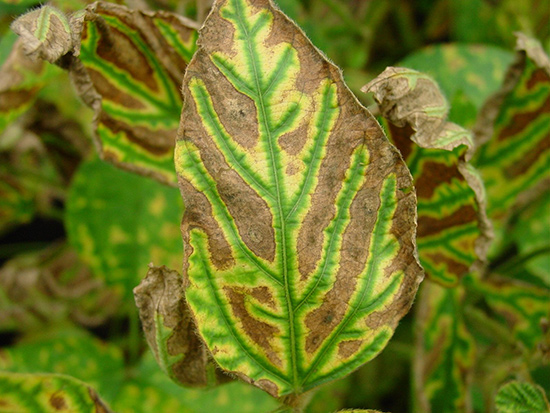
Figure 1. Soybean leaf showing classic symptoms of sudden death syndrome infection, with yellow and brown areas contrasted against a green midvein and green lateral veins.
- F. virguliforme produces spores (macroconidia) on the surface of infected roots during the summer, which then convert to chlamydospores and are sloughed off of the plant.
- Within a growing season, these spores will only spread a short distance from infected plants, but flowing water and movement of soil can spread the pathogen over greater distances.
Root and Stem Symptoms
- SDS begins as a root disease that limits root development and deteriorates roots and nodules, resulting in reduced water and nutrient uptake by the plant.
- On severely infected plants, a blue coloration may be found on the outer surface of tap roots due to the large number of spores produced (Figure 2).

Figure 2. Microscopic view of blue colored spore masses on the root of a soybean plant infected with SDS (left) and F. virguliforme growth on artificial media (right).
- Splitting the root will reveal that the cortical cells have turned a milky gray-brown color while the inner core, or pith, remains white (Figure 3).
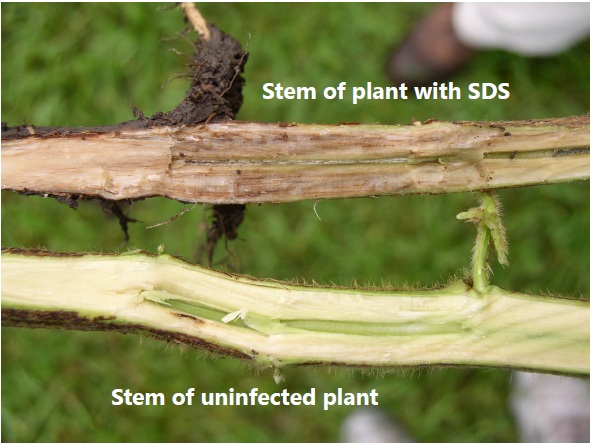
Figure 3. Split soybean plant stems showing the discolored cortical tissue of a SDS-infected plant compared to a healthy plant.
Leaf Symptoms
- Leaf symptoms usually do not appear until the reproductive stages of crop development.
- Leaf symptoms of SDS first appear as yellow spots, usually on the upper leaves, in a mosaic pattern. The yellow spots coalesce to form chlorotic blotches between the leaf veins (Figure 4).
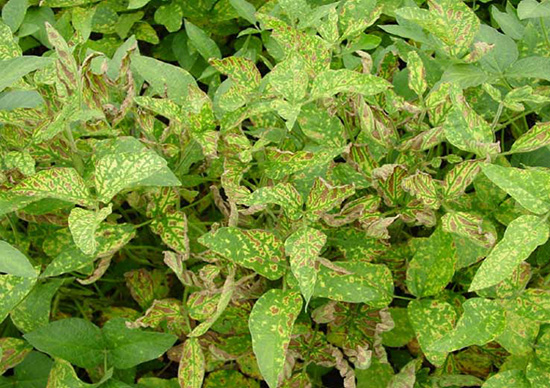
Figure 4. Field view of sudden death syndrome symptoms. Note yellow and brown areas contrasted against a green midvein and green lateral veins. Rapid drying of necrotic areas can cause curling of affected leaves.
- As these chlorotic areas begin to die, the leaf symptoms become very distinct, with yellow and brown areas contrasted against a green midvein and green lateral veins.
- Rapid drying of necrotic areas can cause curling of affected leaves. Leaves drop from the plant prematurely, but leaf petioles remain firmly attached to the stem.
Conditions Favoring Disease Development
- SDS often appears first in localized spots in the field, such as low, poorly drained or compacted areas (Figure 5).
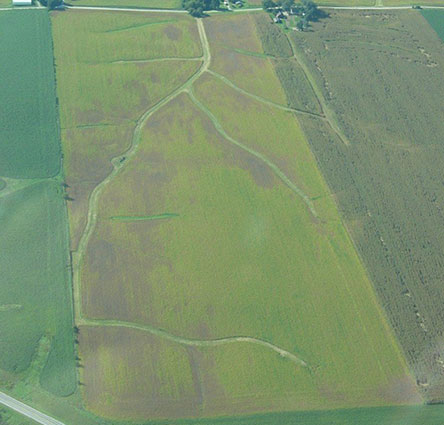
Figure 5. Aerial view of a soybean field with SDS. Symptoms are more prevalent near waterways and areas with poor drainage.
- Higher incidence of SDS often occurs when soybeans have been exposed to cool, moist soil conditions early in the growing season.
- SDS symptoms are usually more severe if SCN is also problematic in the field. SCN increases the stress on the soybean plant and also provides wounds through which the SDS pathogen can enter the roots.
Management
- There are no management options available to protect yield once foliar symptoms of SDS begin to appear. Foliar fungicides have no effect since the infection is in the roots.
- Scouting and management strategies are focused on mitigating disease impact in subsequent seasons.
- The first line of defense against SDS is genetic tolerance of soybean varieties.
- Soybean varieties can differ significantly in susceptibility to SDS infection, with tolerance exhibited primarily as a reduction in symptom severity.
- SCN resistance is also an important consideration for variety selection, since SCN injury can exacerbate SDS problems.
- Victrato® soybean seed treatment (active ingredient: cyclobutrifluram) provides protection of soybean seedlings from F. virguliforme infection.
- Improving field drainage and reducing compaction can help reduce severity of SDS.


Components of LumiGEN® seed treatments are applied at a Corteva Agriscience production facility, or by an independent sales representative of Corteva Agriscience or its affiliates. Not all sales representatives offer treatment services, and costs and other charges may vary. See your sales representative for details. Seed applied technologies exclusive to Corteva Agriscience and its affiliates. Seed applied technologies may not be registered for sale or use in all states. Contact your state pesticide regulatory agency to determine if a product is registered for sale or use in your state. Victrato® is a registered trademark of Syngenta Group Company. Always read and follow label directions.
The foregoing is provided for informational use only. Please contact your Pioneer sales professional for information and suggestions specific to your operation. Product performance is variable and depends on many factors such as moisture and heat stress, soil type, management practices and environmental stress as well as disease and pest pressures. Individual results may vary. Pioneer® brand products are provided subject to the terms and conditions of purchase which are part of the labeling and purchase documents.