
Country Selector
Please enter a valid location
6/23/2025
Sugarcane Beetle

Crop Focus
Written by Debora Montezano, Pioneer Agronomy Research Manager
Key Points
- The sugarcane beetle (Euetheola humilis) is a sporadic pest of seedling corn, primarily in the southern United States.
- Adult sugarcane beetles cause the most significant damage to corn during the seedling stage by feeding on the roots and crown.
- Damage typically occurs in patches and can lead to substantial stand loss and yield reduction if infestations are severe.

- Distribution and Pest Status
- Lifecycle
- Identification
- Injury and Crop Impact
- Scouting and Monitoring
- Management Recommendations
Distribution and Pest Status
- Euetheola humilis, the sugarcane beetle, is a species of rhinoceros beetle in the family Scarabaeidae, native to North America and found throughout North, Central, and South America.
- Sugarcane beetle was historically considered a sporadic pest of corn, primarily in the Gulf Coast and southern United States.
- In recent years, the range of the sugarcane beetle has expanded northward into the Midwest. This expansion is likely driven by changes in crop management practices and shifting climate conditions.
- Populations are most frequently found in fields with abundant crop residue, sod, or grassy weeds, which provide ideal conditions for egg laying and larval development.
- Infestation risk is high when corn is planted following grass sod or pasture, as these rotations leave behind the habitat and food sources the beetles prefer.
- In addition to corn, the sugarcane beetle is a pest of several other crops, including rice, sugarcane, sweet potato, strawberry, and turfgrass.
- While sugarcane beetle outbreaks are rare, when they do occur, they can result in significant crop losses and economic impact for growers.
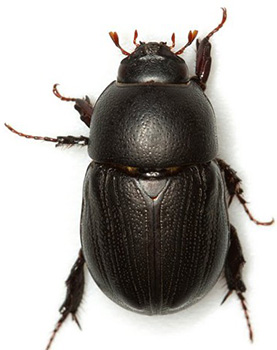
Figure 1. Sugarcane beetle.
Lifecycle
- The sugarcane beetle undergoes complete metamorphosis — progressing through egg, larva, pupa, and adult stages — and typically completes one generation per year, though the timing of each stage can vary by region.
- Adults overwinter in the soil, usually in grassy areas or small grain fields, and become active in spring as temperatures rise.
- They begin feeding in seedling corn soon after emergence, primarily at night.
- Mating occurs shortly after adults become active in the spring, also often during the night. After mating, females lay eggs in the soil, usually in grassy areas or fields with abundant residue.
- Eggs hatch into white, C-shaped larvae in the soil. The larval stage consists of three instars. Larvae feed primarily on decaying plant material and grass roots; corn roots are a poor host for this species. Larval development takes about 57 days.
- After completing the third instar, larvae pupate in the soil, forming a creamy white pupa within a soil chamber.
- New adults emerge in the fall, feed briefly to build energy reserves, and then return to the soil to hibernate for the winter, typically in grassy or undisturbed areas.
Identification
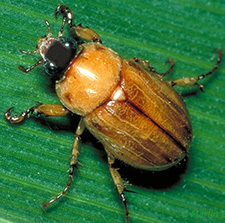
- Adult sugarcane beetles are shiny, robust, ovalshaped, and dark brown to black, measuring about 12-16 mm (½ inch) in length, with clubbed antennae and strong legs for digging (Figure 2).
- Larvae are white, C-shaped grubs with dark brown heads, found in the soil near plant roots, while pupae are creamy white and develop in soil chambers.
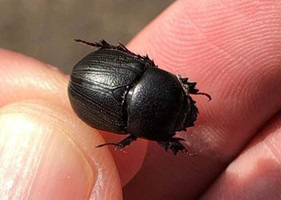
Figure 2. Sugarcane beetle.
Injury and Crop Impact
Adult sugarcane beetles cause the most significant damage to corn during the seedling stage by feeding on roots and the crown, sometimes boring into the stalk just below ground level and giving it a ragged appearance (Figure 3).
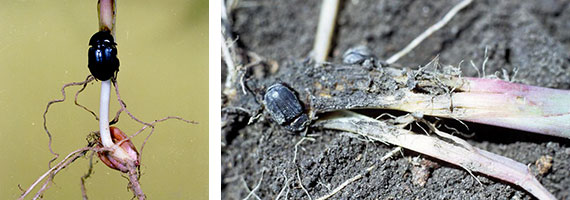
Figure 3. Sugarcane beetles feeding at the base of seedling corn plants.
Similar Species
June Beetle
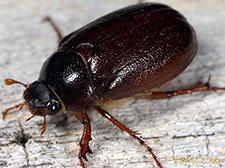
Phyllophaga spp; ¾ inch long; color often dark brown or reddish brown, rarely black; often hairy on ventral side between legs.
Masked Chafer
Cyclocephala spp; ½ inch long; color often yellowish brown, never black; area between eyes resembles a black "mask".
Injury is most common within 45 days of planting, especially in fields with grassy weeds or heavy residue. Affected plants may show leaf streaking, deadheart (death of the growing point), stunting, abnormal side shoots, or die completely (Figure 4).
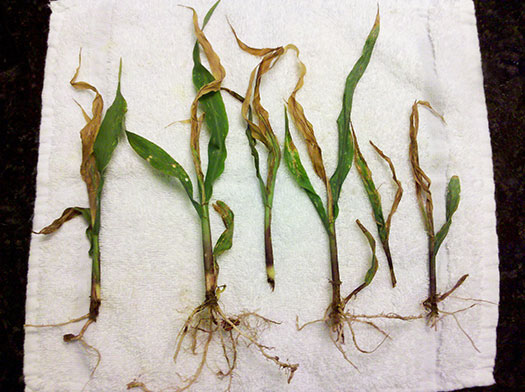
Figure 4. Corn plants injured by sugarcane beetle feeding.
Damage typically occurs in patches and can lead to substantial stand loss and yield reduction if infestations are severe (Figure 5). While grubs may be found near damaged plants, they do not contribute to corn injury.
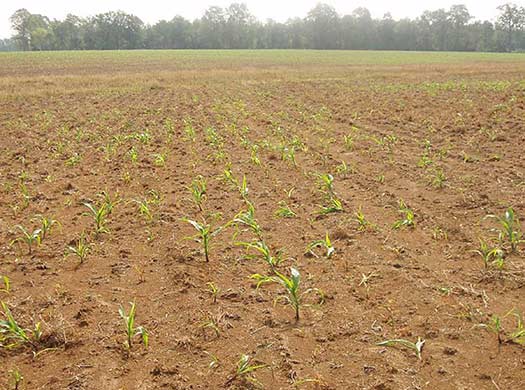
Figure 5. Corn stand loss from sugarcane beetle feeding.
Scouting and Monitoring
- Scouting should begin at planting and continue through early crop growth, focusing on symptoms such as wilting or stand loss.
- Digging around symptomatic plants can help confirm the presence of beetles or larvae. Light traps may be used to monitor adult activity at night and detect early infestation.
Management Recommendations
- Effective management of sugarcane beetle relies on an integrated approach.
- Culturally, it is important to control grassy weeds, minimize heavy residue before planting, avoid planting corn into sod or grassy fields, and improve field drainage.
- Early planting and proper fertilization help encourage vigorous seedling growth.
- Research indicates that neonicotinoid seed treatments can help control larval feeding in corn, but are not very effective against adult feeding, which is the most damaging stage.
- Using a high-rate (1250) insecticide seed treatment in at-risk fields will provide some degree of plant protection but should be paired with additional management practices.
- In fields with a history of sugarcane beetle problems, soil-applied insecticides at planting are recommended.
Photo Credits:
Figure 2: Sam Kieschnick - (www.inaturalist.org/photos/97745967).
Figure 3: (left) Clemson University - USDA Cooperative Extension Slide Series, Bugwood.org, (right) John C. French Sr., Retired, Universities: Auburn, GA, Clemson, and U of MO, Bugwood.org.
The foregoing is provided for informational use only. Contact your Pioneer sales professional for information and suggestions specific to your operation. Product performance is variable and subject to any number of environmental, disease, and pest pressures. Individual results may vary. Pioneer® brand products are provided subject to the terms and conditions of purchase which are part of the labeling and purchase documents.