
Country Selector
Please enter a valid location
Key Points
- Tar spot, caused by the fungal pathogen Phyllachora maydis, is a foliar disease of corn that first appeared in the United States in 2015 and subsequently spread throughout much of the Corn Belt.
- Tar spot development is favored by cool temperatures (60-70ºF, 16-20ºC), high relative humidity (>75%), frequent cloudy days and 7+ hours of dew at night.
- Tar spot reduces yield by reducing the photosynthetic capacity of leaves and causing rapid leaf senescence.
- Hybrid selection for genetic resistance to tar spot and foliar fungicide treatments are key management tools.
- Tar Spot Occurrence in the U.S.
- Identification and Symptoms of Tar Spot
- Tar Spot Epidemiology
- Management Considerations
- References
Tar Spot Occurrence in the U.S.
- Tar spot in corn is caused by the fungus Phyllachora maydis, which was first observed over a century ago in Mexico.
- The first confirmations of tar spot in the U.S. were in Illinois and Indiana in 2015 (Bissonnette, 2015; Ruhl et al., 2016).
- It has subsequently spread across much of the U.S. Corn Belt and into southern Ontario (Figure 1).
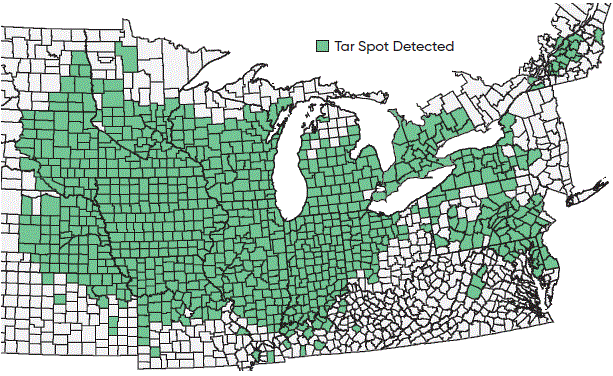
Counties in the Corn Belt with confirmed incidence of tar spot, as of December 2025. (Corn ipmPIPE, 2025; Corteva Plant Diagnostic Lab).
- Tar spot has also been found in several counties in southern Florida and southwestern Georgia.
- In 2018, tar spot established itself as an economic concern for corn production in the Midwest, with severe outbreaks reported in several states that caused significant reductions in corn yield (Telenko et al., 2019).
- A severe outbreak of tar spot impacted a large portion of the Corn Belt again in 2021.
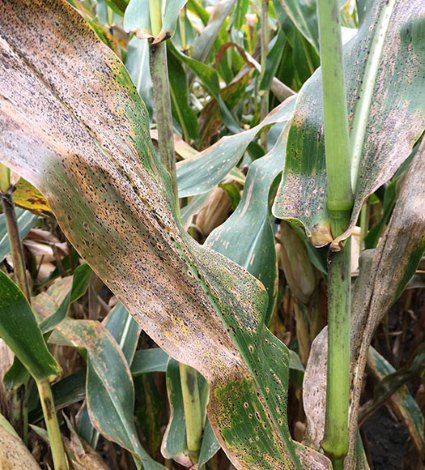
Corn leaves infected with tar spot in a field in Illinois in 2018.
Identification and Symptoms of Tar Spot
- Tar spot is the physical manifestation of fungal fruiting bodies, known as stromata, developing on the leaf.
- The stromata look like spots of tar, developing black oval or circular lesions on the corn leaf.
- The texture of the leaf becomes bumpy and uneven when the fruiting bodies are present.
- Under favorable conditions, tar spot spreads from the lowest leaves to the upper leaves, leaf sheathes and eventually the husks of the developing ears.
- Severe infection can lead to leaf necrosis.
- Tar spot stromata can be confused with insect frass or other diseases, especially when disease incidence is low.
- Three key characteristics can be used to identify tar spot: stromata are raised from the leaf surface, they go through the leaf making them visible on both sides and they cannot be scraped away completely or dissolved in water.
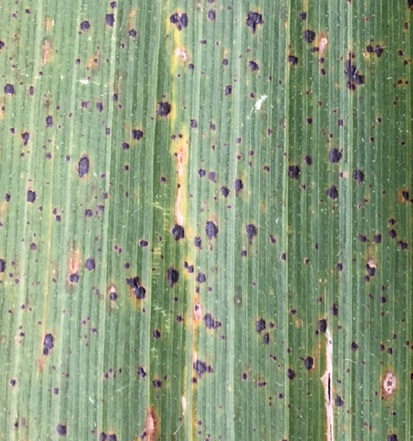
Corn leaves infected with tar spot in a field in Illinois in 2018.
Tar Spot Epidemiology
- P. maydis is an obligate pathogen, which means it needs a living host to grow and reproduce. It is capable of overwintering in the Midwestern U.S. in infected crop residue on the soil surface.
- Tar spot is more likely to develop during cool temperatures (60-70 ºF, 16-20 ºC), high relative humidity (>75%), frequent cloudy days and 7+ hours of dew at night.
- Tar spot is polycyclic and can continue to produce spores and spread to new plants as long as environmental conditions are favorable.
- P. maydis produces windborne spores that have been shown to disperse up to 800 ft. Spores are released during periods of high humidity.
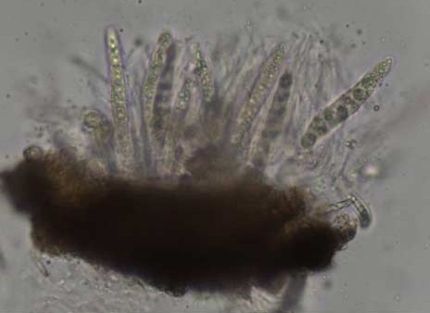
Microscopic view of fungal spores of P. maydis.
Management Considerations
Yield Impact of Tar Spot
- 2018 was the first time that corn yield reductions associated with tar spot were documented in the U.S.
- University corn hybrid trials conducted in 2018 suggested potential yield losses of up to 39 bu/A under heavy infestations (Telenko et al., 2019).
- Severe tar spot infestations have been associated with reduced stalk quality. If foliar symptoms are present, monitor stalk quality carefully to determine harvest timing.
- There is no evidence that tar spot causes ear rot or produces harmful mycotoxins (Kleczewski, 2018).
Differences in Hybrid Response
- Observations in hybrid trials have shown that hybrids differ in susceptibility to tar spot (Kleczewski and Smith, 2018).
- Longer maturity hybrids for a given location have been shown to have a greater risk of yield loss from tar spot than shorter maturity hybrids (Telenko et al., 2019).
- Genetic resistance to tar spot should be the number one consideration when seeking to manage this disease, as it appears to have a greater impact on symptoms and yield loss than either cultural or chemical management practices.
Foliar Fungicides
- Several foliar fungicides are labeled for control of tar spot in corn (Wise 2026).
- A multistate university study conducted in 2020 and 2021 showed that fungicide treatments with multiple modes of action were better at reducing tar spot severity and protecting corn yield than those with only a single mode of action (Telenko et al., 2022).
- Research suggests that tar spot may be challenging to control with a single fungicide application due to its rapid reinfection cycle, particularly in irrigated corn.
- A 2019 Purdue University study compared single-pass and two-pass treatments for tar spot control using Aproach® and Aproach® Prima fungicides under moderate to high tar spot severity (Da Silva et al., 2019).
- Aproach Prima fungicide applied at VT and the two-pass treatments all significantly increased yield relative to the nontreated check. Aproach Prima fungicide applied at VT followed by Aproach fungicide at R2 had the greatest yield, although it was not significantly greater than Aproach followed by Aproach Prima (Figure 2).
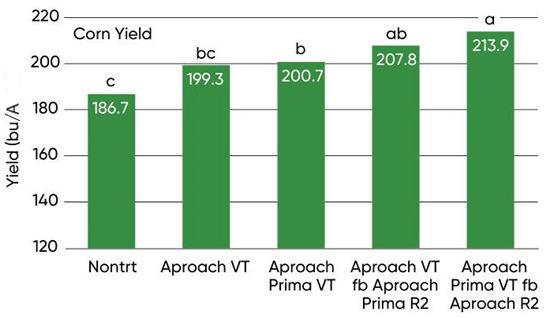
Figure 2. Fungicide treatment effects on corn yield under moderate to high tar spot severity in a 2019 Purdue Univ. study.
Means followed by the same letter are not significantly different based on Fisher’s Least Significant Difference test (LSD; α=0.05).
- Forcivo™ fungicide can help protect your crop with up to 30 days of residual control, giving growers a powerful disease management tool that bolsters plant health and yield potential.
- 2025 Corteva Agriscience and Pioneer field trials results in an average of +17 bu/A over untreated acres and +3.3 bu/A over competitors.
Fungicide products rated good to excellent for control of tar spot. (Wise, 2026).
Trade Name Active Ingredients GLS Rating Forcivo™ 4.0 SC Flutriafol + Azoxystrobin + Fluindapyr G-VG Aproach® Prima 2.34 SC Cyproconazole + Picoxystrobin G-VG Delaro® 325 SC Cyproconazole + Picoxystrobin G-VG Delaro® Complete 3.83 SC Prothioconazole + Trifloxystrobin G-VG Fortix® 3.22 SC
Preemptor™ 3.22 SCFlutriafol + Fluoxastrobin VG Headline AMP® 1.68 SC Pyraclostrobin + Metconazole G-VG Lucento® 4.17 SC Flutriafol + Bixafen G-VG Miravis® Neo 2.5 SE Pydiflumetofen + Azoxystrobin + Propiconazole G Revytek® 4.44 SC Mefentrifluconazole + Fluxapyroxad + Pyraclostrobin VG Topguard® EQ 4.29 SC Flutriafol + Azoxystrobin G-VG Trivapro® 2.21 SE Benzovindiflupyr + Azoxystrobin + Propiconazole G-VG Veltyma® 3.34 SC Mefentrifluconazole + Pyraclostrobin VG
Agronomic Practices to Manage Tar Spot
- The pathogen that causes tar spot overwinters in corn residue. How the amount of residue on a field’s soil surface affects disease severity the following year is unknown.
- Observations so far suggest that rotation and tillage probably have little effect on tar spot severity.
- Duration of leaf surface wetness appears to be a key factor in the development and spread of tar spot. Farmers with irrigated corn in areas affected by tar spot have experimented with irrigating at night to reduce the duration of leaf wetness.
References
- Bissonnette, S. 2015. CORN DISEASE ALERT: New Fungal Leaf disease “Tar spot” Phyllachora maydis identified in 3 northern Illinois counties. The Bulletin. University of Illinois Extension.
- Kleczewski, N. 2018. Tar Spot on Corn: Setting the Record Straight. Illinois Field Crop Disease Hub. University of Illinois Extension.
- Kleczewski, N. and D. Smith. 2018. Corn Hybrid Response to Tar Spot. The Bulletin. University of Illinois Extension.
- Ruhl G., M.K. Romberg, S. Bissonnette, D. Plewa, T. Creswell, and K.A. Wise 2016. First report of tar spot on corn caused by Phyllachora maydis in the United States. Plant Dis 100(7):1496.
- Telenko, D., M.I. Chilvers, N. Kleczewski, D.L. Smith, A.M. Byrne, P. Devillez, T. Diallo, R. Higgins, D. Joos, K. Kohn, J. Lauer, B. Mueller, M.P. Singh, W.D. Widdicombe, and L.A. Williams. 2019. How tar spot of corn impacted hybrid yields during the 2018 Midwest epidemic. Crop Protection Network.
- Telenko, D.E.P., M.I. Chilvers, A.M. Byrne, J.C. Check, C.R. Da Silva, N.M. Kleczewski, E. Roggenkamp, T.J. Ross, and D.L. Smith. 2022. Fungicide efficacy on tar spot and yield of corn in the Midwestern United States. Plant Health Prog. doi.org/10.1094/PHP-10-21-0125-RS.
- Wise, K. 2026. Fungicide Efficacy for Control of Corn Diseases. Crop Protection Network. CPN-2011-W.

Managing Tar Spot
How can you better manage tar spot in 2022? Here's what we know so far.
Managing Tar Spot
How can you better manage tar spot in 2022? Here's what we know so far.

Tar Spot Management and Hybrid Selection For 2022
In this video, Matt Heims, Pioneer Field Agronomist, discusses the importance of selecting the right hybrid to combat Tar Spot.
Tar Spot Management and Hybrid Selection For 2022
In this video, Matt Heims, Pioneer Field Agronomist, discusses the importance of selecting the right hybrid to combat Tar Spot.
Protect Your Field and Your Yield
Prevent against and defeat even the most resistant diseases with fungicide solutions from Corteva Agriscience.


The foregoing is provided for informational use only. Please contact your Pioneer sales professional for information and suggestions specific to your operation. Product performance is variable and depends on many factors such as moisture and heat stress, soil type, management practices and environmental stress as well as disease and pest pressures. Individual results may vary. Pioneer® brand products are provided subject to the terms and conditions of purchase which are part of the labeling and purchase documents.
Not all products are registered for sale or use in all states. Contact your state pesticide regulatory agency to determine if a product is registered for sale or use in your state. Always read and follow label directions.