
Country Selector
Please enter a valid location
5/23/2025
Radiational Cooling Injury in Corn
Crop Focus
Written by Mark Jeschke, Ph.D., Pioneer Agronomy Manager
Photos courtesy of Jim Ruhland, Pioneer Senior Key Account Manager
Key Points
- Radiational cooling injury can occur in corn on calm, clear nights early in the growing season.
- It is characterized by a silvery or dull gray appearance to portions of the leaves.
- Injury to the plant is largely cosmetic and has little or no impact on subsequent growth and yield.
- Radiational Cooling Injury in Corn
- What is Radiational Cooling?
- Conditions that Favor Radiational Cooling
- Impact on Corn
Radiational Cooling Injury in Corn
- Radiational cooling injury, sometimes referred to as “silver leaf” is a type of chilling injury commonly observed in corn early in the growing season when night temperatures drop into the low 40s or upper 30s (°F).
- It occurs on calm, clear nights when rapid heat loss via radiational cooling causes leaf surfaces to drop below the ambient air temperature, resulting in damage to leaf tissue.
- Radiational cooling injury is characterized by a silvery or dull gray appearance to portions of leaves oriented horizontally toward the sky (Figure 1).
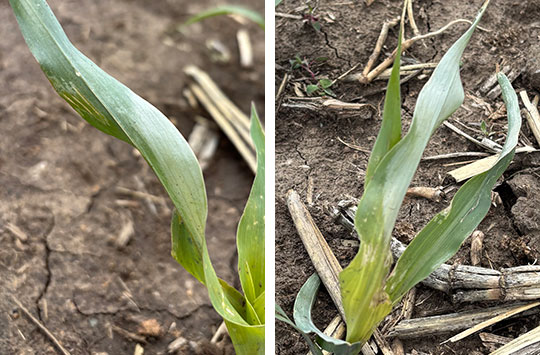
Figure 1. Silver/gray appearance on leaves of corn plants caused by radiational cooling injury.
What is Radiational Cooling?
- Radiational cooling is a natural process by which the surface of the Earth loses heat to the atmosphere and space.
- The sun emits shortwave radiation in the form of UV rays and visible light, which is absorbed by the Earth’s surface during daylight hours.
- A potion of this radiation is emitted back into space as longwave, or infrared radiation.
- During the night, longwave radiation continues to be emitted without shortwave radiation coming in to balance out the deficit, causing the ground to cool.
Conditions that Favor Radiational Cooling
- On calm, clear nights, radiational cooling can cause temperatures near the ground to drop sharply from warm to cold in a short period of time.
- Clear skies allow heat to escape the Earth’s surface more rapidly. Clouds create an insulating effect by absorbing escaping longwave radiation and re-emitting it back toward Earth. On cloudless nights, more of the longwave radiation escapes into the atmosphere and space.
- When the surface rapidly cools, it can create a layer of air near the surface that is much cooler than the air above it, a phenomenon known as an inversion layer.
- Under windy conditions, the warmer air above mixes with the cooler air near the surface, which reduces the amount of surface cooling. When there is no wind, the cool layer stays in place near the surface.
Impact on Corn
- Radiational cooling injury is largely cosmetic and has little or no impact on corn growth and yield.
- Damage is usually limited to the portions of the leaves that were oriented horizontally toward the sky during the night when the injury occurred (Figure 2).
- Injury does not restrict leaf expansion, and new leaves emerging from the whorl will not be injured or affected in any way.
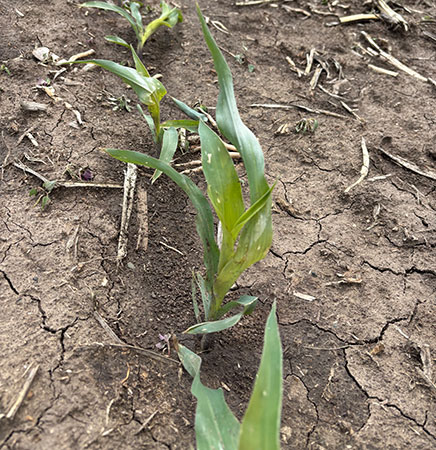
Figure 2. Injury typically occurs to leaf surfaces oriented horizontally facing the sky.
The foregoing is provided for informational use only. Please contact your Pioneer sales professional for information and suggestions specific to your operation. Product performance is variable and depends on many factors such as moisture and heat stress, soil type, management practices and environmental stress as well as disease and pest pressures. Individual results may vary. Pioneer® brand products are provided subject to the terms and conditions of purchase which are part of the labeling and purchase documents.