
Country Selector
Please enter a valid location
11/10/2025
A Primer on Ruminant Corn Starch Digestion

Shared from Inside the ZONE® newsletter, Pioneer Nutritional Sciences
Key Points
- Both ruminal and total-tract starch digestion should be considered.
- Growing environment, time in fermented storage, kernel moisture and particle size all influence starch digestion more than dent hybrid genetics.
- Fecal starch is a practical approach to evaluating total-tract starch digestion.

- Rumen Basics
- Intestinal Digestion
- Kernel Characteristics: Zein and Vitreousness
- European Perspective
- Sources
Rumen Basics
Digestion of starch in the rumen requires multiple species of bacteria that associate to form a biofilm on the exposed surface of the grain. It requires complementary species acting in unison as cellulolytic species are needed to degrade endosperm cell walls to enable other species to attack starch granules. Protozoa also engulf starch granules and serve to regulate the rate of starch digestion and moderate pH decline given their slower digestion rate and attachment to particulate matter thus exiting the rumen much slower than bacteria.
The rate of access to starch granules is governed by endosperm cell walls and the protein (prolamin, zein) matrix. The zein matrix in corn is resistant to proteolytic attack and restricts access of bacterial amylases to the starch granules. Cereals like barley are more rapidly digested because their starch granules are more loosely associated with the protein matrix and that matrix is more readily penetrated by a variety of proteolytic bacteria.
Microbial fermentation of starch produces the volatile fatty acids (VFA) propionate, acetate and butyrate but starch rich diets tend to increase the proportion of propionate. Propionate is absorbed through the rumen wall and transported via the portal vein to the liver where a series of enzymatic reactions (gluconeogenesis) converts it to glucose. Propionate contributes over 50% of the glucose requirement of dairy cows and is critical for the synthesis of lactose which regulates the amount of milk volume the cow produces.
Too little starch digestion in the rumen reduces propionate production and microbial biomass protein (MBP) flow to the intestines. MBP is an important source of high-quality protein for the cow. Too much ruminal starch digestion can lead to subacute acidosis (SARA) causing off-feed, lower production and the production of conjugated linoleic acid (trans-10, cis-12 CLA) causing reduced butterfat yield.
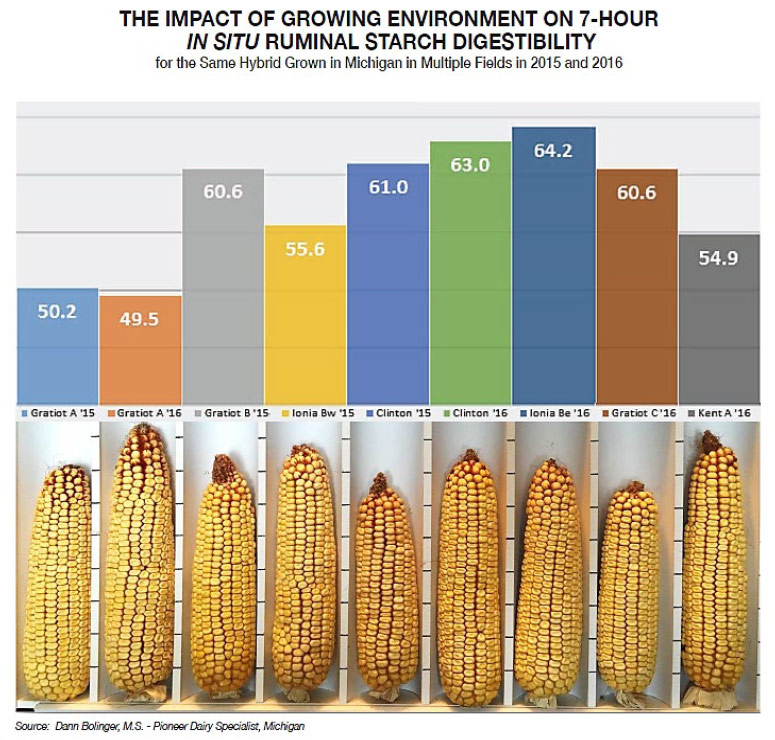
The emergence of a laboratory starch digestibility analysis (7-hour starch digestion) provides an estimate of ruminal starch disappearance but does not account for post-ruminal starch digestion to assess total-tract starch digestion. Fecal starch analysis is a practical approach to evaluate total-track starch digestion. University silage evaluation programs do not include starch digestibility data because it is understood that by the time corn is incorporated into diets, small genetic differences are dwarfed by the influence of growing environment (particularly soil nitrogen fertility), kernel maturity, degree of processing and time in fermented storage.
Intestinal Digestion
Starch escaping ruminal fermentation can be digested by pancreatic and brush border enzymes in the duodenum and absorbed as glucose into the bloodstream. Prior to reaching the intestines, ruminants possess an abomasum (true stomach) that has both low pH and pepsin secretions which initiates the breakdown of zein protein matrix. This is important when feeding non-fermented, dry ground corn that has the protein matrix still intact. Shifting site of digestion to the intestines by feeding dry, unfermented, ground corn reduces the potential for SARA however, it also reduces microbial biomass flow to help meet the protein needs of the cow.
Another benefit of manipulating diets as to where starch is digested is that starch absorbed as glucose from the intestines can have over a 20% greater caloric value than starch fermented to VFA’s in the rumen.
Grain processing methods, like steam flaking or high-moisture corn, that increase ruminal degradation of starch generally increase the digestibility of residual starch that enters the intestines, although there will be a smaller pool of starch due to more extensive ruminal digestion.
It is important that kernel particle size in silage, high-moisture and dry corn be monitored such that large pieces do not end up escaping rumen or upper intestinal digestion given the rapid transport of starch through the entire digestive tract. This can lead to high levels of fecal starch (>1-2%), resulting in economic loss and possibly predispose cows to hemorrhagic bowel syndrome (HBS, bloody gut) due to excessive amount of starch reaching the lower intestines and supporting the growth of toxin-producing organisms.
Kernel Characteristics: Zein and Vitreousness
North America grows primarily high-yielding dent corn hybrids as opposed to flint genetics (e.g. popcorn) grown in colder Maritime environments. Flint hybrids have significantly more vitreous endosperm containing higher levels of the zein protein matrix that can interfere with microbial fermentation. They also tend to yield less starch given the shallow kernel depth.
The amount of zein in corn kernels is influenced by the level of flint background in the hybrid, kernel maturity at harvest, growing environment and kernel position on the ear (less vitreous kernels at the tip versus middle or butt-end of the ear).
Dent hybrids do have varying amounts of vitreous starch (higher test weight hybrids) but it tends to form later in kernel maturation closer to black layer and “combining” maturity. There are minimal differences in the amount of vitreousness between dent hybrids harvested at silage maturities of 1/2- 3/4 milk line resulting in little difference in ruminal, or total-tract starch digestibility among similar maturity dent hybrids grown in the same environment and harvested for silage.
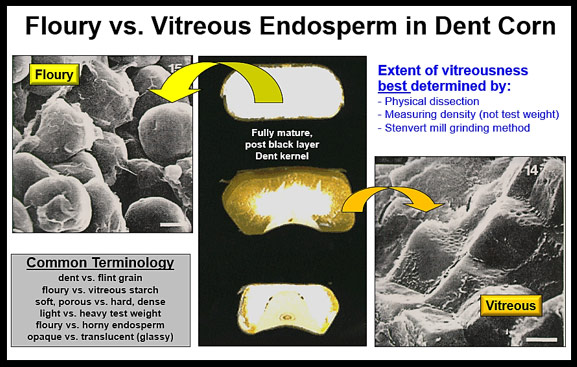
While significant starch digestibility differences between hybrids at silage maturity do not exist, the ruminal starch digestibility of all ensiled hybrids does increase over time in fermented storage. Microbial activity during fermentation and the chemical action of various fermentation end-products (acids, yeast-generated alcohol) alter the kernel storage proteins, removing most of the negative effects of zeins on starch digestibility. Even if the growing environment produces corn with different levels of ruminal starch digestion, after 3-4 months in storage, fermentation activity equalizes these differences.
Typically, about 60-70% of the starch will be ruminally degraded in corn silage immediately upon ensiling and will increase by about 2-3% units per month, stabilizing after about 4-6 months of fermented storage. High-moisture corn, harvested with more mature kernels (near or at black layer) will tend to drift up in ruminal digestibility for a full year in fermented storage.
Unfermented (dry, ground) corn kernels do not change in starch digestibility over time and represent a dietary ingredient valued by nutritionists as more predictable, and less ruminally reactive in high corn silage diets that already contain high levels of rumen fermentable starch.
European Perspective
Flint hybrids have traditionally been grown in places like Europe and Brazil due to historical advantages in early vigor in colder soils. Today, many dent hybrids have adequate early vigor for these environments and offer the potential for considerably higher starch yields.
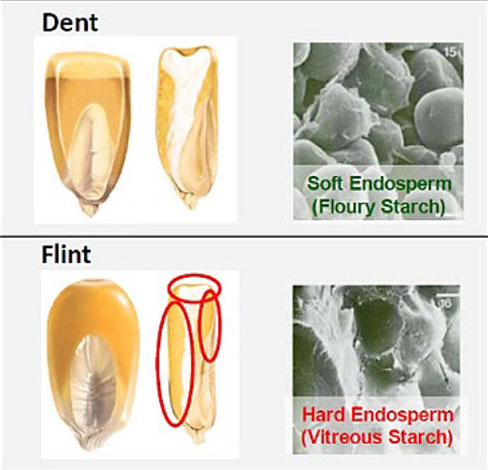
Pioneer is actively breeding dent hybrids for these traditional flint markets and research has shown higher starch yields, improved silage kernel processing scores, higher ruminal starch digestion and lower fecal starch levels compared to flint genetics.
Sources
- McAllister, T., A. Hristov and Y. Wang. 2001. Recent Advances/Current Understanding of Factors Impacting Barley Utilization by Ruminants. Proceedings of 36th Annual Pacific Northwest Animal Nutrition Conference, Boise, Idaho. October 9-11, 2001.
- Svihus, B., A.K Uhlen and O.M. Harstad. 2005. Effect of starch granule structure associated components and processing on nutritive value of cereal starch: a review. Animal Feed Science and Technology 122 (2005) 303-320.
- Mahanna, B. 2009. Digestibility of corn starch revisited: part 1. Feedstuffs Vol. 81, No. 6.
- Mahanna, B. 2009. Digestibility of corn starch revisited: part 2. Feedstuffs Vol. 81, No. 10.
Pioneer® brand products are provided subject to the terms and conditions of purchase which are part of the labeling and purchase documents.