
Country Selector
Please enter a valid location
Corn Stand Evaluation and Replant Considerations
Crop Focus
Written by Mark Jeschke, Ph.D., Pioneer Agronomy Manager
Key Points
Many different stress factors are capable of reducing corn stands, such as:
- Cold or wet soils.
- Insect feeding.
- Unfavorable weather conditions.
- Stand Counts
- Replant Yield Potential
- Other Factors to Evaluate
- Profitability of Replant
- Maturity Selection for Delayed Planting
Stand Counts
| Row Width | Length of Rows |
|---|---|
| 38 inches | 13 ft 9 in |
| 36 inches | 14 ft 6 in |
| 30 inches | 17 ft 5 in |
| 22 inches | 23 ft 9 in |
| 20 inches | 26 ft 2 in |
| 15 inches | 34 ft 10 in |
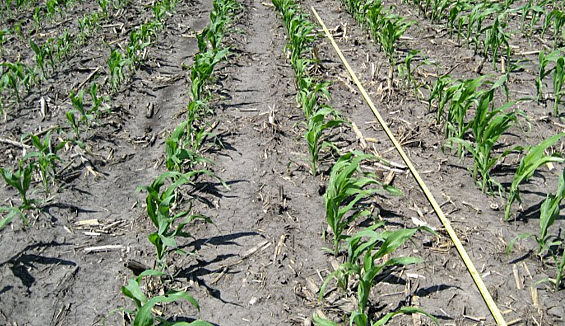
- Take several sample counts to represent the field.
- Sample a length of row equal to 1/1000th of an acre.
- Measure off the distance appropriate for your row width, count the number of live plants and multiply by 1000 to obtain an estimate of plants/acre.
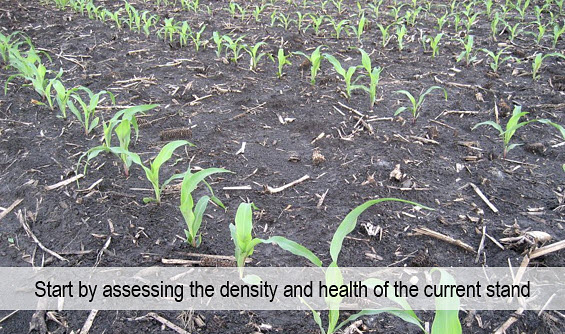
- In situations such as flooding damage, only a portion of the field may need to be considered for replant.
- Frost or hail can damage a wide area. In this case plant density and health should be assessed across the entire field.
- When an injury event such as frost or hail occurs it is best to wait a few days to perform a stand assessment, as it will allow a better determination of whether or not plants will recover.

Growth of green tissue near the growing point indicates that this plant would have recovered.

Soft translucent tissue near the growing point indicates that this plant will not recover.
After a plant stand has been assessed it is important to consider other factors such as:
- Is the stand consistent, are large gaps present?
- Will the stand have adequate crop canopy to assist with weed control and irrigation efficiencies?
- Will replanting provide an economic gain?
- Are the remaining plants healthy and relatively equal in maturity?
Replant Yield Potential
- The expected yield from the current stand should be compared to expected replant yield.
Table 1. Yield potential for a range of plant populations and planting dates (Nafziger, E. 2020. Replanting Corn and Soybeans. Univ. of Illinois).

Other Factors to Evaluate
- Stand uniformity - An uneven stand will yield less than a relatively even stand with the same number of plants.
- Plant health - Plants that are severely injured or defoliated will have reduced photosynthetic capability and a lower yield potential.
Corn yield is influenced by stand density as well as stand uniformity:
- Variation in plant size can have a negative impact on yield.
- Plants with delayed emergence or development are at a competitive disadvantage with larger plants in the stand and will have reduced leaf area, biomass, and yield.


Figure 1. Yield potential of delayed and uneven corn stands.
(Data from Carter, P.R., E.D. Nafziger, and J.G. Lauer, Uneven emergence in corn, North Central Regional Extension Publication No. 344)
Profitability of Replant
- Even if replanting will increase yield, the yield increase must be sufficient to pay for all of the costs associated with replant such as:
- Extra herbicide or tillage costs
- Planting costs
- Increased grain drying costs
Also consider these factors when making a replant decision:
- Probability of an autumn freeze prior to physiological maturity of replanted corn.
- Increased susceptibility of late-planted corn to summer drought or disease and insect pests such as gray leaf spot and European corn borer.
Maturity Selection for Delayed Planting
- A frequent question pertaining to replanting corn is how full season of a hybrid can be planted and still reach normal physiological maturity.
- When considering which hybrid to replant, consider GDU accumulation between the planting date and average first frost date and hybrid GDU requirements to reach physiological maturity.
- Research has shown that corn can adjust its growth and development, requiring fewer growing degree units (GDU’s) to reach maturity when planted late. Late-planted corn showed a reduction in GDU requirements of about six GDU’s per day of planting delay.
- To help guide hybrid selection decisions for delayed planting and replant scenarios, Pioneer researchers conducted planting date studies over 18 years that included hybrids with a range of different comparative relative maturities.
- Results indicate that farmers may consider switching from a full season to an early maturity hybrid if replanting after May 25 and from a mid-maturity to an early maturity hybrid if replanting after June 3 (Figure 2).

Figure 2. Relative profitability of full-season, mid-maturity, and early maturity hybrids in 29 North-Central Corn Belt environments over 17 years of Pioneer research. North-Central Corn Belt studies included 29 environments in South Dakota, Minnesota, Iowa, Michigan, and Ontario and a total of 96 different Pioneer® brand corn products ranging from 87 to 110 CRM.
Adjusted gross income/acre was calculated as gross income at a corn price of $3.50/bu minus drying costs and discounts for low test weights. Higher corn price would move switching date later.
Drying costs were calculated based on 4 cents/bu for each point of moisture above 15%. Higher drying costs would move switching date earlier.
Author: Mark Jeschke
May 2020
The foregoing is provided for informational use only. Please contact your Pioneer sales professional for information and suggestions specific to your operation. Product performance is variable and depends on many factors such as moisture and heat stress, soil type, management practices and environmental stress as well as disease and pest pressures. Individual results may vary. Pioneer® brand products are provided subject to the terms and conditions of purchase which are part of the labeling and purchase documents.