
Country Selector
Please enter a valid location
4/16/2025
Achieving Uniform Emergence in Corn

Crop Focus
Written by Mark Jeschke, Ph.D., Pioneer Agronomy Manager
Key Points
- Uniform emergence is important for maximizing yield potential in corn.
- The key to achieving uniform emergence in corn is for all seeds to experience identical environmental conditions in the furrow.
- Soil moisture is the single most important factor for uniform emergence and the most common cause of uneven emergence.
- Adequate and consistent planting depth is essential for placing seeds in a uniform environment.
- Importance of Uniform Emergence in Corn
- Uniform Environment = Uniform Emergence
- Soil Moisture
- Soil Temperature
- Soil Physical Conditions
- Tips for Achieving Uniform Emergence
Importance of Uniform Emergence in Corn
- Uniform emergence – getting all plants to emergence from the ground at around the same time – is important for maximizing yield potential in corn.
- Uniform emergence is of particular importance in corn compared to other crops because of the highly competitive environment among plants for access to resources and the relatively low plasticity of modern corn hybrids.
- Corn plants that emerge later than their neighbors are at a disadvantage in size and competitiveness and may produce smaller ears or no ears at all.
- Plants adjacent to a smaller plant in the row have some capacity to convert their competitive advantage into increased yield, but not enough to compensate for the lost yield from the smaller plant.
- Unevenness in plant size is generally detrimental to the overall yield of a field.
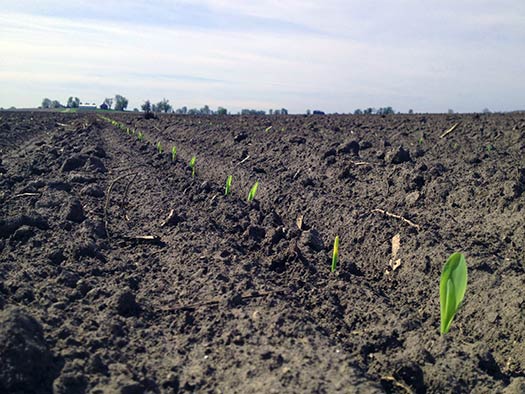
Uniform Environment = Uniform Emergence
- The key to achieving uniform emergence in corn is for all seeds to experience identical environmental conditions in the furrow, so that germination and emergence proceed at the same rate.
- There are three main environmental factors that are critical for uniform corn emergence:
- Adequate and uniform moisture
- Adequate and uniform temperature
- Uniform physical environment around the seed
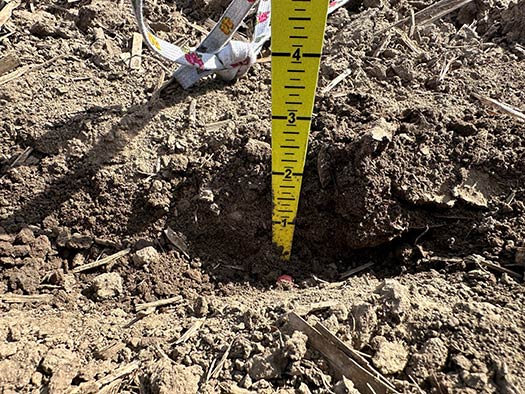
Uniform planting depth is important for placing all seeds into consistent temperature and moisture conditions.
Soil Moisture
- Soil moisture is the single most important factor for uniform emergence and the most common cause of uneven emergence.
- Adequate moisture is necessary to begin the germination process – corn seeds need to imbibe at least 30% of their weight in water to begin germination.
- Adequate and uniform planting depth is important for placing seeds into a uniform moisture environment – shallow planting (less than 1.5 inches) puts seeds into an environment that can be drier and more variable closer to the soil surface.
- Good seed to soil contact is critical for seeds to imbibe moisture and begin germination.
Soil Temperature
- Corn developmental processes are driven by heat unit accumulation, so uneven temperatures will cause seedlings to develop at different rates.
- Thermal time from planting to emergence averages around 120 growing degree units (GDU) based on soil temperature measured at a 4-inch depth.
- Small scale variations in soil temperature can be the results of differences in soil color, texture, and residue cover.
- Darker soils warm more quickly in the sun.
- Courser soils tend to be drier and have less buffering capacity against swings in air temperature.
- Patches of residue cover above the seed furrow shade the soil and keep it cooler compared to bare soil.
Soil Physical Conditions
- Developing roots and shoots need to be able to extend through the surrounding soil at the same rate.
- Any physical obstacle that a developing seedling encounters to its shoot and root development, such as crusted soil, compacted soil, crop residue, clods, or rocks, can cause a delay in its emergence.
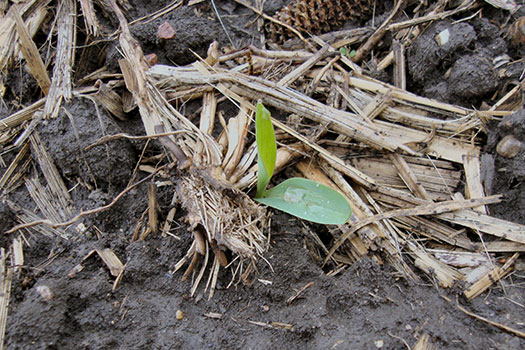
Residue over the furrow can create uneven soil temperature and can be a physical obstruction for emerging seedlings.
Tips for Achieving Uniform Emergence
Seedbed Preparation
- Avoid tilling more than necessary prior to planting – excessive tillage can cause soil to dry out too much and heavily worked soils are more prone to crusting if heavy rains follow planting.
- Avoid working soil too wet – this can create clods, making it harder to get good seed to soil contact at planting.
Planter Preparation
- Coulters and row cleaners can impact seed to soil contact, especially with heavy residues.
- Coulter depth and sharpness are important to allow residues to be cut cleanly rather than crimping and pushing them into the seed furrow.
- Most coulters should be set to run about 1/4 inch above the depth of the double-disc openers.
- Double-disc openers can make or break planting. As disc openers wear, they will no longer form a firm cutting point, which can lead to an irregular furrow. Discs should be replaced when wear exceeds factory specifications.
- Closing wheels are critical for seed to soil contact and furrow closure. For closing wheels to perform properly, it is important to ensure that they are aligned with the opening discs.
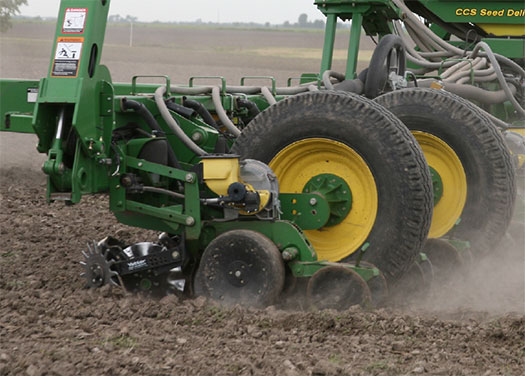
Replacing worn parts and ensuring all components of the planter row units are performing properly are critical for achieving uniform seed placement and good seed to soil contact.
Planting Timing
- Soil temperature – Soil temperatures above 50° F are necessary for germination. This is generally the recommended threshold for planting to achieve uniform emergence.
- Soil moisture – Avoid planting when it is too wet, as this can cause a number of problems, including hairpinning of residue in the furrow, sidewall compaction, and poor furrow closure.
Planting Operation
- It’s important to stop and check during planting to ensure that all row units are performing properly.
- Make sure row cleaners are effectively sweeping residue out of the rows without moving soil, and that residue is not getting pushed into the furrow.
- Adequate and uniform planting depth is one of the most important aspects of the planting operation for achieving uniform emergence. A planting depth of around 2 inches is generally ideal for emergence and nodal root development.
- Check planting depth regularly across the width of the planter.
- Make sure row unit down pressure is sufficient to achieve uniform planting depth without creating sidewall compaction.
- Make sure the closing system is closing the furrow and providing good seed to soil contact. If using spiked closing wheels, check performance to make sure they are fracturing the sidewall but not moving soil to the extent that they disrupt seed placement.
The foregoing is provided for informational use only. Please contact your Pioneer sales professional for information and suggestions specific to your operation. Product performance is variable and depends on many factors such as moisture and heat stress, soil type, management practices and environmental stress as well as disease and pest pressures. Individual results may vary. Pioneer® brand products are provided subject to the terms and conditions of purchase which are part of the labeling and purchase documents.