
Country Selector
Please enter a valid location
3/22/2024
Hybrid and Plant Population Effects on Corn Kernel Weight

Agronomy Research Update
From Corteva™ Agriscience - Written by Liam Bracken, Associate Territory Manager - Commercial Development Program, Ontario; Paul Hermans, Sales Agronomist, Ontario; James D’Aoust, Sales Agronomist, Ontario; and Mark Jeschke, Ph.D., Pioneer Agronomy Manager, Johnston
Key Findings
- A field study was conducted in 2023 to evaluate corn kernel weight, including differences among hybrids, and effects of plant population.
- Kernel weight was generally greater than normal in this study due to favorable grain fill conditions, with hybrid family averages ranging from 77,146 to 66,759 kernels/bu (32.9 to 38.0 g/100 kernels).
- An understanding of relative kernel weights for hybrids can help in calculating more accurate yield estimates.
- Importance of Kernel Weight to Corn Yield
- 2023 Kernel Weight Study
- Results
- Kernel Weight and Yield Estimates
- References
Importance of Kernel Weight to Corn Yield
- Genetic gains and enhanced management are the main contributing factors to the approximately 2 bu/acre annual increase in average corn yields.
- Corn breeders have improved the genetic ability of hybrids to maintain kernels per ear at higher populations (Tollenaar and Lee, 2002), resulting in more kernels per acre and more yield.
- However, another key factor in the yield equation that has been receiving more attention recently from industry and university institutions is kernel weight.
- Genetic improvements in kernel weight have been associated with an extended kernel-fill period (Fernandez et al., 2022).
- Understanding the relative importance of kernel number and kernel weight in how an individual hybrid builds yield can improve the accuracy of pre-harvest yield estimates as well as help in evaluating the influence of late-season management or environmental conditions on kernel weight.
- When making pre-harvest yield estimates, the traditional 90,000 kernels/bu kernel weight factor used for calculating yield may underestimate the yield of the crop.
2023 Kernel Weight Study
- A field study was conducted in 2023 to evaluate corn kernel weight, including differences among hybrids, and effects of plant population.
- Locations: 9 locations in Eastern Ontario
- Plot Layout: 1-2 replications per location
- Hybrids: Several, range from 90 to 98 CRM
- Plant Populations: 26,000, 30,000, 34,000, and 38,000 plants/acre
Sampling Methods
- Three representative ears were collected from each hybrid and population and shelled to obtain moisture.
- 100 kernels from each sample were divided and weighed, and the weight corrected to 15.5% moisture.
- Kernel weights (expressed as kernels/bushel) were calculated based on 56lbs in a bushel of corn.
Results
- In 2023, growing conditions were above average through this geography with above average rainfall and an open fall.
- Locations in the study encompassed a large range of yield environments, with hybrid within location yields ranging from 161 to 293 bu/acre.
- Kernel weight was generally larger than average in this study with hybrid family averages ranging from 77,146 to 66,759 kernels/bu (32.9 to 38.0 g/100 kernels) (Table 1).
- The total range of kernel weights observed in the study was large, ranging from 104,000 to 59,000 kernels/bu (24.4 to 43.1 g/100 kernels).
- To account for environmental differences between locations, a relative kernel weight for each hybrid within a location was calculated as a percentage of the location average. Those percentages were then averaged by hybrid family over all plot locations, as shown in Table 1.
Table 1. Average kernel weight by hybrid family expressed as kernels/bu and g/100 kernels, relative kernel weight as a percentage of the location average and number of comparisons.
| Hybrid Family | Kernel Weight (kernels/bu) | Kernel Weight (g/100 kernels) | Relative Kernel Weight (% of Loc. Mean) | # Comp |
|---|---|---|---|---|
| P9026 | 73,475 | 34.6 | 100.7 | 20 |
| P90630 | 72,623 | 35.0 | 101.9 | 11 |
| P9233 | 70,868 | 35.8 | 104.4 | 19 |
| P9316 | 77,035 | 33.0 | 96.1 | 18 |
| P9466 | 73,066 | 34.8 | 101.3 | 25 |
| P9492 | 70,410 | 36.1 | 105.1 | 16 |
| P9535 | 69,869 | 36.4 | 105.9 | 11 |
| P9624 | 73,190 | 34.7 | 101.1 | 7 |
| P96760 | 73,269 | 34.7 | 101.0 | 20 |
| P97299 | 74,576 | 34.1 | 99.2 | 7 |
| P9823 | 66,759 | 38.0 | 110.8 | 3 |
| P9845 | 68,883 | 36.9 | 107.4 | 10 |
| DKC42-05 | 77,146 | 32.9 | 95.9 | 10 |
| DKC46-40 | 74,342 | 34.2 | 99.5 | 5 |
- Kernel weight decreased as plant population increased. Figure 1 shows average kernel weights for two Pioneer® brand corn products that declined from and average kernel weight of 36.4 g/100 kernels at 26,000 plants/acre to 32.8 g/100 kernels at 38,000 plants/acre.
- Kernel weight of the two corn products was similar at lower populations, but P9026AM™ brand corn lost more kernel weight at higher populations than P9466AML™ brand corn did.
- Yield of both corn products was maximized at the highest population, as the greater number of kernels per unit area more than compensated for lower kernel weight (Figure 2).
- The drop in kernel weight at high population for P9026AM™ was not reflected in yield, which was less than that of P9466AML™ but not much more so than at the lowest population.
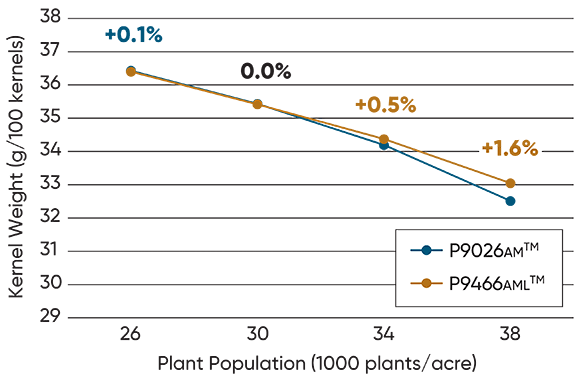
Figure 1. Kernel weight (g/100 kernels) of Pioneer® P9026AM™ (AM, LL, RR2) and P9466AML™ (AML, LL, RR2) brand corn by plant population.
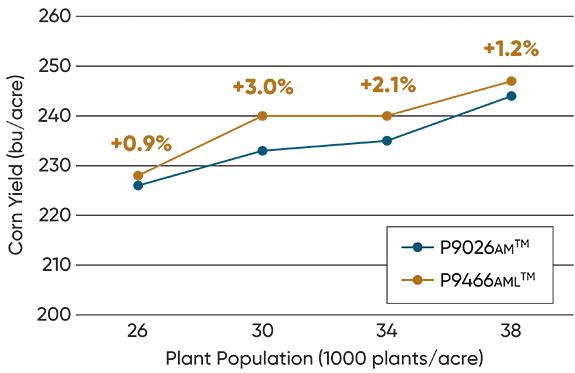
Figure 2. Yield (bu/acre) of Pioneer® P9026AM™ (AM, LL, RR2) and P9466AML™ (AML, LL, RR2) brand corn by plant population.
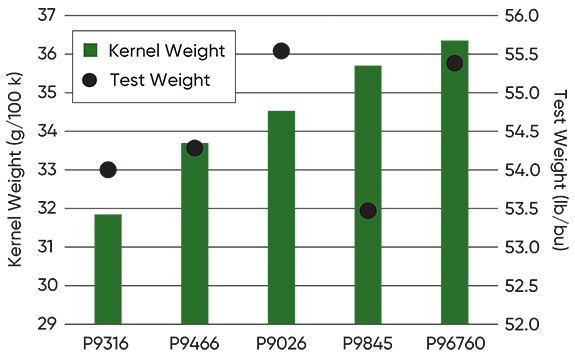
Figure 3. Average kernel weight and test weight of several Pioneer hybrid families in the 2023 study in Eastern Ontario.
Kernel Weight and Yield Estimates
- Kernel weight is influenced by many factors including hybrid genetic profile, management, and environmental conditions can impact how the hybrid maintains the full kernel weight potential. Any conditions such as lack of water, disease pressure or nutrient deficiencies can impact the late season grain fill period and kernel weight.
- An understanding of relative kernel weights for hybrids can help in calculating more accurate yield estimates. In addition, provides us an understanding of how hybrids make its yield to influence management decisions or aid in diagnosing product performance.
- When estimating yields, consider using 80,000 kernels per bushel as your standardized kernel weight estimate for most hybrids. For a hybrid family such as P96760, a lower kernels/bu (~70,000) may be more appropriate. Conversely, hybrids in the P90630 family, having a factor of 90,000 kernels/bu may be more suitable. If late season growing conditions are conducive, a lower kernel/bu number may be assigned (~70,000 kernels/bu), compared to 90,000 kernels/bu if late season conditions are poor.
References
- Fernandez, J.A., C.D. Messina, A. Salinas, P.V. Vara Prasad, J.B. Nippert, and I.A. Ciampitti. 2022. Kernel weight contribution to yield genetic gain of maize: a global review and US case studies. J. of Exp. Botany. 73:3597-3609.
- Tollenaar, M., and E.A. Lee. 2002. Yield potential, yield stability and stress tolerance in maize. Field Crops Res. 75:161-169.






AM - Optimum® AcreMax® Insect Protection system with YGCB, HX1, LL, RR2. Contains a single-bag integrated refuge solution for above-ground insects. In EPA-designated cotton growing counties, a 20% separate corn borer refuge must be planted with Optimum AcreMax products. AML - Optimum® AcreMax® Leptra® products with AVBL, YGCB, HX1, LL, RR2. Contains a single-bag integrated refuge solution for above-ground insects. In EPA-designated cotton growing countries, a 20% separate corn borer refuge must be planted with Optimum AcreMax Leptra products. Agrisure Viptera® is a registered trademark of, and used under license from, a Syngenta Group Company. Agrisure® technology incorporated into these seeds is commercialized under a license from Syngenta Crop Protection AG. Liberty®, LibertyLink® and the Water Droplet Design are trademarks of BASF. Roundup Ready® is a registered trademark used under license from Monsanto Company.
The foregoing is provided for informational use only. Please contact your Pioneer sales professional for information and suggestions specific to your operation. 2023 data are based on average of all comparisons made in 9 locations through Dec. 1, 2023. Multi-year and multi-location is a better predictor of future performance. Do not use these or any other data from a limited number of trials as a significant factor in product selection. Product responses are variable and subject to a variety of environmental, disease, and pest pressures. Individual results may vary. All Pioneer products are hybrids unless designated with AM, AML, AMT, AMX, AMXT, Q, V, PCE, PCUE, PWE & PWUE, in which case they are brands.