
Country Selector
Please enter a valid location
12/4/2025
Importance of Late-Season Plant Health in Silage Production
Dann Bolinger, M.S., Pioneer Dairy Specialist
Shared from Inside the ZONE® newsletter, Pioneer Nutritional Sciences
Key Points
- Healthier corn plants exhibited a wider harvest window (32% - 42%DM) compared to less healthy plants.
- Healthier corn plants provided opportunity to capture more starch, digestible starch and total yield by allowing harvest of a more mature plant without sacrificing fiber digestiblity.
- Genetic differences appeared to be significant enough to utilize plant health as a primary corn brand and hybrid selection criteria.
- Pioneer® brand corn hybrids showed an advantage over Dekalb® and Enogen® brand corn products in all of these considerations.

- Introduction
- Trial Design
- Widening the Harvest Window
- Enhancing Yield Potential
- Increasing Starch Value
- Acknowledgement
Introduction
Drought, plant diseases, fungicide utilization and other circumstances influencing plant stress have demonstrated that greater plant health is advantageous in corn silage production. While genetic variation in plant health among commercially available corn hybrids is broadly recognized, there has been little exploration into the implications of those differences on whole plant corn silage yield and quality. Anecdotal observations suggest potentially impactful differences in corn silage production between commercially available genetic sources. A 2024 field trial observed and quantified these differences in plant health between leading silage corn seed brands and their influence on yield, quality and harvestability.
Trial Design
Three corn hybrid products from each of Pioneer, Dekalb and Enogen brands of 107±3 corn relative maturity (CRM) were planted in alternating strips in uniform highly productive loam soils (Table 1). Average weekly milk line progressions by brand were equal across brands demonstrating comparable physiological maturity.
Table 1. Brand representation of 107±3 CRM hybrid products.
| Pioneer (P) | Dekalb (D) | Enogen (E) | |
|---|---|---|---|
| 1. | P04511V | DKC105-25RIB | E105Z5-D10 |
| 2. | P0732Q | DKC106-98RIB | E107C1-D10 |
| 3. | P0720Q | DKC107-33RIB | E110F4-D10 |
The growing season was very favorable for high yields and high plant health from preplant through R5 (dent). The trial received a fungicide application via a ground applicator at R1 (green silk). Precipitation and soil moisture were adequate until R5. Droughty, hot conditions during the harvest period (R5 to ¾ milk line, ML) provided significant plant stress. During this time, some hybrids began to show susceptibility to tar spot, northern leaf blight and/or Fusarium crown rot. However, disease is believed to be secondary to moisture stress in attributing to plant health decline.
Samples of 1/1000th acre strips alternating between the center two rows were harvested at 6 inches within a uniform area of field. Harvest samples were collected weekly corresponding to plant maturities: R5, ¼ ML, ½ ML, and ¾ ML. Yield samples were weighed to nearest 0.5 pound (i.e. ~0.25 T/A@35%DM). Chopped whole plant samples were analyzed by Rock River Laboratory, Inc., Watertown WI. Data is summarized by seed brand (n=3). Plant health was visually assessed in addition to measuring whole plant percent dry matter (DM).
Widening the Harvest Window
All three brands entered the harvest window (32%-42%DM) within 24 hours of each other (Figure 1).
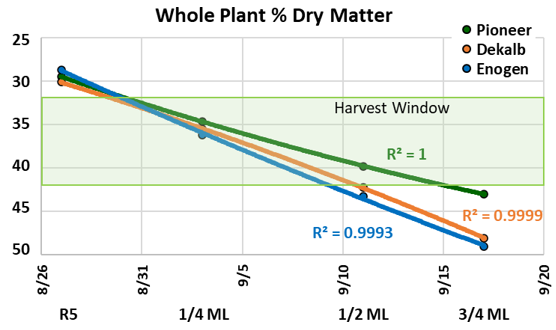
Figure 1. Whole plant dry matter from R5 (dent) through ¾ milk line sampling points relative to harvest window (shaded area, 32%DM-42%DM)
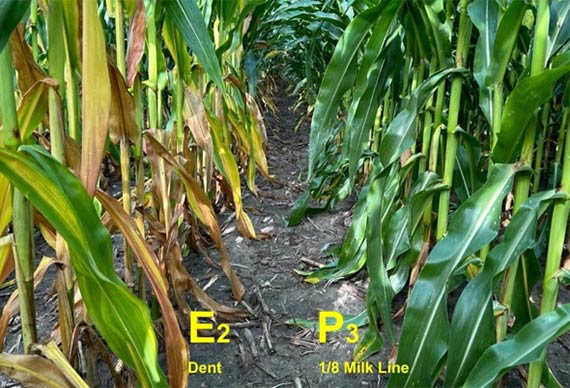

Images 1 & 2. Hybrid product visual differentiation of plant health with concurrent milk line observations (BL=R6, black layer). Grain corn relative maturity (CRM) ratings listed as advertised by respective brand.
Pioneer – P1: P04511V, P2: P0732Q, P3: P0720Q
Dekalb – D1: DKC105-25RIB, D2: DKC106-98RIB, D3: DKC107-33RIB
Enogen – E1: E105Z5-D1, E2: E107C1-D1, E3: E110F4-D1
Trendline predictions of days within the harvest window (32%DM - 42%DM) varied by brand:
- Pioneer brand products had a harvest window of 15.9 days, which is 30% and 60% more days than Dekalb (12.2d) and Enogen (10.2d), respectively.
- Pioneer brand products exited the harvested window (>42%DM) at approximately ¾ milk line, while Dekalb and Enogen brands exited the harvest window (>42%DM) at approximately ½ milk line.
Enhancing Yield Potential
As expected, whole plant yield increased with the crop’s physiological maturity represented by milk line progression (Figure 2). Starch deposition in the kernels accounted for the additional tons per acre over time (data not shown). The magnitude of the Pioneer yield advantage increased with time and crop maturity (Figure 2). This observation is likely associated with healthier plants being better able to maintain photosynthetic sugar and starch production, while less healthy plants were losing capacity to capture radiant energy.
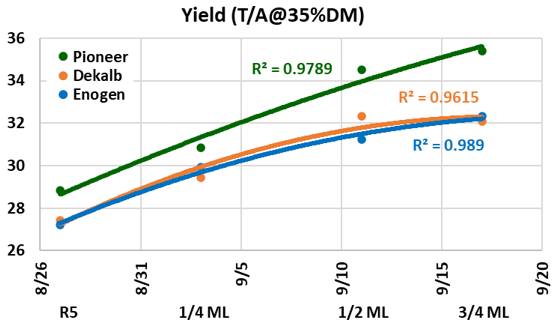
Figure 2. Whole plant silage yields relative to harvest timing and kernel milk line (ML) progression.
Increasing Starch Value
There was little difference between brands in %starch and starch accumulation rates relative to harvest date or milk line (Figure 3). Relative to harvest %DM basis, Pioneer demonstrated higher starch content (+1.7% & +2.2% over Dekalb & Enogen, respectively). This advantage reflects an advanced milk line at comparable %DM (42.1%-43.0%DM) at differing milk line (½ vs. ¾ ML, Figure 3). This is a consequence of better late season plant health.
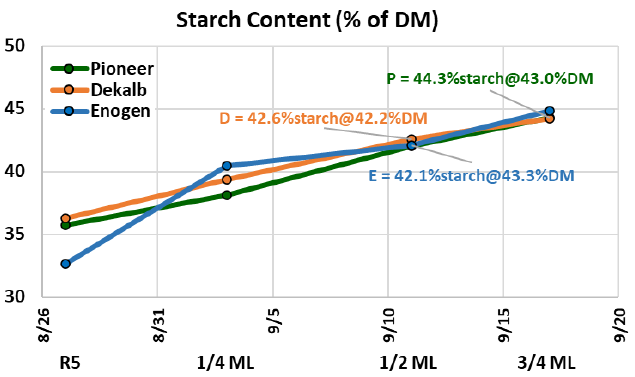
Figure 3. Starch content as percent of whole plant dry matter over time and physiological maturity.
Rumen starch digestibility (%ISSD7) of fresh, pre-ensiled corn is not a reliable predictor of %ISSD7 post-fermentation, however it is worth exploring for the sake of discussion. Brand differences measured at the same kernel milk line are small and not likely biologically meaningful for the cow (Figure 4).

Figure 4. Rumen in situ starch digestibility at 7 hours (%ISSD7) with time and kernel maturation.
The rate of deposition of starch exceeds the rate of decline in %ISSD7, thus rumen digestible starch yield is greater at more advanced kernel milk line regardless of brand genetics (Figure 5). Whole farm, seed to feed, profitability favors harvesting a more mature kernel for this reason.
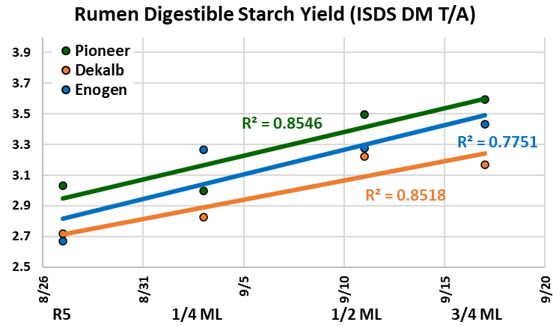
Figure 5. Rumen 7 hour in situ digestible starch (ISDS) dry matter yield demonstrating relationship of starch yield, digestibility and crop maturity.
Fiber digestibility (%NDFD30) between brands was not biologically significant (Figure 6). For all brands, %NDFD30 remained constant from R5 through ¾ milk line (Figure 6). This lack of decline is unexpected as previous studies have shown a modest decrease of 0.2%NDFD30 for each 1%DM increase through the harvest window.

Figure 6. Fiber digestibility (%NDFD30) with time and kernel maturation.
Acknowledgement
Special thanks to field trial cooperator Wilson Centennial Farms, Inc., Carson City, Michigan.
Pioneer® brand products are provided subject to the terms and conditions of purchase which are part of the labeling and purchase documents.