
Country Selector
Please enter a valid location
11/18/2025
Plant Health and Rumen Starch Digestion of Corn Silage

Dann Bolinger, M.S., Pioneer Dairy Specialist
Shared from Inside the ZONE® newsletter, Pioneer Nutritional Sciences
Key Points
- Healthy corn plants permit the harvesting of more mature kernels for corn silage, enhancing yield and starch content while maintaining fiber digestibility.
- Although more physiologically mature plants have lower rumen starch digestibility, healthier corn plants have greater rumen starch digestibility, at harvest and after 28 days of ensiling.

- Introduction
- Study Design
- Plant Health Impact on Starch Digestion
Introduction
Improvements in corn plant health have been associated with hybrid genetics, fungicide utilization, plant nutrient uptake and other stress reducing practices. Healthy plants faciliate harvesting corn for silage in a more mature state without sacrificing fiber digestibility (Figure 1). Allowing plants to advance in maturity notably enhances yield and starch content. A frequently raised quality concern of advancing maturity of a healthy plant is the decline of rumen starch digestibility. Is the decline in pre-ensiled rumen starch digestibility impactful enough to discourage harvesting at an advanced maturity?

Figure 1. Changes in corn silage yield and at-harvest quality as plants mature from R5 (dent) to ¾ milk line (n=9; Bolinger, 2024)
Study Design
A fungicide trial is an excellent method for comparing differences in plant health alone. The same hybrid, same field, same planting and harvest dates eliminates all known variables not associated with simple plant health. Two 2021 fungicide trials in Michigan were harvested at multiple kernel maturities with rumen starch digestibility (%ISSD7) measured at harvest (pre-ensiled) and 28 days ensiled. Visual assessments demonstrated obvious differences in plant health (Figure 2), while maintaining comparable plant physiological maturity.
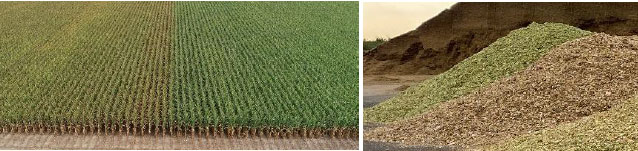
Figure 2. Visual appraisal of plant health differences within same hybrid with and without fungicide. (Left: Field B at ¼ ML, Right: Field B at ½ ML)
Plant Health Impact on Starch Digestion
In both trials (different fields, hybrids and intensity of disease pressure) and regardless of kernel maturity the healthier plants have greater rumen starch digestibility (Figure 3). Plant health appeared to be more reliable than whole plant dry matter as a predictor of change in rumen starch digestibility during ensiling.

Figure 3. Rumen starch digestibility of two fields with and without fungicide, at harvest and ensiled 28 days at different plant maturities. (Bolinger, 2021)
Water moving from healthy stover to the grain while in the silo is likely a contributing factor to healthier plants having greater post-ensiled rumen starch digestibility. The concept of reconstituting dry corn kernels with water has been demonstrated as an effective means to regain lost rumen starch availability (Benton, et.al., 2003). Healthy plant moisture migration in storage is also a probable contributing cause for the observed convergence and ranking changes in relative pre- vs. post-ensiling hybrid rumen starch digestibility (Figure 4).

Figure 4. Individual sample rumen starch digestibility changes during ensiling. Left: %ISSD7 0 to 16 weeks ensiled, n=17 (Bolinger, 2018). Right: %IVSD7 0 to 135 day ensiled, n=4 (Lawrence, et.al., 2020).
Pioneer® brand products are provided subject to the terms and conditions of purchase which are part of the labeling and purchase documents.