
Country Selector
Please enter a valid location
Effects of Seed Orientation at Planting on Corn Growth
Written by Dan Emmert and Mark Jeschke, Pioneer Agronomy Sciences
Key Findings
- A 2022 field demonstration was conducted to study the effects of seed orientation in the furrow at planting on corn growth.
- Seeds planted with the kernel tip down emerged about 20 GDUs earlier than those planted with the tip pointed up.
- Seeds planted tip down with the germ oriented toward the interrow had greater light capture and lower temperature under the canopy during late vegetative growth stages.
- Does Seed Orientation Matter?
- Previous Research on Seed Orientation
- 2022 Seed Orientation Field Demonstration
- Results
- Follow the Maize
- References
Does Seed Orientation Matter?
- Agronomists and corn producers have long been interested in the potential to improve corn growth and yield by controlling the orientation of the corn seed in the furrow at planting.
- The reason that seed orientation could potentially influence corn growth is because of how the initial growth from the germinating seed occurs (Figure 1):
- The radicle root emerges near the tip of the kernel.
- The coleoptile emerges from the embryo (germ) side of the kernel and elongates in the opposite direction toward the dent end of the kernel.
- When a corn kernel planted with the tip pointed downward, the emerging radicle and coleoptile are already pointed in the direction they need to grow, without the need for the seedling to expend additional energy and time to bend their growth downward and upward, respectively (Figure 2).
- Furthermore, the direction of the germ side of the kernel influences the orientation of the plant’s leaves, particularly during the early vegetative stages.
- Seeds planted with the germ side perpendicular to the row will tend to have leaves oriented across the row rather than toward adjacent plants in the row.
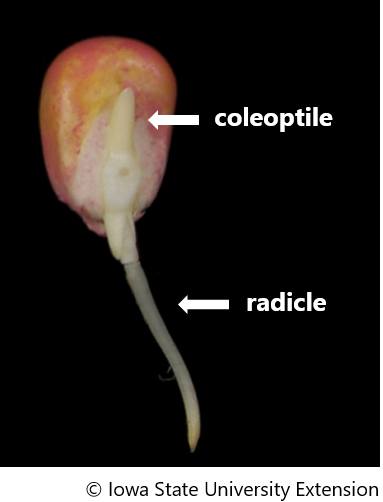
Figure 1. Germinated corn seed showing the emerging coleoptile and radicle.
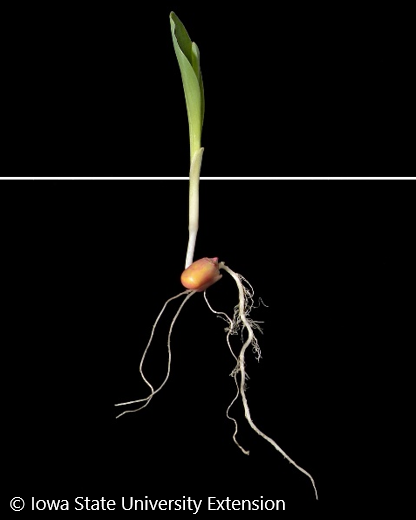
Figure 2. Corn seedling that was planted with the kernel tip angled upward, showing how both the coleoptile and radicle had to bend as they elongated to grow in the proper direction.
Previous Research on Seed Orientation
- Several previous research studies have investigated the potential for controlled seed orientation to provide:
- Better stand establishment
- More uniform emergence
- More efficient light utilization
- Quicker canopy closure
- Results of these studies have been mixed, with some studies showing a yield advantage with uniform seed orientation, while others have shown improvements in emergence uniformity and light capture but no significant effect on yield.
- A 3-year Pioneer study comparing seeds planted with the germ oriented with the row, across the row, or randomly over a range of plant populations produced different results in each year of the study (Paszkiewicz, et al., 2005).
- Research over the years on corn seed orientation has been limited, however; likely due to the labor-intensive nature of the work and difficulty in mitigating confounding factors.
- The lack of any available planting technology capable of controlling seed orientation in the furrow has likely also limited the amount of interest in researching seed orientation – even it were shown to matter, growers would have no way of doing anything about it.
- However, with the advent of planting technologies such as John Deere’s ExactEmerge, that maintain control of the seed from the meter until it is deposited in the furrow, manipulating seed orientation seems like much less of a leap in technology than it would have been 50 years ago when the first research into the question was being conducted.
2022 Seed Orientation Field Demonstration
- A field demonstration was conducted in 2022 near Montgomery Indiana to investigate the effects of corn seed orientation on speed of emergence, canopy closure, and light capture.
- The study compared four different seed orientations:
- Tip down, germ across the row
- Tip up, germ with the row
- Tip down, germ with the row
- Seed laying flat in the furrow
- Seed furrows 1.5 inches deep spaced 30 inches apart were created using a planter with the closing wheels tied up.
- Seeds were then planted by hand in the furrows in each of the four different orientations and the seed furrows were closed (Figure 3).
- Time to emergence and canopy closure were recorded, as well as measurements of light capture and temperature under the canopy.
- Light capture was assessed by measuring the amount of light that was able to penetrate the canopy and reach ground level using an Apogee DLI-400 light meter.
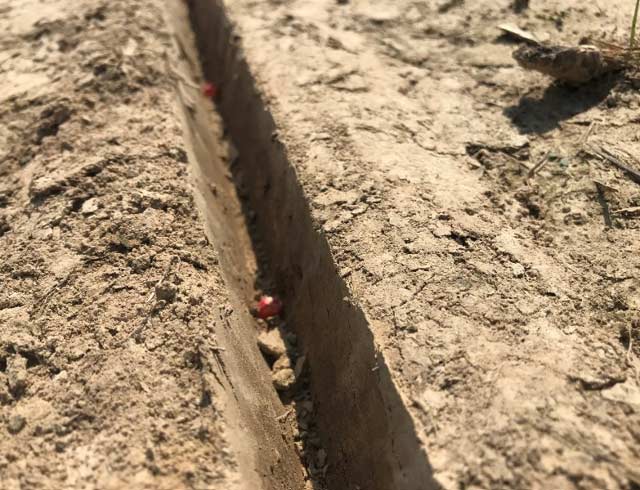
Figure 3. Seeds that have been hand planted into the open furrow in the 2022 seed orientation demonstration.
Results
Emergence
- Seeds planted with the tip down emerged faster than those planted tip up by approximately 20 GDUs (Figure 4).
Leaf Orientation
- The impact of germ direction on leaf orientation for seeds planted tip down was apparent during early vegetative growth.
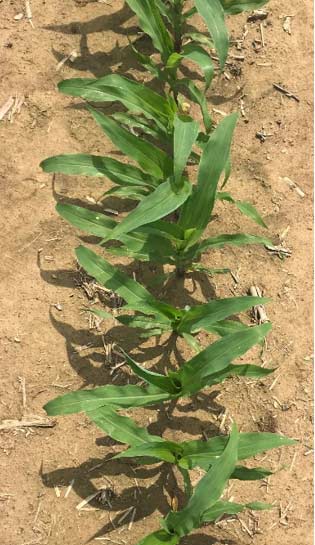
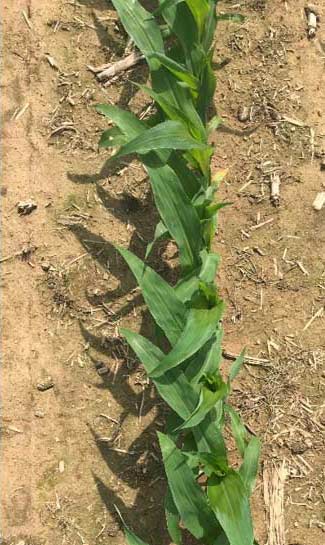
- Seeds planted with the tip down and germ oriented perpendicular to the row resulted in leaves growing across the row, while seeds planted tip down with the germ parallel to the row resulted in leaves growing with the row (Figure 5).
- Seeds planted with the tip up did not result in uniform leaf orientation, even though the germ orientation was uniform. This is due to the circuitous path the coleoptile had to take around the kernel as it emerged.
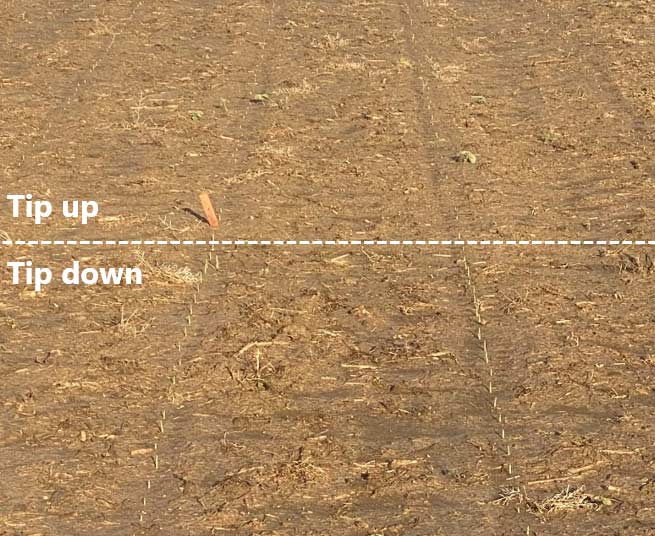
Figure 4. Emerged seedlings from corn seeds planted tip down (foreground) and tip up (background) showing faster emergence with seed planted tip down.
Germ across the row. |
Germ with the row. |
Figure 5. Corn plants from seeds planted tip down with the germ oriented across the row (left) and with the row (right) showing the impact of germ direction of leaf orientation during early vegetative growth. | |
Canopy Closure and Light Capture
- Seeds planted with the tip down and germ perpendicular to the row resulted in leaves growing across the row which closed the canopy quicker than seeds planted tip down with the germ parallel to the row or seeds planted tip up (Figure 6).
- Light penetration through the canopy was measured from July 3 to July 13. Plots with seeds planted tip down and the germ oriented across the row captured an average of 40% more light than those with the germ oriented with the row (Figure 7).
- A period of high temperatures and drought stress occurred during late vegetative growth stages. The greater light interception in plots with leaves oriented across the row was able to reduce daytime soil surface temperatures by around 14° F.
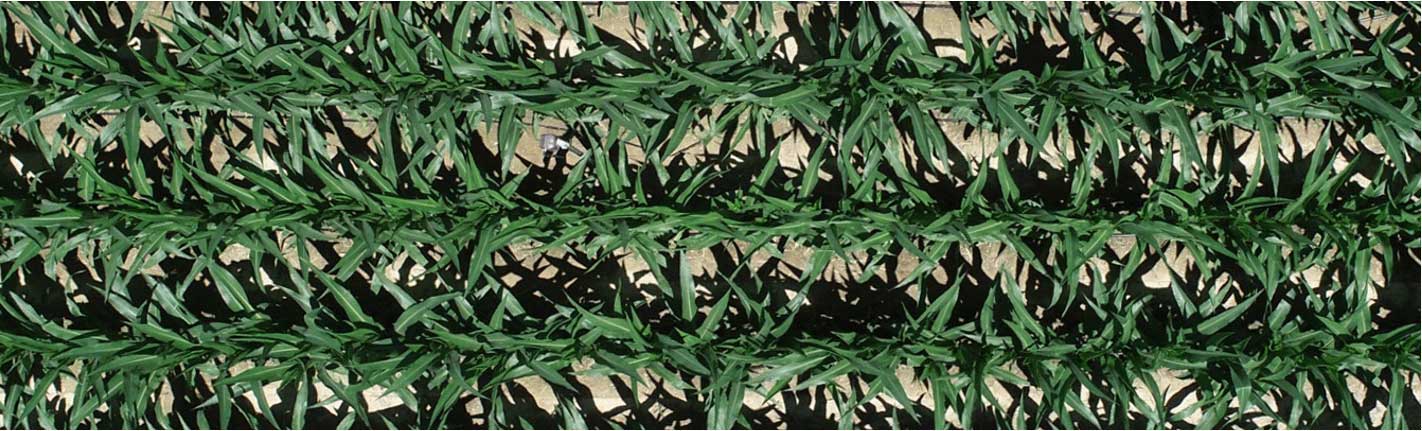

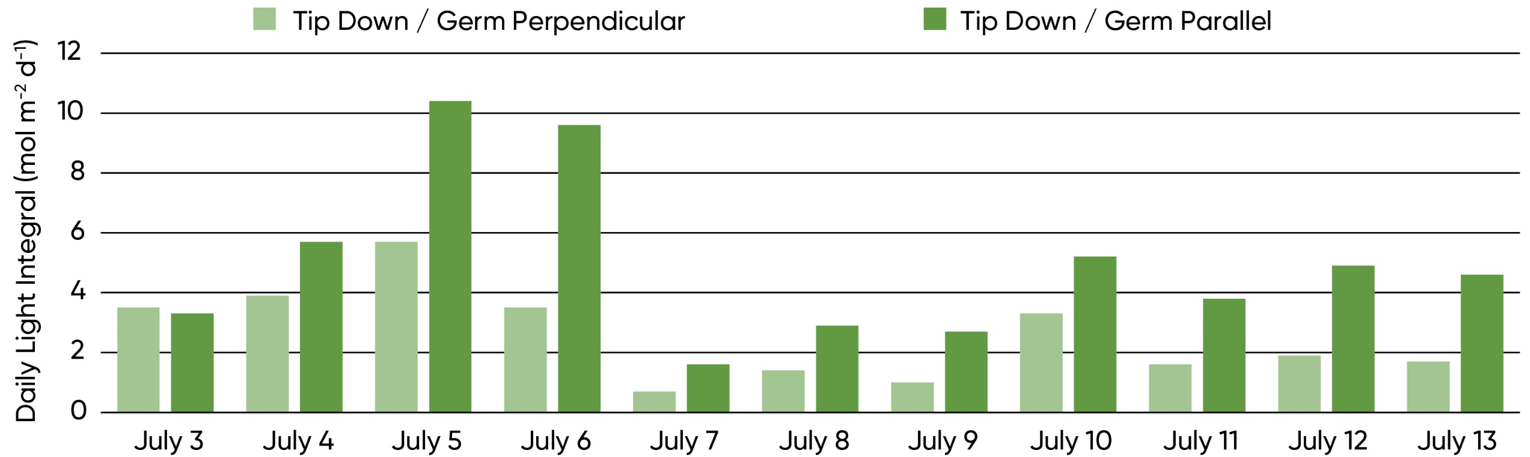
Figure 7. Daily light integral at ground level for plots with seeds planted tip down and germ perpendicular to the row and seeds planted tip down and germ parallel to the row (Larger values = more light penetrating the canopy and reaching the ground). Click here or on the image above for a larger view.
- Previous research has demonstrated the ability of corn plants to alter their leaf orientation in response to their environment during the early vegetative growth stages, shifting leaf growth preferentially toward the interrow (Jeschke and Uppena, 2015).
- In this study, however; whatever adjustment occurred was not enough to overcome the effects of seed orientation at planting.
- Results of this study show that controlling seed orientation at planting may offer some benefits to corn growth and performance, particularly under stressful conditions.
Follow the Maize
References
- Jeschke, M. and A. Uppena. 2015. Corn Leaf Orientation Response to Plant Density. Pioneer Research Update. Vol 5. No. 7. Corteva Agriscience. Johnston, IA.
- Paszkiewicz, S.R., D. Ellerman, and K. Schrader. 2005. Corn Seed Planting Orientation and Plant Population Influence on Physiological Responses and Grain Yield. ASA-CSSA-SSSA International Annual Meetings 58:816a.
The authors thank Mike Wagler and Rosedale Ag Service for their many contributions to this demonstration.
The foregoing is provided for informational use only. Please contact your Pioneer sales professional for information and suggestions specific to your operation. 2022 data are based on average of all comparisons made in one location through Nov. 1, 2022. Multi-year and multi-location is a better predictor of future performance. Do not use these or any other data from a limited number of trials as a significant factor in product selection. Product responses are variable and subject to a variety of environmental, disease, and pest pressures. Individual results may vary.