
Country Selector
Please enter a valid location
4/16/2025
Soybean Seeding Rate and Stand Establishment

Crop Focus
Written by Mark Jeschke, Ph.D., Pioneer Agronomy Manager
Key Points
- There are many factors that affect soybean stand establishment, which means that optimum seeding rates can vary by region, cropping practice, and field.
- Germination and emergence rates must be taken into account when determining seeding rates, as not all seeds that are planted will germinate and not all of those that germinate will successfully emerge.
- Soybean seeding rates should be high enough to provide some degree of protection against less-than-ideal conditions at emergence.
- Soybean Seeding Rate
- Yield Environment
- Stand Establishment
- Calculating Seeding Rate
- Importance of Adequate Seeding Rates
- References
Soybean Seeding Rate
- Establishing healthy and uniform stands is important to maximize soybean profitability.
- Yield of soybeans is generally less responsive to plant density than some other crop species such as corn due to the inherent adaptability of the plant.
- The ability of soybean plants to increase their lateral branching in low density environments gives them some capacity to compensate for poor stand establishment.
- Because there are many factors that affect soybean stand establishment, optimum seeding rates can vary considerably by region, cropping practice, and field.
Yield Environment
- Yield environment is an important consideration for soybean seeding rates.
- Research has shown that seeding rates should be higher in areas of lower productivity and lower in areas of high productivity (Gaspar, 2019; Jeschke, 2023).
- The need for higher soybean seeding rates in lower productivity environments is primarily due to limitations on plant growth rate and branching.
- Plant growth can be limited due to many factors, such as precipitation, soil water holding capacity, nutrient supply, or rooting depth.
- These factors, which are commonly limiting in low productivity areas, can challenge the ability of soybean plants to maximize season-long light interception.
- Increased plant density is therefore required to maximize light interception and yield in these lower productivity environments.
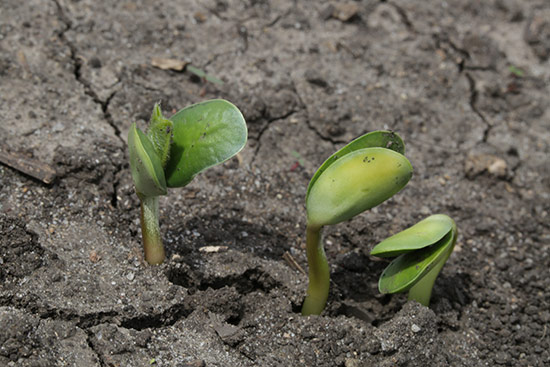
Stand Establishment
- An important consideration in soybean seeding rate decisions is the fact that plant density at the end of the season can be considerably less than the number of seeds that went into the ground.
Germination and Emergence
- Germination and emergence rates must be taken into account when determining seeding rates, as not all seeds that are planted will germinate and not all of those that germinate will successfully emerge.
- Corteva Agriscience conducts warm germination and other seed quality tests to ensure that its seed meets quality standards that lead the industry. Warm germination results are printed on the seed tag.
- In most years, germination scores are 90% or greater; however, in cases where weather conditions affect seed production over a wide area, some soybean varieties may be tagged with a standard warm germination score of less than 90%.
- In Canada, soybean varieties will be tagged as Canada Certified No. 2 if the standard warm germination score is less than 85%.
- Modern soybean seed treatments have improved stand establishment rates by protecting germinating and emerging seedlings from soil-borne pathogens. However, abiotic factors such as soil crusting, crop residue, and imbibitional chilling can still impact emergence rates.
Survival
- Soybeans naturally undergo some amount of plant attrition during the growing season, so the number of plants per acre at the end of the season will not be equal to the number of plants that originally emerged.
- Attrition is important to consider when targeting a minimum final stand. The rate of attrition increases with plant density. Research has found that attrition rates of 10 to 20% are typical with current seeding rates. Assuming a 15% attrition rate (85% survival), an initial plant stand of 120,000 plants/acre at V2 would result in a final stand of 102,000 plants/acre.
Calculating Seeding Rate
To achieve a target final stand, it is necessary to account for non-germinating seeds, non-emerging seeds, and plant survival to calculate seeding rate, using the following equation:
| Targeted Final Stand | |
| ------------------------------------------- | = Seeding Rate |
| Germination x Emergence x Survival |
The following three examples show the seeding rate necessary to achieve a harvest stand of 100,000 plants/acre under different scenarios:
Example 1. Normal germination, good emergence
| 100,000 plants/acre | |
| -------------------------- | = 137,600 seeds/acre |
| 0.90 x 0.95 x 0.85 |
Example 2. Normal germination, challenging emergence
| 100,000 plants/acre | |
| -------------------------- | = 163,400 seeds/acre |
| 0.90 x 0.80 x 0.85 |
Example 3. Low germination, challenging emergence
| 100,000 plants/acre | |
| -------------------------- | = 183,800 seeds/acre |
| 0.80 x 0.80 x 0.85 |
Always start by checking the seed bag tag for the warm germination score.
Importance of Adequate Seeding Rates
- Soybean seeding rates should be high enough to provide some degree of protection against less-than-ideal conditions at emergence. Pushing seeding rates too low can increase the risk of needing to replant if everything does not go exactly right.
- Replanting soybeans can mean losing some of the higher yield potential with timely planting. Recent data suggest that modern soybean varieties have a greater yield response to earlier planting (Propheter and Jeschke, 2017; Van Roekel, 2019), making timely planting important to maximize yield potential.
- Earlier planting allows soybeans to take advantage of longer day lengths during mid-summer and can extend the duration of reproductive growth (Parker et al., 2016).
Additional Soybean Seeding Rate Considerations
- Soil type. Soils with high clay content are much more likely to crust and restrict soybean emergence and can promote seedling diseases in wet springs.
- Planting date. Early planting usually means colder, wetter soil, slower emergence, and reduced stands. Soybeans planted very late, including double-crop beans, require higher rates because they are destined to be shorter and produce fewer pods per plant.
- Tillage / residue cover / seedbed condition. No-till systems provide a less hospitable environment for soybean emergence due to colder soils, more residue, and possible seed placement / soil contact challenges. Cloddy soils may also reduce seed-soil contact.
- Planter or drill. Planters have traditionally done a better job of seed singulation and placement, increasing plant counts and stand uniformity. Growers using drills may need higher seeding rates to establish equally productive stands.
- Seedling disease risk. Some regions have higher seedling disease risk due to soil types, weather patterns, and pathogen race shifts. Higher seeding rates are needed to establish target stands in areas or fields with a history of higher disease risk.
- Iron deficiency chlorosis risk. Recent research studies have shown the value of high seeding rates in reducing chlorosis symptoms.
- White mold risk. In fields with a historically high risk of white mold, very high seeding rates are not recommended.
References
- Gaspar, A.P. 2019. Soybean Seeding Rate – Past, Present, and VRS Future. Pioneer Crop Insights. Vol. 29 No. 1. Corteva Agriscience, Johnston, IA.
- Jeschke, M. 2023. Soybean Seeding Rate Considerations. Pioneer Crop Insights. Vol. 33 No. 2. Corteva Agriscience, Johnston, IA.
- Parker, A., K. Fry, and K. Reese. 2016. Planting Date Effect on Soybean Reproductive Duration. Pioneer Agronomy Research Update Vol. 6 No. 2. Corteva Agriscience, Johnston, IA.
- Propheter, J. and M. Jeschke. 2017. High Yield Soybean Production in the Western Corn Belt. Pioneer Crop Insights Vol. 27 No. 5. Corteva Agriscience, Johnston, IA.
- Van Roekel, R. 2019. The Importance of Early Planting for Soybeans in the Midwest. Pioneer Crop Focus Vol. 11 No. 1. Corteva Agriscience, Johnston, IA.
The foregoing is provided for informational use only. Please contact your Pioneer sales professional for information and suggestions specific to your operation. Product performance is variable and depends on many factors such as moisture and heat stress, soil type, management practices and environmental stress as well as disease and pest pressures. Individual results may vary. Pioneer® brand products are provided subject to the terms and conditions of purchase which are part of the labeling and purchase documents.