
Country Selector
Please enter a valid location
Key Points
- Corn rootworm populations can be affected by environmental conditions during the fall at the time of egg laying and over the winter.
- Most egg laying occurs 4 to 6 inches deep in the soil profile but under dry conditions may extend as deep as 8 inches for northern corn rootworm and 12 inches for western corn rootworm.
- Exposure to subfreezing temperatures can reduce the overwintering survival of corn rootworm eggs. Egg mortality increases with lower temperatures and longer durations of exposure.
- The deeper eggs are positioned in the soil, the more they will be buffered against fluctuations and extremes in air temperature.
- Snow cover can make a large difference in soil temperature and provide substantial protection for overwintering corn rootworm eggs.
- Fall tillage does not appear to have a uniformly positive or negative impact on egg survival.
- Cold Weather Survival
- Effects of Fall Conditions on Egg Deposition
- Effects of Winter Cold on Egg Survival
- Protection From Cold Exposure
- Tillage Impacts
- Larval Mortality
- Conclusions
- References
Cold Weather Survival
Western corn rootworm (Diabrotica virgifera virgifera) and northern corn rootworm (D. barberi) both overwinter as eggs in the soil, a cold weather survival strategy that has been sufficiently effective for them to persist as major insect pests of corn in temperate regions. The potential corn rootworm population level in a field for a given year is set by the number of eggs laid in the soil the previous fall and the percentage that survive the winter to hatch in the spring.
The number of eggs deposited in the soil will depend in large part on the density of the corn rootworm adult population the previous year. The proportion that ultimately hatch in the spring can be affected by environmental conditions during the fall at the time of egg laying and over the winter.
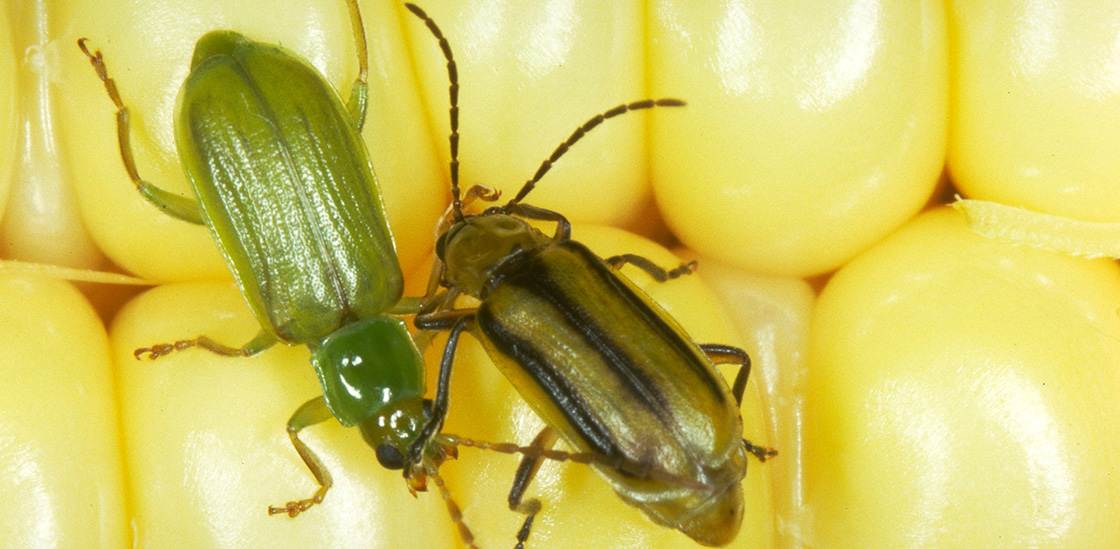
Figure 1. Western and northern corn rootworm beetles deposit eggs in the soil during August and September where they will remain through the winter and hatch the following season.
Effects of Fall Conditions on Egg Deposition
The proportion of corn rootworm eggs that are able to survive over the winter and successfully hatch in the spring is influenced by a number of factors, beginning with the soil condition at the time of egg laying in the fall. Gravid females will seek oviposition sites with optimal moisture conditions, which can be influenced by soil texture and residue cover. Egg laying can be spatially variable due to variation in soil texture and moisture levels throughout a field. Gravid females are not able to burrow in the soil, so they rely on already-existing openings in the soil, such as drought cracks and earthworm burrows, to move down in the soil to find suitable moisture levels. Most egg laying occurs 4-6 inches deep in the soil profile but under dry conditions may extend as deep as 8 inches for northern corn rootworm and 12 inches for western corn rootworm (Figure 2).
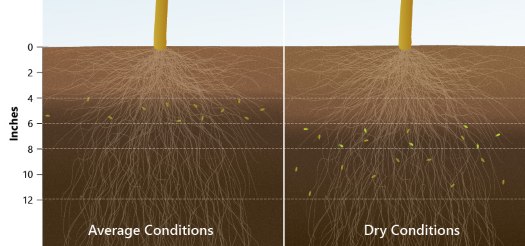
Figure 2. Corn rootworm beetles move deeper in the soil to lay eggs under dry conditions.
Effects of Winter Cold on Egg Survival
Exposure to subfreezing temperatures can reduce the overwintering survival of corn rootworm eggs. Egg mortality increases with lower temperatures and longer durations of exposure. Table 1 and Table 2 show predictive models for percent egg hatch of western and northern corn rootworms based on intensity and duration of cold stress (Woodson and Gustin, 1993; Woodson and Ellsbury, 1994).
Table 1. Cold temperature exposure effects on percent (%) hatch of western corn rootworm eggs in a laboratory study (Woodson and Gustin, 1993.)
| Temp (F) | Duration of Exposure (weeks) | |||||||||
|---|---|---|---|---|---|---|---|---|---|---|
| 1 | 2 | 3 | 4 | 5 | 6 | 7 | 8 | 9 | 10 | |
| 32 | 81 | 81 | 81 | 81 | 81 | 81 | 81 | 81 | 81 | 81 |
| 30 | 77 | 76 | 74 | 73 | 72 | 71 | 70 | 68 | 67 | 66 |
| 28 | 73 | 70 | 68 | 65 | 63 | 61 | 58 | 56 | 53 | 51 |
| 26 | 68 | 65 | 61 | 57 | 54 | 50 | 47 | 43 | 40 | 36 |
| 24 | 64 | 59 | 54 | 50 | 45 | 40 | 35 | 30 | 26 | 21 |
| 22 | 60 | 54 | 48 | 42 | 36 | 30 | 24 | 28 | 12 | 6 |
| 20 | 56 | 48 | 41 | 34 | 27 | 20 | 12 | 5 | 0 | 0 |
| 18 | 51 | 43 | 35 | 26 | 18 | 9 | 1 | 0 | 0 | 0 |
Table 2. Cold temperature exposure effects on percent (%) hatch of northern corn rootworm eggs in a laboratory study (Woodson and Ellsbury, 1994).
| Temp (F) | Duration of Exposure (weeks) | |||||||||
|---|---|---|---|---|---|---|---|---|---|---|
| 1 | 2 | 3 | 4 | 5 | 6 | 7 | 8 | 9 | 10 | |
| 32 | 48 | 53 | 57 | 61 | 65 | 67 | 70 | 71 | 73 | 73 |
| 30 | 53 | 58 | 61 | 65 | 68 | 70 | 72 | 73 | 74 | 74 |
| 28 | 57 | 61 | 64 | 67 | 69 | 71 | 73 | 74 | 74 | 74 |
| 26 | 59 | 63 | 66 | 68 | 70 | 71 | 72 | 73 | 72 | 72 |
| 24 | 60 | 63 | 66 | 68 | 69 | 70 | 70 | 70 | 70 | 69 |
| 22 | 60 | 62 | 64 | 66 | 67 | 67 | 67 | 67 | 66 | 64 |
| 20 | 58 | 60 | 62 | 63 | 63 | 63 | 63 | 62 | 60 | 58 |
| 18 | 55 | 57 | 58 | 58 | 58 | 58 | 57 | 55 | 53 | 51 |
| 16 | 51 | 52 | 52 | 53 | 52 | 51 | 50 | 48 | 45 | 42 |
| 14 | 45 | 46 | 46 | 46 | 45 | 43 | 41 | 39 | 36 | 33 |
Eggs of northern corn rootworm are generally more cold-tolerant than those of western corn rootworm, which accounts for its more northerly distribution. Northern corn rootworm eggs must be exposed to a period of cold temperatures during diapause before hatch can occur. This chilling requirement reduces the likelihood of hatch occurring during short-term warming periods that may occur during the fall (Ellsbury et al., 1998). Western corn rootworm eggs do not require a chilling period during diapause.
Protection From Cold Exposure
The depth at which eggs are deposited in the soil profile can affect their ability to survive the winter. The deeper eggs are positioned in the soil, the more they will be buffered against fluctuations and extremes in air temperature. Soil texture can influence temperature buffering as well, as courser soils have lower buffering ability than finer soils.
Figure 3 shows air and soil temperature data collected near Aberdeen, South Dakota in January 2024, a month that experienced a weeklong period of air temperatures below 0˚F. Temperature buffering increased with soil depth — soil temperature during this cold snap reached as low as 11˚F at 2-inch depth, 14˚F at 4-inch depth and 22˚F at 8-inch depth (Figure 3).
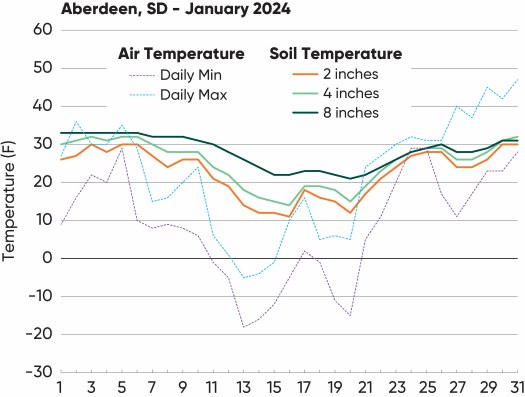
Figure 3. Air and soil temperatures at Aberdeen, SD for the month of January 2024 (NOAA).
Based on the predictive model data shown in Table 2, northern corn rootworm eggs deposited 8 inches deep would be expected to hatch at a 60% rate, compared to only 45% hatch for eggs deposited at 4 inches, due to greater cold exposure.
Snow cover and crop residue insulate the soil from extreme temperatures, which can result in higher overwinter survival. A dry fall followed by a snowy winter provides the best conditions for overwinter survival of corn rootworm eggs because temperature buffering will be maximized by the deeper deposition of eggs in the soil profile and insulating effect of snow cover.
Snow cover can make a large difference in soil temperature and provide substantial protection for overwintering corn rootworm eggs (Figure 4).
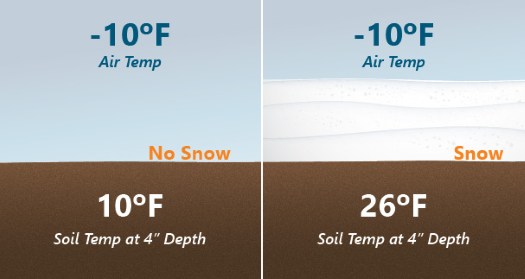
Figure 4. Example of the difference that snow cover can make in insulating soil from subfreezing air temperatures, based on data collected by the University of Nebraska at Scottsbluff, NE in 2025 (Peterson et al., 2025).
Soil temperature data collected by the University of Nebraska at Scottsbluff, NE in 2025 illustrated the buffering effect of snow cover. This location experienced cold snaps in both January and February of 2025 in which the air temperature dropped below -10˚F. The February cold snap was accompanied by ample snow cover but the January one was not. With no snow cover, soil temperature at a depth of 4 inches reached as low as 10˚F, but with snow cover, soil temperatures remained above 25˚F (Peterson et al., 2025).
There can be substantial spatial variation in overwintering survival across a field; as soil moisture, snow cover and exposure to wind can vary based on soil texture and topography (Figure 5).
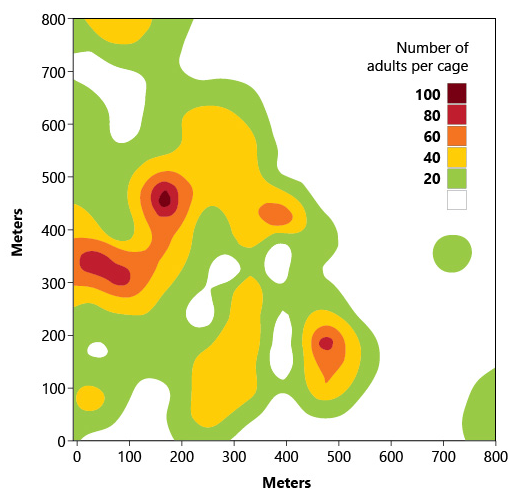
Figure 5. Contour map describing spatial variation in numbers of northern corn rootworm adults emerging per 0.5 m2 of soil surface in a quarter-section field of corn rotated with soybean (From Ellsbury et al., 1998).
Differences in overwinter survival mean that areas of a field with the greatest density of eggs during the fall will not necessarily be the areas with the most eggs that hatch in the spring. If larval feeding pressure during the summer appears to be relatively uniform across a field, it is likely indicative of a high level of winter survival that allowed larvae to establish throughout the field.
Tillage Impacts
Fall tillage does not appear to have a uniformly positive or negative impact on egg survival (Gray and Tollefson, 1988). Tillage redistributes eggs within the plow layer, which may move some eggs shallower in the soil where they are less likely to survive and some eggs deeper where they are more likely to survive.
Larval Mortality
Just as environmental conditions can have a large impact on the survival of corn rootworm eggs over the winter, conditions during the spring can influence how many larvae are able to establish feeding and survive to adulthood. Of all the weather conditions that can affect corn rootworm population levels, flooding after hatch likely has the greatest potential to reduce populations. Soil saturation and flooding following corn rootworm hatch can dramatically reduce larval survival, causing larvae to either drown or be unable to locate corn roots for feeding (Riedell and Sutter, 1995).
Conclusions
Overwinter survival of western and northern corn rootworm eggs in the soil can be affected by soil conditions during the late summer and fall when eggs are deposited, as well as temperature and snow cover over the winter. Prolonged exposure to subfreezing temperatures can reduce rootworm egg survival; eggs of western corn rootworm are generally more susceptible to cold exposure than northern corn rootworm. The insulating effect of snow cover provides considerable protection for rootworm eggs in the soil, even when air temperatures dip well-below 0˚F. Spatial variation in microclimate across a field during the fall and winter can result in highly variable patterns of corn rootworm pressure and adult emergence the following season.
References
- Ellsbury, M.M., J.L. Pikul, Jr., and W.D. Woodson. 1998. A. review of insect survival in frozen soils with particular reference to soil-dwelling stages of corn rootworms. Cold Regions Sci. and Technol. 27:49-56.
- Gray, M.E., and J.J. Tollefson. 1988. Influence of tillage systems on egg populations of western and northern corn rootworms (Coleoptera: Chrysomelidae) J. of the Kansas Entomol. Soc. 61:186-194.
- Peterson, J., A. Lima, A. da Silva Santana, J. McMechan, P.-C. Lai, and J. Bradshaw. 2025. How Have Winter Temperatures Affected Insect Overwintering in Nebraska? CropWatch April 17, 2025. Institute of Agriculture and Natural Resources University of Nebraska-Lincoln.
- Riedell, W.E., and G.R. Sutter. 1995. Soil moisture and survival of western corn rootworm larvae in field plots. J. Kansas Entomol. Soc. 68(1): 80-84
- Woodson, W.D., and R.D. Gustin. 1993. Low temperature effects on hatch of western corn rootworm eggs (Coleoptera: Chrysomelidae). J. Kansas Entomol. Soc. 66:104-107.
- Woodson, W.D., and M.M. Ellsbury. 1994. Low temperature effects on hatch of northern corn rootworm eggs (Coleoptera: Chrysomelidae). J. Kansas Entomol. Soc. 67:102-106.
The foregoing is provided for informational use only. Please contact your Pioneer sales professional for information and suggestions specific to your operation. Product performance is variable and depends on many factors such as moisture and heat stress, soil type, management practices and environmental stress as well as disease and pest pressures. Individual results may vary. Pioneer® brand products are provided subject to the terms and conditions of purchase which are part of the labeling and purchase documents.