
Country Selector
Please enter a valid location

1/9/2020
Rethinking Corn Silage Planting Options
Shared from Inside the ZONE® newsletter, Pioneer Nutritional Sciences
- Key Points
- Introduction
- Dry Matter Intake
- Feed Efficiency
- Milk Production
- Conclusion
- References
Key Points
The concept of planting approximately 20-30% of silage acres to brown midrib (BMR) and 70-80% to standard silage hybrids (depending upon the individual dairy) involves:
- Ability to group cows and segregate/manage BMR in a separate bunker/pile.
- Allocating BMR to transition cows for 3-4 weeks pre-calving.
- Feeding BMR for 4-5 weeks in lactation diets then switching to standard corn silage to maintain dry matter intake (DMI) and milk production without negatively impacting feed efficiency (FE).
- Resulting in less agronomic risk and higher silage yields while maintaining high milk production and FE.
Introduction
BMR silage genetics consistently offer higher NDF digestibility compared to standard (non-BMR) silage hybrids but this advantage currently comes at the cost of poorer agronomics and upwards of a 15-20% yield reduction. The increased feed intake coupled with lower yielding hybrids makes having an adequate land base essential for successful BMR adoption.
While BMR agronomics are improving, Eastridge (1999) focused attention on the variability in animal response to BMR in a summary of 10 BMR dairy trials where these was no consistent pattern in DMI and no consistent response in milk yield to level of BMR silage in the diet.
One of the first full lactation studies (Longuski, 2003) where BMR was fed only in the lactation diet (not in the transition diet), showed significantly higher 3.5% fat corrected milk yields from 50 to 150 days in milk (DIM) compared with the isogenic control silage but was similar from 0 to 50 and from 150 to 300 DIM.
This variability in response to BMR diets led several universities and research institutions to investigate when cows were most responsive in milk production by feeding BMR at different stages of the transition and lactation cycle. The economic and agronomic merits of this approach of targeted BMR feeding is based on these research studies. The full studies can be found in the references but only the overall conclusions of the effect of selective feeding of BMR on DMI, FE and milk production will be presented in this paper.
Dry Matter Intake
Figure 1 shows DMI data from a Cornell trial (Stone et al.) where cows were fed BMR from 4 weeks pre-fresh until 4 weeks postpartum then switched to an all standard corn silage diet. This study shows the increase DMI potential of BMR over a standard silage hybrid is not maintained beyond 4-5 weeks into lactation.
Figure 1: Dry matter intake response in BMR diets (Cornell, 2012)
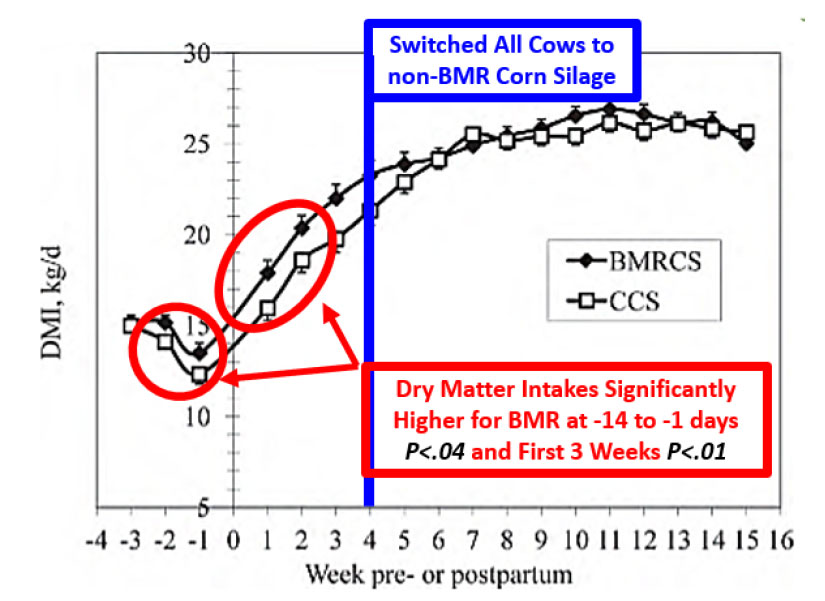
Dry matter intake in cows fed either conventional corn silage (CCS) or brown midrib corn silage (BMRCS) during both the prepartum and postpartum periods, followed by a common lactation diet containing CCS from weeks 4 to 15.
Figure 2 is data from a Utah State University study showing that feeding BMR in the transition period is important to improving intakes following calving. However, switching to a standard corn silage diet (cc) resulted in more milk per pound of dry matter intake later in the lactation (blue circle).
Figure 2: Dry matter intake response in BMR diets (USU, 2014)

Dry matter intake of Holstein dairy cows fed corn silage-based diets prepartum at wk -4 up to wk 20 of lactation. CCS = conventional corn silage-based TMR prepartum; BMRCS = brown midrib corn silage-based TMR prepartum. CC = conventional corn silage-based TMR prepartum and postpartum; BB = brown midrib corn silage-based TMR prepartum and postpartum; CB = conventional corn silage-based TMR prepartum and brown midrib corn silage-based TMR postpartum; BC = brown midrib corn silage-based TMR prepartum and conventional corn silage-based TMR postpartum.
Feed Efficiency
The higher intake resulting from increased NDF digestibility in BMR appears not to result in higher milk production beyond cows in early lactation when intakes are adequate to meet production needs. Higher intake with no additional milk results in economic losses by lowering FE.
A 2011 study at Miner Institute showed BMR-fed, mid-lactation cows had 2.6 lb higher DMI (P<0.001) but significantly lower FE (1.50 vs 1.60, P<0.03) compared to cows fed a standard corn silage diet.
Milk Production
A 2001 trial at the US Dairy Forage Research Center (Figure 3) showed that cows fed BMR 3 weeks pre-fresh and 4 weeks postpartum produced 6.2 pounds more 3.5% fat corrected milk and maintained the milk advantage after switching to a standard corn silage diet.
Figure 3: Dry matter intake response in BMR diets (USU, 2014)

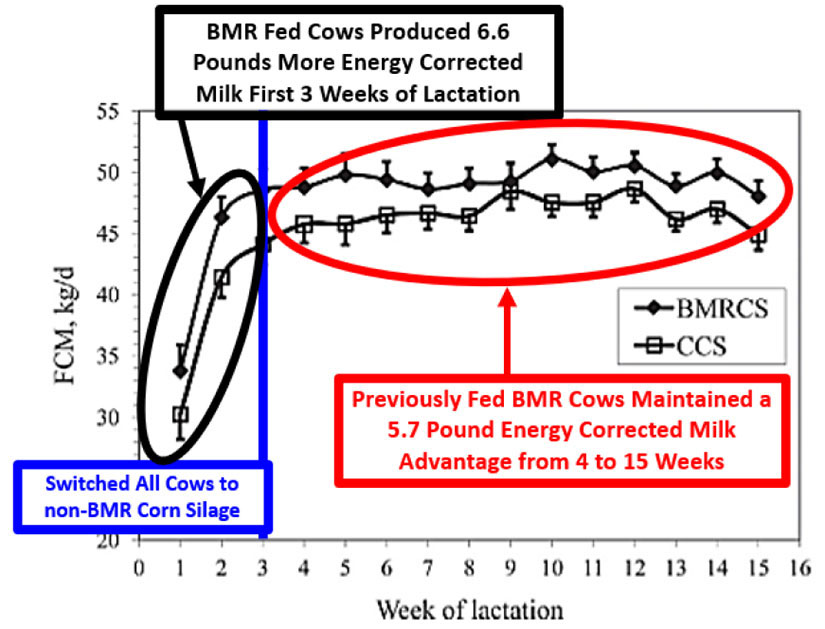
Milk production data from the 2012 Cornell trial is shown in Figure 4. As in other trials, cows fed BMR in the transition group and 3-5 weeks postpartum maintained their energy corrected milk production advantage even when cows were switched to a standard corn silage diet at 4 weeks into their lactation.
Figure 4: Milk production in BMR diets (Cornell, 2012)
Conclusion
- The decision as to how much BMR to plant and which groups of cows should receive BMR has to be made on every individual dairy with input from their cropping team and their nutritionist.
- This decision typically means balancing BMR inventory needs for cow groups benefiting most from BMR against increased agronomic risk and lower yields.
- The data presented in this option, which supports selective planting and targeted feeding of BMR silage, is simply being offered up as a starting point in these discussions.
References
- Cotanch, K.W., H. M. Dann, C. Whitehouse, C. S. Ballard, and R. J. Grant, Effect of replacement of conventional corn silage with brown midrib corn silage on behavior and performance of lactating dairy cows. William H. Miner Agricultural Research Institute, Chazy, NY. J. Dairy Sci. Vol. 94, E-Suppl. 1 #T337.
- Eastridge, M.L. 1999. Brown midrib corn silage. Proceedings 1999 Tri-State Nutrition Conference. p. 178-191.
- Kelley, A.W. 2014. Physiological impacts and lactational performance of dairy cow fed brown midrib corn silage during dry period through early to mid-lactation. Utah State Graduate Theses and Dissertations. 4027.
- Longuski, R.A. 2003. Effects of BM3 corn silage on the lactational performance of dairy cows. Michigan State University Master’s Thesis.
- Santos, H, V.R. Moreira, Z. Wu, and L.D. Satter. 2001. Use of brown midrib 3 corn silage as the major forage for transition cows. USDA Forage Research Center Research Summary 2000/2001.
- Stone, W.C., L.E. Chase, T.R. Overton, K.E. Nestor. 2012. Brown midrib corn silage fed during the peripartal period increased intake and resulted in a persistent increase in milk solids yield of Holstein cows. J. Dairy Sci. 95:6665-6676.

Pioneer® brand products are provided subject to the terms and conditions of purchase which are part of the labeling and purchase documents.