
Country Selector
Please enter a valid location
Cotton / Soybean Rotations in Reniform Nematode Infested Fields

Agronomy Research Update
From Pioneer Agronomy Sciences - Written by Jonathan Siebert, Ph.D., Agronomy Manager
Key Findings
- Research studies were conducted to study the value of reniform and root-knot nematode resistance traits in cotton varieties in a cotton / soybean rotation.
- In the presence of moderate reniform nematode populations, REN + RKN trait cotton varieties yielded an average of 500 lbs/A more than cotton without a nematode trait.
- Yields of soybean following cotton varieties with REN + RKN traits increased by an average of 8 bu/A.

- Background
- Research Objectives
- Methods
- Results
- Conclusions
Background
- Reniform nematode (Rotylenchulus reniformis) is widespread throughout the Southern United States and is a prevalent economic pest on cotton acres, potentially costing growers more than $60 per acre in management expense and yield loss.
- The southern root-knot nematode (Meloidogyne incognita) is also a major pest of cotton, as well as several other crops due to its wide host range.
- Even at moderate population levels, reniform nematode and root-knot nematode can reduce cotton yields enough for economic impact – sometimes without severe symptomology being apparent in the field.
- While seed treatments and other chemical control measures can provide short-term nematode suppression, the best management approach in cotton is to integrate nematode resistant varieties that reduce overall reniform nematode and root-knot nematode populations.
- In soybeans, the negative impacts of root-knot nematode and soybean cyst nematode are well known by producers, but reniform nematode is often overlooked as an economic threat.
- Many soybean varieties offer native resistance to root-knot nematode and soybean cyst nematode, but there are currently no soybeans that offer reniform nematode resistance.
Research Objectives
- Two recent research studies led by Assistant Research Professor Dr. Tessie Wilkerson of Mississippi State University were conducted to study the value of reniform and root-knot nematode resistance traits in cotton varieties in a cotton / soybean rotation.
- The first study evaluated the efficacy of nematode resistance traits and seed treatments for protecting cotton yields under high reniform nematode pressure.
- The second study focused on the effect of nematode resistance traits on cotton yield, reniform nematode population levels and yield of soybeans grown the following season.
Methods
Experiment 1
- Research was conducted over three years (2020-2022) near Stoneville, MS on Bosket VFSL soil under continuous cotton production with high reniform nematode population levels.
- The experiment was conducted at two locations each year for a total of six site-years of data.
- Each experiment was set up as a two-way factorial with three different nematode trait packages and two different seed treatments.
- Nematode Traits
- No nematode trait
- Root-knot nematode resistance (RKN)
- Root-knot + reniform nematode resistance (RKN + REN)
- Seed Treatments
- Base seed treatment
- PhytoGen TRiO™ seed treatment
- Soil samples were collected from each treatment at the end of the season and tested for reniform nematodes to assess population levels.
Experiment 2
- Research was conducted over three years (2022-2024) near Stoneville, MS on Bosket VFSL soil with high reniform nematode population levels.
- In the first year of the cotton / soybean rotation, large plots (12 row x 600 ft) were planted with four different cotton varieties:
- Competitive variety – no nematode trait
- PhytoGen variety – 1 gene RKN trait
- PhytoGen variety – 2 gene RKN trait
- PhytoGen variety – RKN (1 or 2 gene) + REN trait
- Soil samples were collected at planting and harvest and tested for reniform nematodes to measure changes in population levels over the course of the growing season.
- In the second year of the cotton / soybean rotation, each of the large plots from the prior season was subdivided into a small-plot trial with eight different soybean varieties (two of which had resistance to root-knot nematodes).
Results
Experiment 1
- Seed treatment did not influence stand counts, early season vigor, cotton yield or reniform nematode populations.
- Yield was similar between cotton varieties with no nematode trait and varieties with a RKN trait (Figure 1).
- Cotton varieties with REN + RKN traits yielded an average of 175 lbs/A more than those with no nematode trait or RKN trait only (Figure 1).
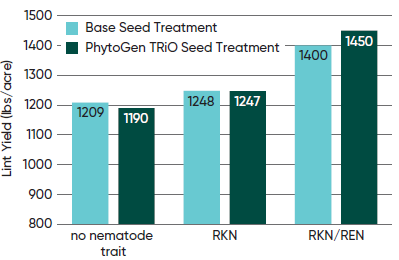
Figure 1. Average cotton yield (lbs/acre) over three years in two high reniform nematode locations as affected by seed treatment and resistance traits for root-knot (RKN) and reniform (REN) nematodes.
- End of season reniform nematode population levels averaged 30% lower in plots with REN + RKN trait varieties.
Experiment 2
- In the presence of moderate reniform nematode populations, REN + RKN traited cotton varieties yielded an average of 500 lbs/A more than cotton without a nematode trait (Figure 2).
- Cotton varieties with RKN traits outyielded cotton without a nematode trait by 100 lbs/A and 200 lbs/A; for single and dual gene RKN resistant varieties, respectively (Figure 2).
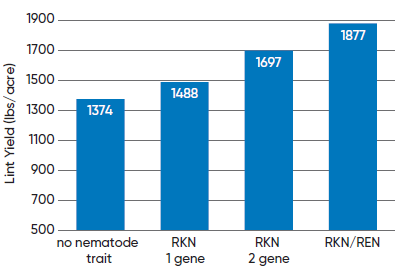
Figure 2. Average cotton yields (lbs/A) of varieties with different root-knot (RKN) and reniform (REN) nematode resistance traits.
- Reniform nematode populations increased by 500% over one year when cotton without nematode traits was planted (Figure 3).
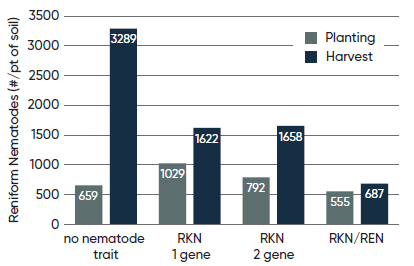
Figure 3. Average reniform nematode population levels (number/pt of soil) at planting and harvest of cotton varieties with different root-knot (RKN) and reniform (REN) nematode resistance traits.
- Yields of soybean following cotton varieties with RKN traits (single or dual gene) increased by an average of 4 bu/A across varieties (Figure 4).
- Yields of soybean following cotton varieties with REN + RKN traits increased by an average of 8 bu/A across varieties (Figure 4).
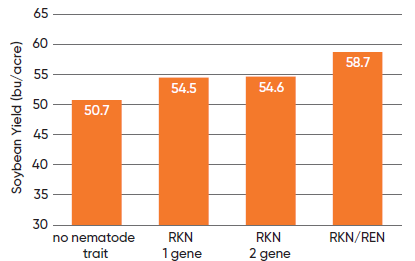
Figure 4. Average yield of eight soybean varieties planted following cotton with different root-knot (RKN) and reniform (REN) nematode resistance traits.
- The highest yield for each of the eight soybean varieties was achieved when planted following REN + RKN traited cotton.
- The two soybean varieties with root-knot nematode resistance did not have a yield advantage over non-RKN varieties in reniform nematode infested fields.
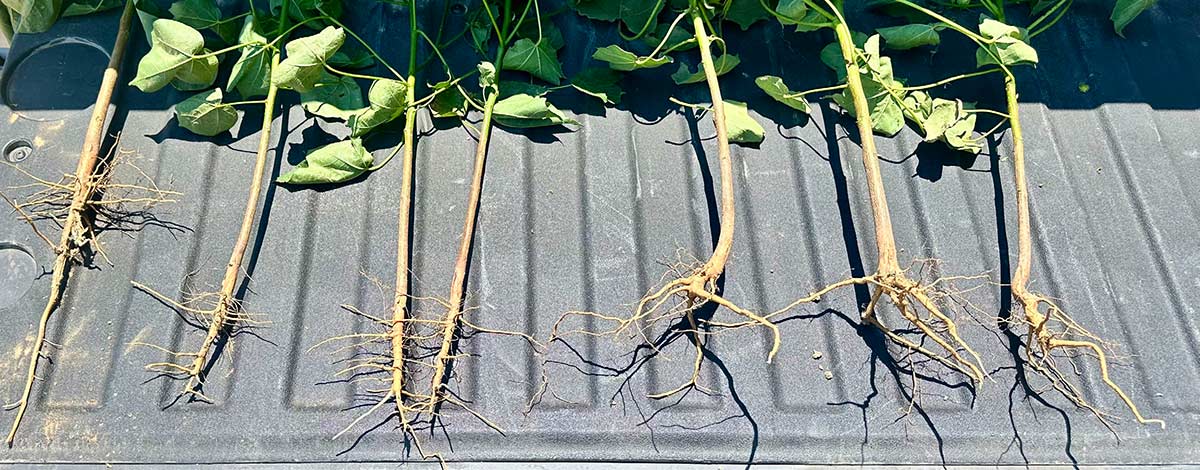
Figure 5. Roots of cotton plants exposed to reniform nematode. Plants on the left are a variety with reniform nematode resistance and plants on the right are a variety without reniform nematode resistance.
Conclusions
- Reniform nematodes are an often-overlooked pest that can negatively impact yield in both cotton and soybeans.
- One reason reniform nematode populations can devastate cotton and soybean yields is because populations can increase dramatically in one season.
- In these trials, reniform nematode populations increased fivefold in one season with a non-resistant cotton variety.
- RKN-only varieties provided limited benefit against reniform nematode, and population levels were still able to double over the season.
- The only cotton variety that successfully managed reniform nematode populations was the PhytoGen brand variety with REN + RKN resistance.
- The yield benefits of planting a REN + RKN cotton variety carried over into soybeans planted the following season, demonstrating that successful management of reniform and root-knot nematodes in a cotton-soybean rotation begins with planting resistant cotton varieties.
TRiO Seed Treatment is an on-seed application, provided by Corteva Agriscience, of separately registered products provided by Syngenta Group Company, Albaugh, LLC and Corteva Agriscience. TRiO Seed Treatment is an on-seed application of separately registered products: Apron XL®, Maxim® 4FS, Rally® 40WSP, Resonate™ 600 ST, Vibrance® CST, BioST™ Insecticide 100 and BioST™ Nematicide 100. ®Apron XL, Maxim and Vibrance are registered trademarks of a Syngenta Group Company. ™ Resonate and BioST are trademarks of Albaugh, LLC. Always follow IRM, grain marketing and all other stewardship practices and pesticide label directions.
The foregoing is provided for informational use only. Please contact your Pioneer sales professional for information and suggestions specific to your operation. Product performance is variable and depends on many factors such as moisture and heat stress, soil type, management practices and environmental stress as well as disease and pest pressures. Individual results may vary. Pioneer® brand products are provided subject to the terms and conditions of purchase which are part of the labeling and purchase documents.