
Country Selector
Please enter a valid location
The Future of Wheat is in Hybrid Genetics
Crop Insights
From Corteva™ Agriscience — Daniel Wiersma, Wheat Global Product Manager
Key Points
- Wheat is a globally important crop that needs innovative technology to advance yield potential in the future.
- Hybrid wheat systems have been explored since the 1960s but have struggled to achieve scalability in commercial production.
- Corteva Agriscience has developed a novel wheat hybridizing system aiming to bring hybrid wheat to market by the end of the decade — marking a significant innovation milestone.
- Hybrid technology is expected to deliver an initial genetic gain of 10% or more, outperforming leading wheat varieties in the market today.
- Leveraging Corteva’s deep expertise in hybrid genetics, wheat breeders are poised to accelerate its genetic rate of gain in the years ahead.
- Worldwide Importance of Wheat
- Wheat Innovation is Needed
- Wheat Breeding and Hybridization
- Expected Benefits of Hybrid Wheat
- The Promise of Hybrid Wheat
- References
Worldwide Importance of Wheat
Wheat (Triticum aestivum L.) is among the most important global crops. It is planted on more than 600 million acres and produces more than 800 million metric tons of grain annually. Figure 1 shows relative production in various regions and countries of the world. The highest-yielding areas of the world include Western Europe and parts of North America.
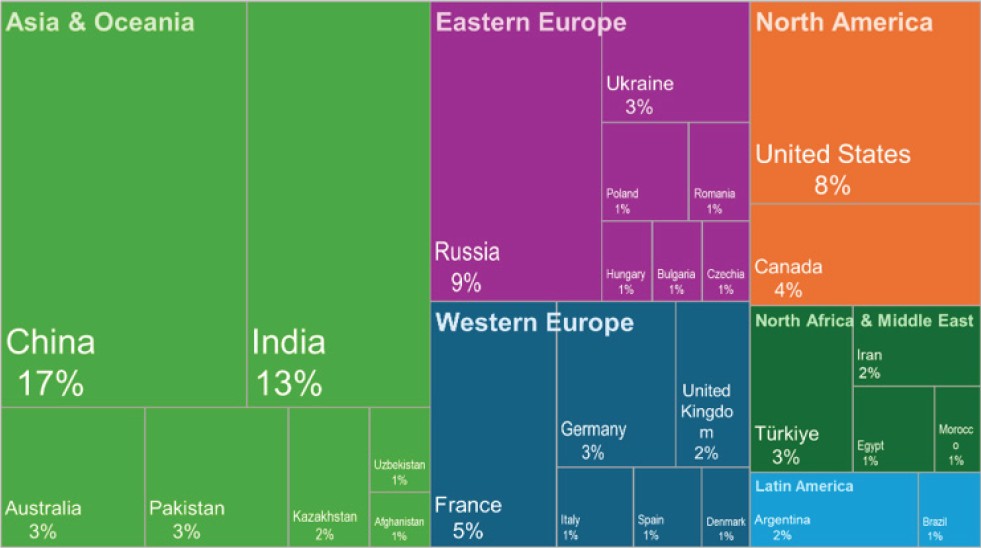
Figure 1. Global wheat production (% of total production) by region and country (FAOSTAT, 2025).
20% of Protein and Calories are provided by wheat globally. Second-most traded grain commodity in the world, second to corn, accounting for ⅓ of total grain trade. North America grows about ⅛ of global wheat production. |  |
The highest-yielding areas of the world include Western Europe and parts of North America.
Wheat is used primarily for human consumption, providing high nutritional value including carbohydrates (calories) and proteins along with important minerals and vitamins. Wheat grain provides approximately 20% of the protein and calories in our global diet (Erenstein et al., 2022).
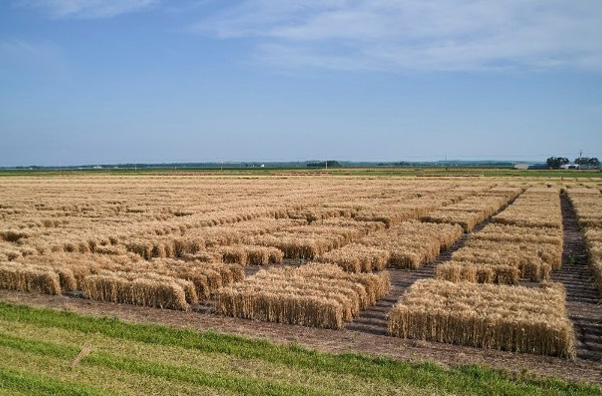
Wheat is a key crop for food security in many parts of the world and grain movement around the world through exports and imports is high, accounting for around one-third of global grain trade.
Wheat Innovation is Needed
Wheat breeders across both public and private sectors have been developing improved varieties since the early 1900s. Thanks to genetic gains and better agronomic practices, global wheat grain production more than doubled between the 1960s and 2010 (FAOSTAT, 2025). However, recent research by Boehm et al. (2022) found that grain yield for hard red winter (HRW) wheat varieties adapted to the Northern Great Plains has stagnated since about 2008.
| Recent research found that yield of hard red winter wheat varieties adapted to the Northern Great Plains has stagnated since about 2008. |
In 2024, Corteva scientists initiated a study designed to measure the rate of genetic yield gain for HRW wheat. The study analyzed 44 HRW varieties released since the early 1900s, grown across nine locations in Kansas. Results showed a modest yield improvement of just 2.2 bu/A per decade (Figure 2).
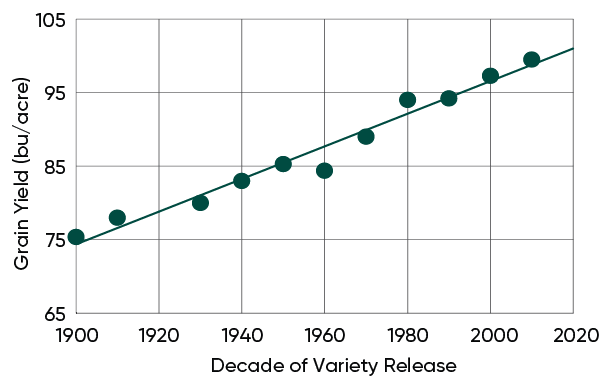
Figure 2. Average grain yield of HRW wheat varieties by decade of variety release. 2025 harvest of 44 varieties at nine research locations in Kansas.
This is lower than the 3 bu/A per decade yield gains estimated from USDA yield data for Kansas farmers, which reflect productivity gains achieved through improved genetics and crop management practices.
These findings highlight the need for new innovations in wheat to enhance yield potential and yield stability — especially as global demand continues to rise.
Hybrid Breeding – A Promising Path for Wheat
Hybrid breeding has been a powerful driver of yield improvements in major crops like rice (Oryza sativa L.) and corn (Zea mays L.). As a prime example, the Pioneer Hi-Bred Company (now a part of Corteva Agriscience) increased corn yield potential by 600% over the past 100 years through continuous genetic advancements.
Studies of experimental wheat hybrids in Europe and the United States suggest that yield increases of 10-25% and an improvement in yield stability are achievable. With today’s advanced genetic tools and access to a broad germplasm base, even greater improvements are within reach.
Despite these promising benefits, hybrid wheat has faced challenges. The complexity of cross-pollination and the relative costs and scalability of hybrid seed production have slowed progress. While producing hybrid wheat at scale is a major technological challenge, it’s a critical step toward sustainably increasing global food production for a growing population and a changing climate.
Wheat Breeding and Hybridization
The primary goal of hybrid plant breeding is to combine the strengths of two different parents to create plants with superior traits. This improvement in yield and other characteristics is known as heterosis or hybrid vigor.
How Does Hybridization Work in Wheat?
Wheat plants are naturally self-pollinating. Each flower contains both male (anthers) and female (pistil) parts. When heading begins, pollen is released from the anthers and fertilizes the pistil of the same plant.
Important Terms
Heterosis — also called hybrid vigor, it is the effect of having superior performance/characteristics from a cross between two different parent lines as compared to the performance of each individual parent.
Genetic gain — a measure of year-to-year improvement of newly developed varieties for grain yield and other traits of interest.
Male sterile — plants producing ineffective pollen or no pollen and used in breeding for making hybrid seeds.
Aleurone — the outermost layer of cells found in the endosperm of wheat providing crucial physiological function and contributes to the grain’s nutritional profile, including antioxidants.
To create new varieties, breeders manually cross-pollinate wheat by physically removing the anthers from a flower (a process called emasculation) and applying the pollen from another plant. While effective on a small scale, the method isn’t practical for large-scale hybrid wheat production.
| To produce hybrid wheat on a commercial scale, breeders must prevent self-pollination and encourage outcrossing between two inbred parents. |
To produce hybrid wheat on a commercial scale, breeders must prevent self-pollination and encourage outcrossing between two inbred parents. This requires a system that disables the plant’s natural ability to self-fertilize.
Beginning in the 1960s, several methods were explored to achieve this, focusing on making sterility systems where plants do not produce viable pollen. A recent review by Revell et al. (2025) outlines three primary approaches for reliable and scalable pollination control in wheat.
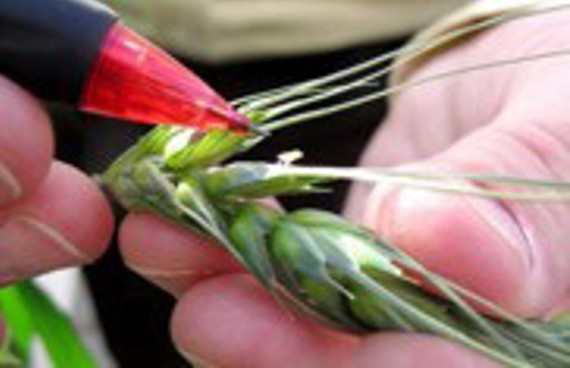
- Cytoplasmic Male Sterility (CMS) involves altering the plant’s mitochondrial (cytoplasm) DNA, so it doesn’t produce pollen. This is the most widely use system used by wheat breeders today. However, it has some drawbacks:
- It requires a third parent to restore fertility, making it a 3-line system.
- It works only with a limited range of wheat germplasm.
- It results in low seed set in hybrid seed production fields.
- Chemical Hybridizing Agents (CHA) are a class of chemicals that cause male sterility when applied to wheat. They have been used on a limited basis because of the narrow window for the CHA chemical application and instability due to environmental conditions.
- Nuclear Male Sterility (NMS) is a newer male sterility system developed by scientists at Corteva Agriscience. Using the Male Sterile 45 (MS45) gene, this method relies on genetic changes in the plant’s nucleus to induce male sterility (Singh et al., 2018, Rhode et al., 2025).
Corteva’s novel MS45 seed production technology system offers several advantages for producing hybrid wheat:
- No need for fertility restoration: Unlike other systems, it uses normal male plants and doesn’t require genetic manipulation to restore fertility in the female line.
- Easy maintenance of female lines: The female “maintainer” lines reproduce through self-pollination.
- Color-based seed sorting: The MS45 gene of the maintainer line is tightly linked to a gene for blue aleurone expression (seeds with a blue hue). This allows seeds to be sorted by color to isolate red male-sterile seeds from blue maintainer seeds. The red male-sterile seeds are then planted together with male pollen-producing seed to grow F1 hybrid seed.
- Proven performance: Corteva’s hybrid wheat system consistently delivers strong hybrid vigor and stable performance across all tested environments.
- Non-GMO approach: All breeding is done using conventional methods — no genetic modification (GMO) or gene-editing is involved.
Hybrid Wheat System Deployment
To successfully produce and deploy hybrid wheat, three key elements must be in place:
- First, breeders need a reliable pollination control system, allowing them to cross two inbred parent lines effectively.
- Second, germplasm resources must be developed to take full advantage of hybrid vigor — boosting yield and other agronomic or disease traits.
- Third, the seed production process must be scalable to cover millions of acres and remain cost-effective for both farmers and seed companies investing in the technology (Figure 3).
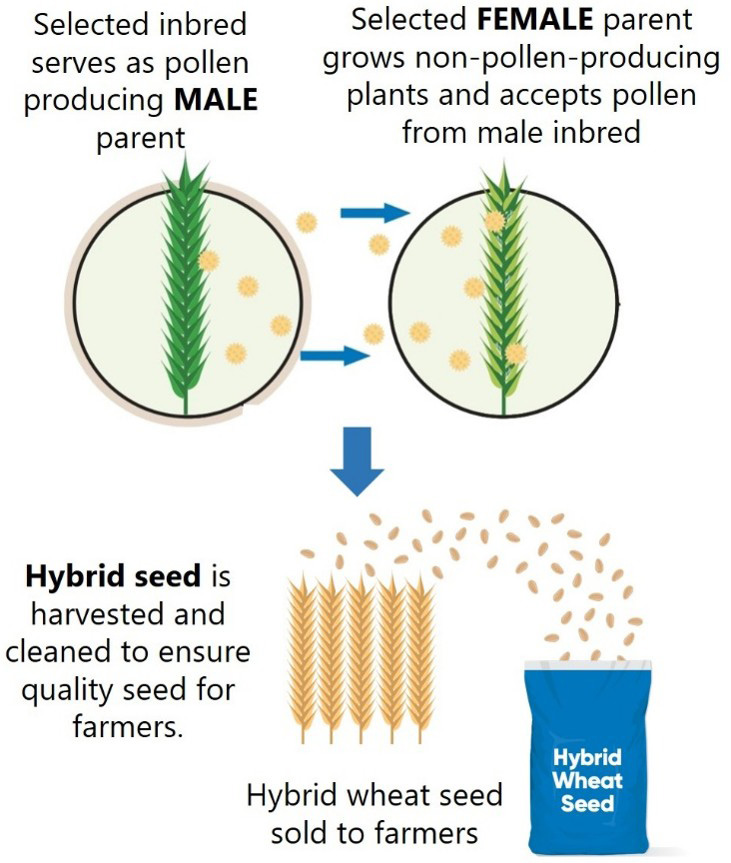
Figure 3. System for the hybrid wheat seed production stage where fertile male and non-pollen producing female seeds are planted in the same field to create hybrid offspring.
| The biggest factor influencing the economics of hybrid wheat is the cost of producing hybrid seed. |
The biggest factor influencing the economics of hybrid wheat is the cost of producing hybrid seed. A key part of this process is timing — known as “nicking” — which ensures that the female plant is ready to receive pollen when the male is shedding it. Ideally, the female parent flowers two to five days earlier than the male parent (Schmidt et al., 2024), and the male plant should be taller to help pollen better reach the female flowers.
New Enabling Tools for Wheat Breeding
For centuries, wheat has fed civilizations, yet its genetic complexity remained a stubborn frontier. With its hexaploid genome — six sets of chromosomes tangled in a labyrinth of genetic code — wheat posed a genetic challenge that defied easy analysis and use.
That changed in 2018 with the completion and publication of the wheat genome (Appels et al., 2018), a landmark achievement in agricultural science. With a new roadmap of where genes are located, scientists at Corteva were able to engineer a novel sterility system for producing hybrid wheat.
| The use of genomic prediction tools allows breeders to unravel the complexity of selecting for multiple traits. |
But the genome did more than enable hybridization of wheat. It helped transform breeding itself. Marker-assisted selection became more targeted, more precise and more intentional. Breeders could now target specific genes to improve disease resistance, drought tolerance and other favorable traits for wheat.
The use of genomic prediction tools, integrating large datasets and predictive models, allows breeders to unravel the complexity of selecting for multiple traits. What was once a slow, intuitive process became a data-driven sprint — accelerating Corteva’s wheat breeding progress.
Expected Benefits of Hybrid Wheat
Higher yields: Early generation hybrids have 10% or greater yield potential compared to elite commercial varieties in moderate to high yield environments (Figure 4).
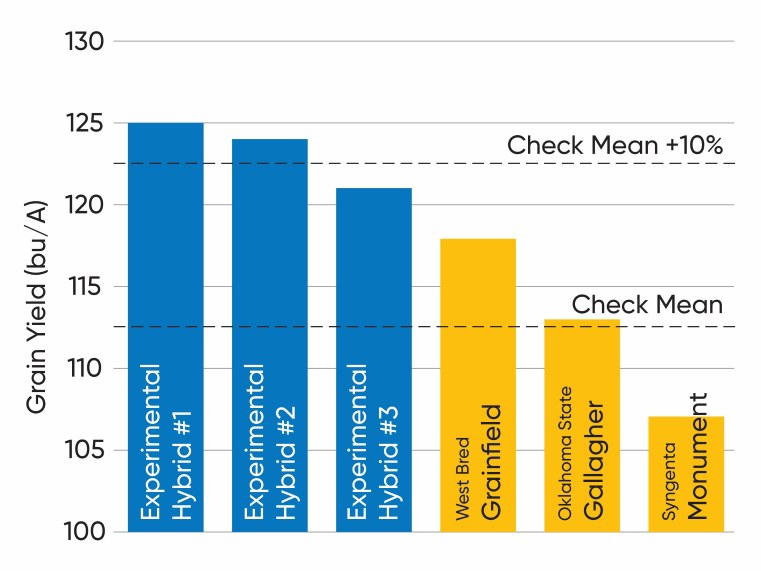
Figure 4. Yield comparison of experimental hybrid HRW wheat lines and elite commercial varieties planted in 2024 and harvested in 2025 at multiple Kansas research locations.
Under water-limited stress, the advantage of hybrids over leading varietal wheat products is 20% or greater (Figure 5).
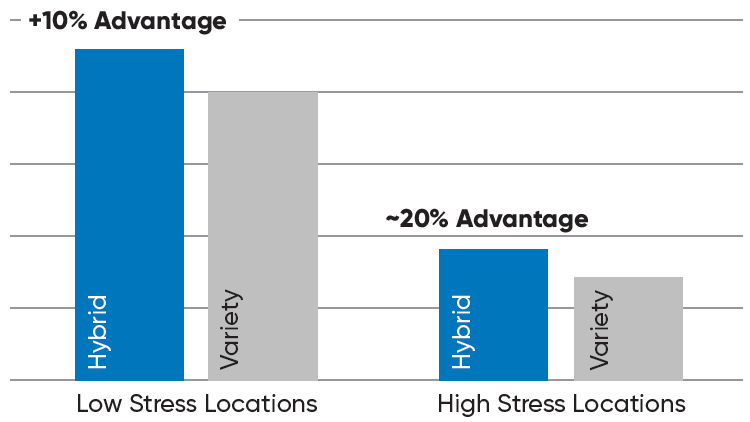
Figure 5. Comparison of hybrid performance versus leading commercial check varieties of HRW wheat in low-stress and high-stress (water-limited) environments.
Corteva Agriscience yield trial testing; two years of testing with siz to ten locations/year in each of the market classes. HRW testing in NE, KS, CO, OK.
Improved stability: Hybrids offer more consistent performance across diverse growing conditions, reducing risk potential for farmers.
Enhanced disease resistance: Combining disease resistance genes from both parent inbred lines accelerates protection against key diseases.
Sustainability: Hybrids can deliver higher yield potential using the same inputs as varietal wheat, making them a more sustainable option.
Better input response: Hybrids may offer greater potential to respond to water, fertilizer or other crop inputs.
Market acceptance: For widespread adoption, hybrids must meet expectations for high grain yield, disease resistance and lodging while meeting industry standards for grain quality.
The Promise of Hybrid Wheat
| Hybrid technology, paired with cutting edge genetic tools, is reshaping how we select for the traits that matter most. |
In the unfolding story of agricultural innovation, hybrid wheat marks a pivotal chapter. With its introduction, wheat producers are on the brink of a transformation. Hybrid technology, paired with cutting edge genetic tools, is reshaping how we select for the traits that matter most — yield, agronomics, quality and resilience. These tools don’t just improve precision, but they help accelerate the pace of progress. (Figure 6).
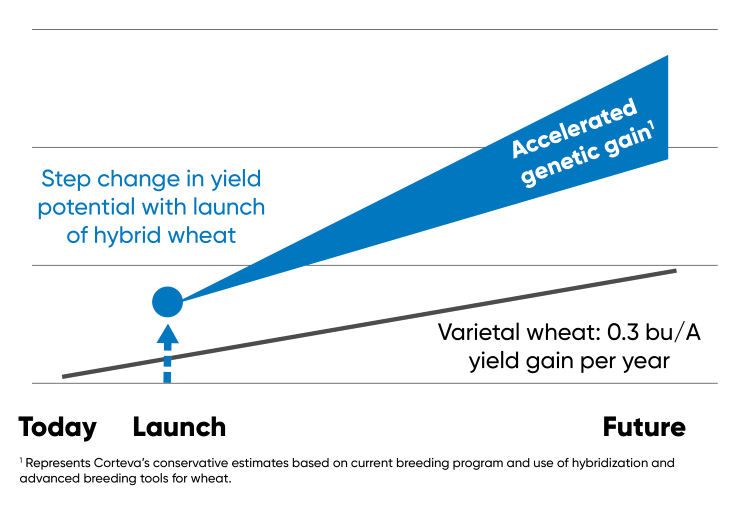
¹Represents Corteva’s conservative estimates based on current breeding program and use of hybridization and advanced breeding tools for wheat.
Figure 6. Change in yield potential with hybrid wheat.
Corteva’s first generation of hybrid wheat will debut in the HRW wheat class, followed by Soft Red Winter (SRW) and Hard Red Spring (HRS) wheat classes by the end of the decade. But the real story lies in the pipeline — where breeders are already refining the characteristics of male and female lines to enhance pollination success and unlock even greater yield potential. It’s a quiet revolution, rooted in biology, driven by data and poised to reshape the future of wheat.
References
- Appels, R. et. al. 2018. Shifting the limits in wheat research and breeding using a fully annotated reference genome. International Wheat Genome Sequencing Consortium. Science 316:6403.
- Boehm Jr., J.D., S. Masterson, N. Palmer, X. Cai, and F. Miguez. 2023. Genetic improvement of winter wheat (Triticum aestivum L.) grain yield in the Northern Great Plains of North America, 1959–2021. Crop Sci. 63:3236-3249.
- Erenstein, O., M. Jaleta, K.A. Mottaleb, K. Sonder, J. Donovan, and H.-J. Braun. 2022. Global Trends in Wheat Production, Consumption and Trade. In: Reynolds, M.P., Braun, HJ. (eds) Wheat Improvement. Springer, Cham.
- FAOSTAT. Food and Agriculture Organization of the United Nations. Statistics Division. Rome, Italy.
- Revell, I., P. Zhang, C. Dong, W.T. Salter, and R. Trethowan. 2025. Heterosis in wheat: Mechanisms, benefits, and challenges in hybrid development. J. of Exp. Bot. eraf159.
- Rohde, A., M.C. Albertsen, S.A. Boden, P. Bansept-Basler, P.H.G. Boeven, C. Cavanagh, L.E. Dixon, C. Frohberg, L. Griffe, J. Lage, L. Maeder, M. Millán-Blánquez, P.D. Olson, L. Röhrig, T. Schnurbusch, C. Uauy, and R. Whitford. 2025. New genomic resources to boost research in reproductive biology to enable cost-effective hybrid seed production. The Plant Genome, 18:e70092.
- Singh, M., M. Kumar, M.C. Albertsen, J.K. Young, and A.M. Cigan. 2018. Concurrent modifications in the three homeologs of Ms45gene with CRISPR-Cas9 lead to rapid generation of male sterile bread wheat (Triticum aestivum L.). Plant Molecular Biology 97:371–383.
The foregoing is provided for informational use only. Contact your Pioneer sales professional for information and suggestions specific to your operation. Product performance is variable and subject to any number of environmental, disease, and pest pressures. Individual results may vary. Pioneer® brand products are provided subject to the terms and conditions of purchase which are part of the labeling and purchase documents.