
Country Selector
Please enter a valid location
High Humidity Can Disrupt Pollen Shed in Corn

Crop Focus
Written by Mark Jeschke, Ph.D., Pioneer Agronomy Manager
Key Findings
- Anthers on the tassels of corn plants need to be dry in order to release pollen.
- Peak pollen shed typically occurs mid-morning when rising temperatures cause the relative humidity to drop and the dew on the plant evaporates.
- On days when cool, wet conditions or high humidity prevent the anthers from drying out, pollen shed may be delayed until later in the day or may not occur at all.
- Pollination Period in Corn
- What Factors Can Disrupt Pollination?
- Video: Determining Successful Corn Pollination
- Mechanism of Pollen Shed
- Pollen Shed Occurs on a Diurnal Cycle
- Effect of Ambient Conditions on Dehiscence
- High Humidity Effects on Pollination
Pollination Period in Corn
- Pollen shed across a field of corn typically lasts 10 to 14 days, with around a 4-day period when pollen shed is at its peak.
- Pollen shed from an individual plant occurs over a shorter period – typically not more than 7 days.
- Peak pollen shed from an individual plant typically occurs on the second and third day and then tapers off after that.
- Not all plants begin shedding pollen at the exact same time, which is why the total pollination period lasts longer than that of individual plants.
- Plant-to-plant variability in the timing of peak pollen shed, along with the sheer volume of pollen produced (estimates range from 2 to 25 million grains per plant), provide a margin of safety for achieving complete pollination.
- Even if unfavorable conditions disrupt pollination for a few days, there is still usually enough time and pollen available to complete pollination without issue.
- However, when unfavorable conditions persist for more than a few days, it is possible that incomplete pollination can result.
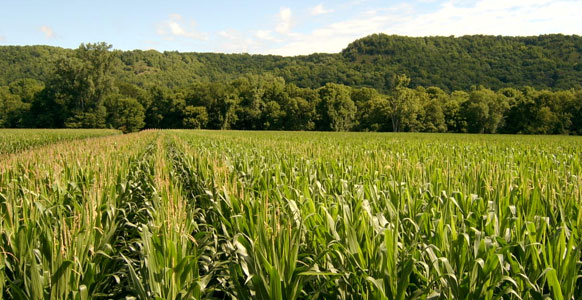
Figure 1. Corn plants across a field do not all reach pollination at exactly the same time, so the pollination period for the field is longer than that of an individual plant.
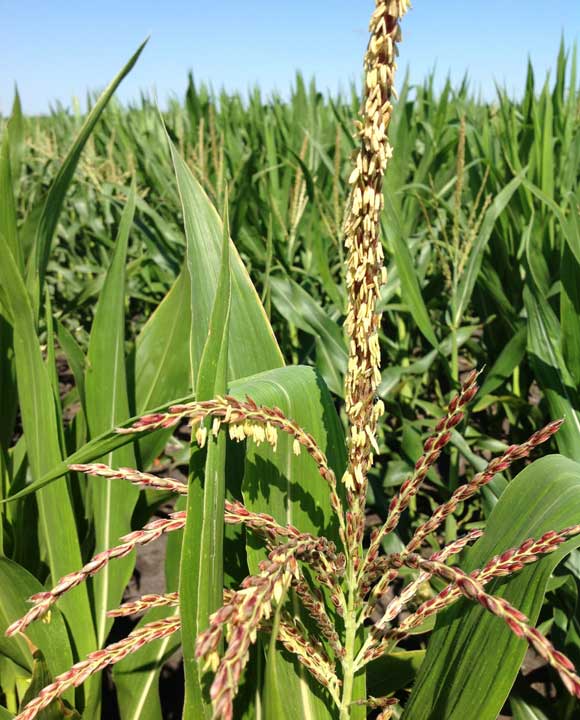
Figure 2. Each tassel has around 1,000 individual spikelets and each one contains two florets encased in two large glumes. Each floret contains three anthers. Pollen shed begins in the middle of the central tassel spike and then progresses outward from there (Nielsen, 2018).
What Factors Can Disrupt Pollination?
- Incomplete pollination can result from issues on the receiving end; i.e., there is plenty of pollen released but the silks are unable to receive it.
- Heavy feeding on silks by insects such as corn rootworm beetles or Japanese beetles is one factor that can prevent the silks from receiving pollen.
- Extreme drought stress during silking can delay silk emergence until after peak pollen shed, referred to as “missing the nick.”
- However, problems can also occur on the sending end that prevents viable pollen from reaching receptive silks.
- Extreme heat during pollen shed can desiccate pollen grains before they reach silks.
- Prolonged wet and humid conditions can also cause problems. Anthers on the tassel need to be dry to release pollen. If they cannot dry out, pollen shed can not occur.
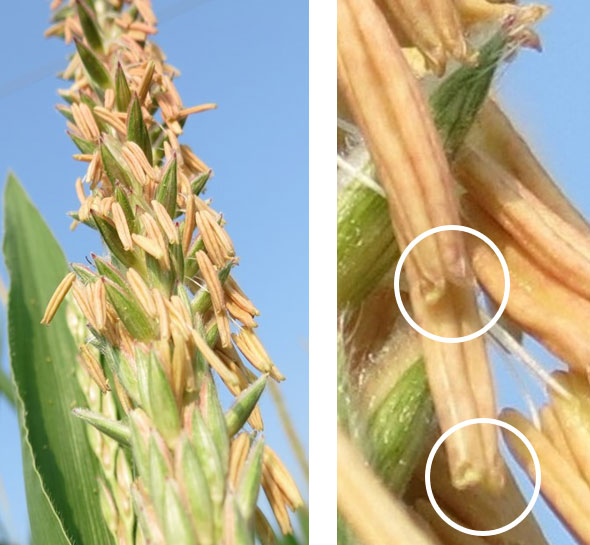
Figure 3. Close-up view of anthers on a corn tassel showing the outward bend at the tips of the locules, creating an opening for pollen to escape.
Video: Determining Successful Corn Pollination
Mechanism of Pollen Shed
- Pollen release from anthers requires two events. First, pollen grains mature inside anthers. Secondly, pores of anthers open to release pollen, a process called dehiscence.
- The opening of the anthers and subsequent pollen release is initiated by the desiccation of the anther tips (Aylor et al., 2003).
- Each anther is comprised of four pieces called locules that are held together by a thin membrane of tissue called the septum.
- Shortly before dehiscence, the four locules will fuse together in pairs forming two locules.
- As the tips of the two locules dry, they bend outward creating a pore through which pollen is released (Figure 3).
- Evaporation of water from the anther as well as active retraction of water by the plant may both play a role in anther desiccation and pollen shed (Bonner and Dickinson, 1990; Heslop-Harrison et al., 1987).
- This process is reversible – if the anther is rewetted, the locules will unbend and the pore will close – and if ambient conditions such as high humidity or rain prevent the anther from drying out, it will not open at all.
- Under wet and windy conditions, anthers may fall to the ground without ever opening to release their pollen.
Some Important Terms
Anther: In flowering plants, the part of a stamen that produces and contains pollen.
Exsertion: The pushing out of the anthers from inside the florets.
Dehiscence: The splitting of a mature plant structure along a built-in line of weakness to release its contents; in this case, the anther and pollen.
Diurnal: A process that cycles over a 24-hour day.nthers on the tassels of corn plants need to be dry in order to release pollen.
Pollen Shed Occurs on a Diurnal Cycle
- The dependence of pollen shed on anther desiccation means that it tends to follow a diurnal cycle, with peak pollen shed occurring in the morning when rising temperatures and falling humidity dry the dew off the plant.
- The exact timing of peak pollen shed can vary from day to day depending on weather conditions.
- A Corteva Agriscience field study that tracked pollen shed in a corn field over a period of four days in 2021 found that pollen shed peaked before 10:00 a.m. on two of the days and after 10:00 on the other two days, and that the timing roughly corresponded with the time at which the morning dew was completely evaporated (Strachan, 2022).
- In some cases, pollen shed has been shown to have a bimodal pattern with a large peak mid-morning, followed by a lull, then a subsequent smaller peak 2-3 hours later (van Hout et al., 2008).
- In cases where a second peak is observed, it appears to be associated with an increase in wind turbulence.
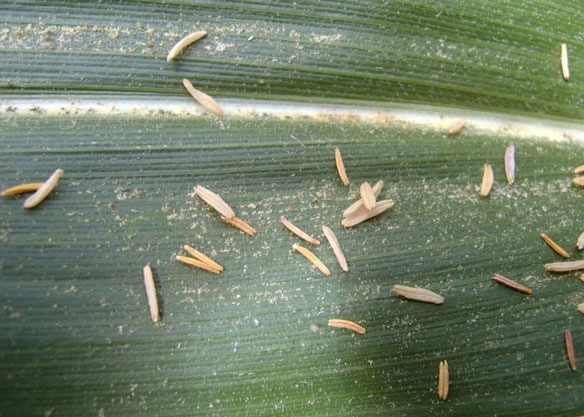
Figure 4. Corn anthers and pollen grains on a leaf. Anthers drop off of the tassel once their pollen has been released.
Effect of Ambient Conditions on Dehiscence
- Although it is well understood that drying out of the anthers is necessary for pollen shed, the effect of ambient conditions on this process is complex and can involve multiple factors.
- Consequently, it has been difficult to pin down exact temperature or relative humidity thresholds necessary for pollen shed to occur.
- One field study conducted to address this question found that the initial morning release of pollen was related to a decrease in relative humidity that raised vapor pressure deficit (VPD) values to 0.2-0.5 kPa around the anthers (Jarosz et al., 2005). (At an air temperature of 65°F, a VPD range of 0.2-0.5 kPa would correspond to a relative humidity range of 75-90%.)
- Wind can affect the rate of anther drying and the physical movement it creates helps disperse pollen.
- Direct solar radiation also appears to play a role in drying of the anthers and pollen release (van Hout et al., 2008).
- Cool, cloudy, and high humidity conditions can lead to a temporary pause in pollen shed (Jackson and Lyford, 1999).
High Humidity Effects on Pollination
- High humidity conditions can suspend pollen shed in corn, but what is the risk that an extended period of high humidity could have a serious impact on pollination?
- Corn has evolved characteristics to ensure complete pollination in most circumstances – plants produce way more pollen than is needed to pollinate the ears and the pollen is not all released at the same time – so there is some margin of safety even if conditions prevent pollen shed for a day or two.
- It is possible that an extended period of wet and humid conditions could disrupt pollen shed over a longer duration, but such a period would be unusual during the summer.
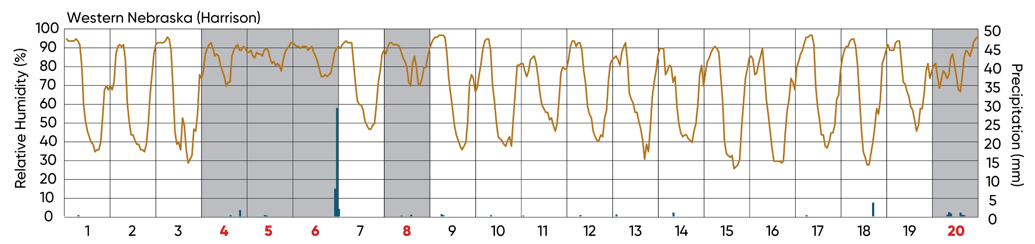
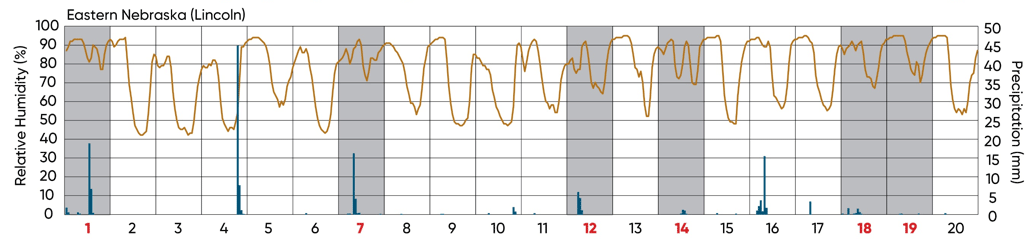
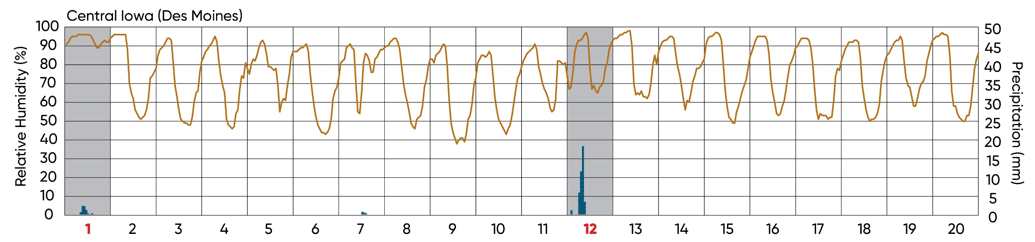
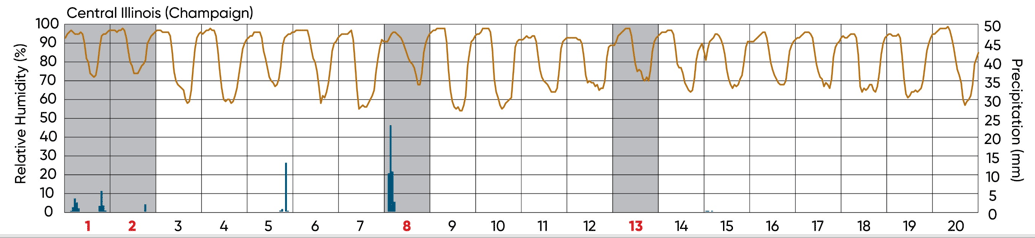
- Figure 5 shows hourly precipitation and relative humidity data for four Corn Belt locations from July 1 to 20 in 2023.
- Precise thresholds for pollen shed are difficult to ascertain because of the multiple factors involved (only two of which are considered here) but the charts below provide a look at humidity and precipitation over a 20-day period and days when these factors could have potentially reduced pollen shed.
Figure 5. Hourly relative humidity and precipitation for four locations from July 1 to July 20, 2023. Days shaded in gray or those where pollen shed could potentially have been reduced by rainy conditions or high humidity (>70%). Data from NOAA NCEI U.S. Climate Reference Network monitoring stations.

Aylor, D.E., N.P. Schultes, and E.J. Shields. 2003. An aerobiological framework for assessing cross-pollination in maize. Agric. For. Meteorol. 119:111-129. Bonner, L.J. and H.G. Dickinson. 1990. Anther dehiscence in Lycopersicon esculentum. II. Water relations. New Phytol. 115:367-375. Heslop-Harrison, J.S., Y. Heslop-Harrison, and B.J. Reger. 1987. Anther filament extension in Lilium: potassium ion movement and some anatomical features. Ann. Bot-London 59:505-515. Jackson, S.T., and M.E. Lyford. 1999. Pollen dispersal models in quaternary plant ecology: assumptions, parameters and prescriptions. Bot. Rev. 65:39-75. Jarosz, N., B. Loubet, B. Durand, X. Foueillassar, and L. Huber. 2005. Variations in maize pollen emission and deposition in relation to microclimate. Environ. Sci. Technol. 39:4377-4384. Nielsen, R. 2018. Tassel Emergence & Pollen Shed. Purdue University Extension Entomology, Pest & Crop Newsletter. Strachan, S. 2022. Timing of pollen shed in corn. Pioneer Agronomy Research Update. Vol. 12, No. 11. Corteva Agriscience. Johnston, IA. van Hout, R., M. Chamecki, G. Brush, J. Katz, and M.B. Parlange. 2008. The influence of local meteorological conditions on the circadian rhythm of corn (Zea mays L.) pollen emission. Agric. For. Meteorol. 148:1078-1092.
The foregoing is provided for informational use only. Please contact your Pioneer sales professional for information and suggestions specific to your operation. Product performance is variable and depends on many factors such as moisture and heat stress, soil type, management practices and environmental stress as well as disease and pest pressures. Individual results may vary. Pioneer® brand products are provided subject to the terms and conditions of purchase which are part of the labeling and purchase documents.