
Country Selector
Please enter a valid location
Integrated Management of Red Crown Rot in Soybean

Agronomy Research Update
Written by Carl Bradley, Ph.D., University of Kentucky
Research conducted by Dr. Carl Bradley, University of Kentucky, as a part of the Pioneer Crop Management Research Awards (CMRA) Program. This program provides funds for agronomic and precision farming studies by university and USDA cooperators throughout North America. The awards extend for up to four years and address crop management information needs of Pioneer agronomists, sales professionals and customers.
Key Findings
- Red crown rot caused significant reductions in soybean yield at one of the two research locations.
- Red crown rot symptoms developed quickly after the R3 growth stage and increased in both severity and incidence through the R6.5 stage.
- Results showed that an integrated approach of variety selection and fungicide seed treatment or in-furrow treatment is the best strategy for protection of soybeans against red crown rot.
- Background and Objectives
- Study Description
- Results
- Summary and Conclusions
- References
Background and Objectives
- Red crown rot (RCR) is a fungal disease of soybeans caused by the soil-borne pathogen Calonectria ilicicola (anamorph: Cylindrocladium parasiticum) that causes deterioration of the root and stem (Figure 1).
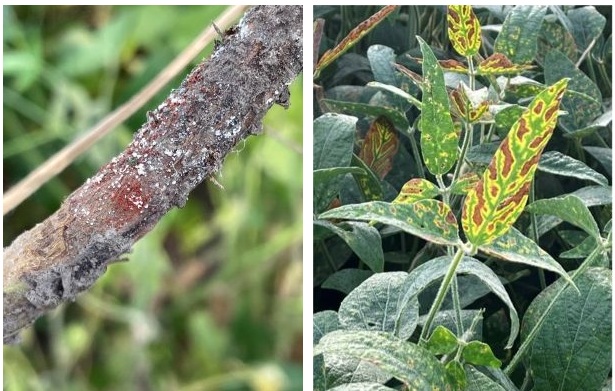
Figure 1. The key distinguishing characteristic of red crown rot is the presence of perithecia on the crown and roots just below the soil line. Foliar symptoms can be very similar to those of other common soybean disease such as sudden death syndrome.
- Red crown rot is a relatively new disease of soybeans in the Midwestern U.S., having first been detected in Pike County, Illinois in 2017 (Kleczewski, 2020). In the years since its initial detection, red crown rot has spread through central Illinois and into Kentucky (Bradley, 2021).
- Management options for red crown rot are limited, and no rescue treatments are available to mitigate plant damage and yield impact once infection has been detected.
- A two-year field study was initiated in 2025 to evaluate the effectiveness of soybean genetic tolerance, fungicide seed treatments and in-furrow fungicide application in reducing red crown rot severity and protecting soybean yield.
- This field study was conducted by Dr. Carl Bradley of the University of Kentucky and supported by the Pioneer Crop Management Research Awards (CMRA) Program.
Study Description
Research Locations
- Graves County, KY
- Jackson, KY (RCARS)
Graves County — Management and RCR Pressure
- Previous Crop: corn / winter canola
- Seeding Rate: 135,000 seeds per acre
- Row Spacing: 30 inches
- Plot Size: 4 rows x 15 ft
- Red Crown Rot Inoculation: none, natural RCR infestation
Jackson — Management and RCR Pressure
- Previous Crop: soybean
- Seeding Rate: 135,000 seeds per acre
- Row Spacing: 30 inches
- Plot Size: 4 rows x 13 ft
- Red Crown Rot Inoculation: Inoculated with Calonectria ilicicola grown on sterilized sorghum seeds at planting (50 g inoculum per row per plot)
Graves County — Management and RCR Pressure
- Previous Crop: corn / winter canola
- Seeding Rate: 135,000 seeds per acre
- Row Spacing: 30 inches
- Plot Size: 4 rows x 15 ft
- Red Crown Rot Inoculation: none, natural RCR infestation
Jackson – Management and RCR Pressure
- Previous Crop: soybean
- Seeding Rate: 135,000 seeds per acre
- Row Spacing: 30 inches
- Plot Size: 4 rows x 13 ft
- Red Crown Rot Inoculation: Inoculated with Calonectria ilicicola grown on sterilized sorghum seeds at planting (50 g inoculum per row per plot)
Experimental Design
- Randomized complete block, 4 replications per location
Experimental Factors
- Soybean RCR Genetic Tolerance
- Susceptible: RCR susceptible variety
- Tolerant: RCR tolerant variety
- Fungicide Treatment
- Base: standard fungicide seed treatment package
- ILEVO: Base + ILEVO® seed treatment
- Saltro: Base + Saltro® fungicide seed treatment
- Proline: Base + Proline® fungicide applied in-furrow (5 fl oz per acre)1
- ILEVO + Proline: Base + ILEVO® seed treatment + Proline® fungicide applied in-furrow (5 fl oz per acre)
Red Crown Rot Disease Assessments
- RCR Severity (0-9): Visual rating of symptom intensity on infected plants, where 0 = no symptoms and 9 = plant death
- RCR Incidence (%): Percentage of plants within a plot showing RCR symptoms
- RCR Severity Index (0-100): (Severity (0-9) x Incidence (%))/9
Data Collection
- RCR Severity and Incidence
- Jackson: R3 (Aug 11), R5 (Aug 28), R6 (Sept 10), R6.5 (Sept 18)
- Graves County: R6 (Sept 8)
- Soybean Yield: bu/A at harvest
Results
Site Characterization
- Red crown rot pressure and soybean yield levels differed considerably between the two field research locations in 2025 (year 1 of a 2-year study).
- The Jackson location, which was inoculated with red crown rot, had high disease pressure, as well as high yield levels (Table 1).
Table 1. Red crown rot disease pressure and soybean yield levels at the two field research locations in 2025.
Parameter Graves County Jackson Disease Pressure Moderate High Max RCR Severity Index 44.3 93.0 Yield Range 12–32 bu/A 26-62 bu/A - The Graves County location, which relied on natural red crown rot pressure, had moderate disease pressure, as well as much lower overall yield levels.
Disease Progression
- Red crown rot incidence (% of plants infected) and severity (severity of symptoms on infected plants) both contributed to disease pressure and differed significantly among treatments at both locations.
- Red crown rot symptoms developed quickly, following the R3 growth stage.
- At the Jackson location, where disease symptoms were assessed at multiple growth stages, no symptoms were observed in any treatment at R3 but were prevalent by R5 and increased in both severity and incidence through R6 and R6.5 (Figure 2).
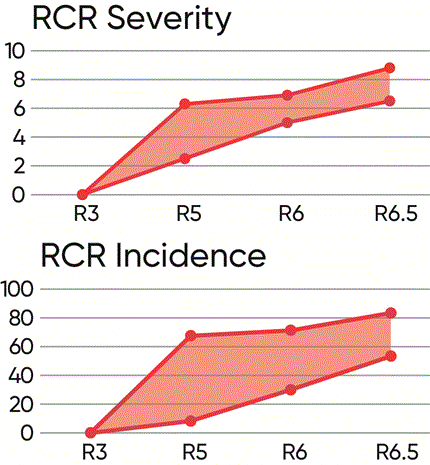
Figure 2. Range of RCR severity and incidence by growth stage at Jackson.
Graves County — RCR Severity and Soybean Yield
- Red crown rot disease severity index was significantly affected by integrated management program at the Graves County location, which had moderate disease pressure.
- The ILEVO + Proline treatment was the only fungicide treatment that significantly reduced RCR severity index on the susceptible variety compared to the base seed treatment (Figure 3A).
Graves County, KY - Moderate RCR Pressure
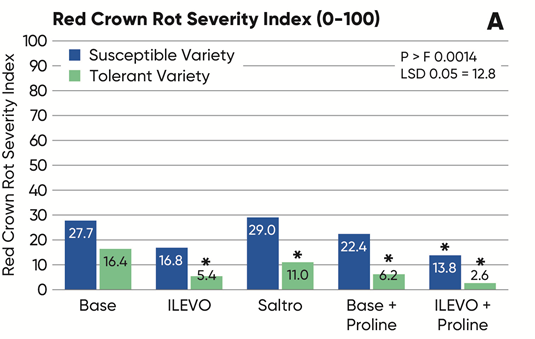
Figure 3A. Red crown rot severity index at the Graves County, KY, field research location. Asterisks indicate treatments that were significantly better (lower RCR severity or higher yield) than the susceptible variety with the base seed treatment.
- The combination of tolerant variety and fungicide treatments were successful in reducing RCR severity index — all fungicide treatments except for the base treatment reduced RCR severity index on the tolerant variety compared to the susceptible variety with the base treatment.
- Despite significant differences in RCR severity index, soybean yield did not significantly differ among RCR integrated management programs (Figure 3B).
Graves County, KY — Moderate RCR Pressure
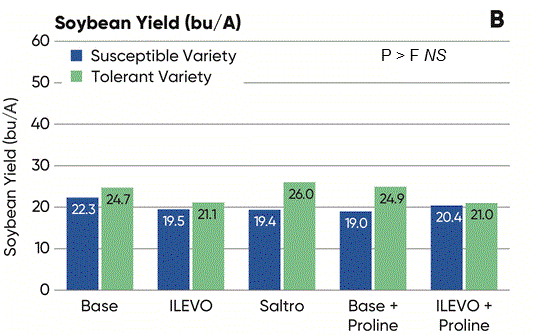
Figure 3B. Soybean yield under moderate red crown rot pressure at the Graves County, KY, field research locations.
Jackson — RCR Severity and Soybean Yield
- Red crown rot inoculation at the Jackson location was successful in producing high-disease pressure, with the susceptible variety with the base seed treatment having an average RCR severity index of 81.2, compared to 27.7 at the Graves County location (Figure 3C).
Jackson, KY — High RCR Pressure
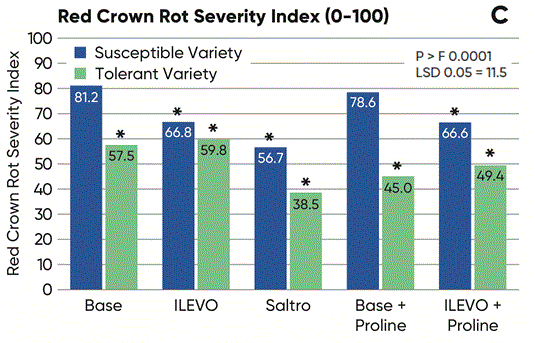
Figure 3C. Red crown rot severity index at the Jackson, KY, field research location. Asterisks indicate treatments that were significantly better (lower RCR severity or higher yield) than the susceptible variety with the base seed treatment.
- The Proline treatment was the only fungicide treatment that did not reduce RCR severity on the susceptible variety, with the ILEVO, Saltro and ILEVO + Proline treatments all having significantly lower RCR severity compared to the base seed treatment (Figure 3C).
- The tolerant variety had significantly lower RCR severity than the susceptible variety, even without any additional fungicide treatment (Figure 3C); however, this did not result in a significant yield improvement (Figure 3D).
- On the susceptible variety, the Saltro treatment and the ILEVO + Proline treatment both had significantly greater yield compared to the base seed treatment (Figure 3D).
- The combination of tolerant variety and the Saltro, Proline and ILEVO+Proline treatments significantly increased yield compared to the susceptible variety + base seed treatment (Figure 3D).
Jackson, KY — High RCR Pressure
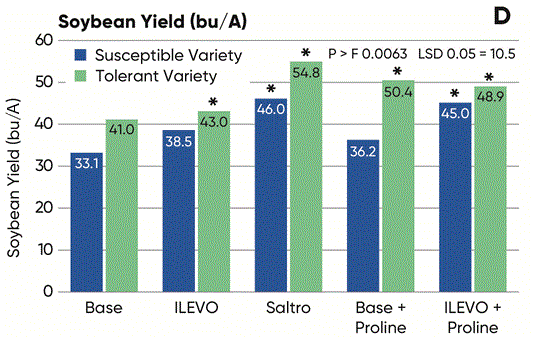
Figure 3D. Red crown rot soybean yield at the Jackson, KY, field research location. Asterisks indicate treatments that were significantly better (lower RCR severity or higher yield) than the susceptible variety with the base seed treatment.
Summary and Conclusions
- The moderate red crown rot pressure under natural infestation at the Graves County location did not appear to affect soybean yield, as there were no significant differences in yield among varieties and treatments.
- Even without an impact on soybean yield, the significant differences in red crown rot severity suggest that the combination of a tolerant variety and fungicide treatment is the most effective approach to managing red crown rot.
- Further research in 2026 should be helpful in elucidating the relationship between red crown rot disease severity and impact on soybean yield.
- Results from the Jackson location — where RCR severity was considerably higher and yield was significantly impacted — further support the conclusion that an integrated approach of variety selection and fungicide seed treatment or in-furrow treatment is the best strategy for protection of soybeans against red crown rot.
- The best outcomes, in terms of disease severity reduction and yield protection, were achieved with the combination of a tolerant variety and a fungicide treatment. The best outcome overall was achieved with the tolerant variety + Saltro seed treatment (Figure 4).
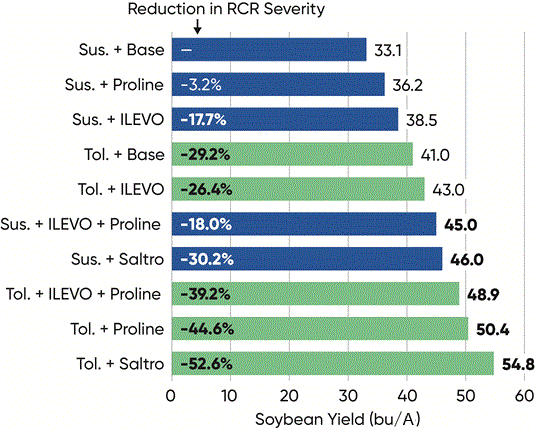
Figure 4. Ranking of RCR integrated management variety and treatment combinations under high RCR pressure at the Jackson location. Values in bold indicate a significant advantage relative to the susceptible variety + base seed treatment.
References
- Bradley, C. 2021. Kentucky soybeans: Red crown rot observed in state. AgFax.
- Kleczewski, N. 2020. Red crown rot: What to look for in your soybean fields. Illinois Field Crop Disease Hub. Univ. of Illinois Extension.
1Proline 480 SC Fungicide is not currently labelled for control of red crown rot of soybeans with in-furrow application, although it is labelled for control of Cylindrocladium black rot in peanuts, which is caused by the same pathogen. Always read and follow product label directions.
The foregoing is provided for informational use only. Please contact your Pioneer sales professional for information and suggestions specific to your operation. Product performance is variable and depends on many factors such as moisture and heat stress, soil type, management practices and environmental stress as well as disease and pest pressures. Individual results may vary. Pioneer® brand products are provided subject to the terms and conditions of purchase which are part of the labeling and purchase documents.