
Country Selector
Please enter a valid location
Soybean Cyst Nematode Populations in Minnesota and Wisconsin

Agronomy Research Update
From Pioneer Agronomy Sciences - Written by Brent Larson, Field Agronomist and Jay Zielske, Field Agronomist.
Key Findings
- Soybean cyst nematode (SCN) reproduction on soybean varieties with PI88788 and Peking SCN resistance was compared across 30 locations.
- SCN populations increased substantially on the PI88788 variety at several locations but remained steady or decreased on the Peking variety at most locations.
- Soybean growers can reduce the risk of SCN damage by planting resistant varieties, rotating between PI88788 and Peking resistance sources and using a nematode protectant seed treatment.
- Objective and Study Description
- Results
- SCN Management
- Study Locations
Objective and Study Description
- Soybean cyst nematode (SCN) samples were collected from 30 soybean fields in Minnesota and Wisconsin to determine SCN population levels.
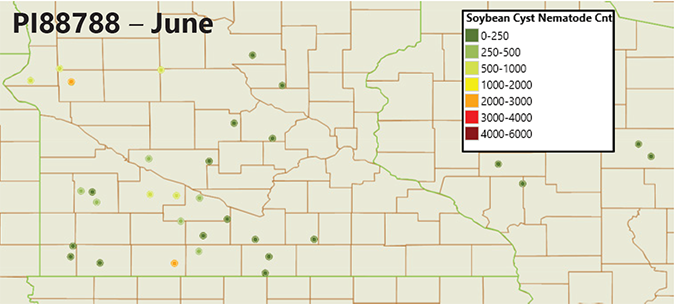
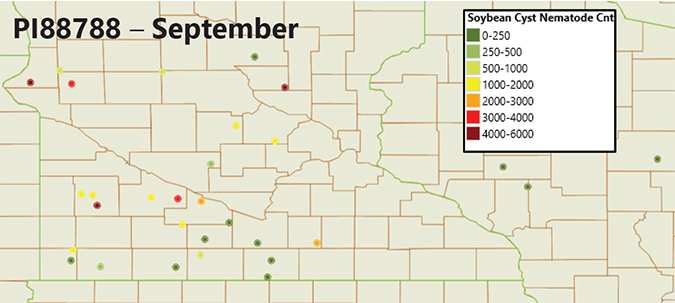
- Study locations were sampled twice during the 2024 growing season, in June and again in September, to assess changes in SCN population levels during the growing season.
- Each study location included a soybean variety with PI88788 SCN resistance and one with Peking SCN resistance planted side by side, allowing a comparison of SCN population changes between the two varieties.
- Sample cores were taken to a depth of approximately 6 inches. Subsamples from across the PI88788 or Peking variety areas were blended into composite soil samples and submitted to Western Laboratories for analysis.
Results
- SCN eggs were detected at at 24 of the 30 study locations with the June sampling and 26 of 30 locations with the September sampling (Table 1).
Table 1. SCN population levels at study locations (based on the higher of the two sample counts) at the June and September sampling timings.
SCN Population (eggs/100 cc of soil) June Sampling September Sampling number of locations Zero 6 4 Low (<500 eggs) 14 8 Moderate (500-2000) 6 10 Mod-High (2000-5000) 4 7 High (5000-8000) 0 1 0 1
- Across 10 study locations with moderate to high SCN population levels (based on June sampling) SCN egg counts increased by an average of 251% from June to September on the soybean variety with PI88788 SCN resistance and decreased by an average of 8% on the soybean variety with Peking SCN resistance (Figure 1).
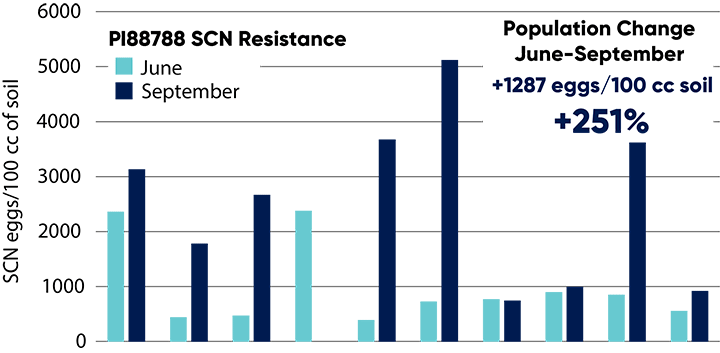
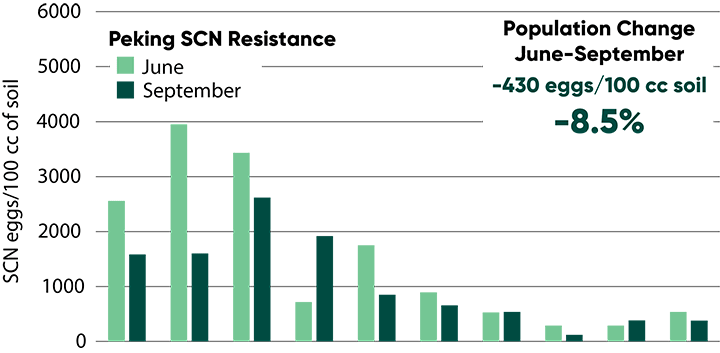
Figure 1. SCN egg counts in June and September samples at study locations with moderate to high SCN population levels.
- Among moderate to high SCN locations, SCN eggs counts on the PI88788 variety increased substantially (>100%) at five locations and decreased at only one.
- SCN eggs counts on the Peking variety increased at only one location and were steady or decreased at all other locations.
SCN Management
Decreased Efficacy of PI88788 Resistance
- Beginning in the 1990s, the widespread availability of soybean varieties with PI88788 SCN resistance provided a largely effective management tool for SCN in North America.
- In recent years however, PI88788 has been losing its effectiveness as a SCN management tool.
- Levels of reproduction on PI88788 among Midwestern SCN populations have increased steadily over the last two decades – results from the current study are consistent with this trend.
- These results show that SCN populations are adapting to PI88788 resistance and the resistance is considerably less effective now compared to when it was introduced in the early 1990s.
Management Recommendations
- The SCN Coalition provides the following recommendations for developing a plan to manage SCN:
- Test your fields to know your numbers.
- Rotate resistant varieties.
- Rotate to non-host crops.
- Consider using a nematode protectant seed treatment.
Rotate Resistant Varieties
- If your SCN populations are found to be increasing, select varieties with sources of resistance other than PI88788.
- The most common source of resistance other than PI88788 is PI548402 or “Peking” resistance.
Rotate to Non-Host Crops
- Rotation to a non-host crop to reduce SCN pressure.
- Corn, alfalfa and small grains are the most common non-crop choices for reducing SCN numbers.
- Since SCN persists in the soil for many years, it cannot be totally eradicated by rotation.
Seed Treatments
- Several nematicide seed treatments with activity against SCN are currently available and can provide added protection when used with a SCN-resistant soybean variety.
- Nematicide seed treatments are intended to supplement current SCN management strategies, not replace them. Seed treatments should therefore be used in coordination with SCN-resistant varieties and rotation to non-host crops.
Study Locations
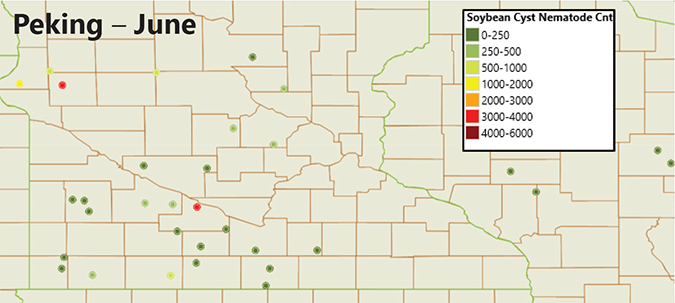
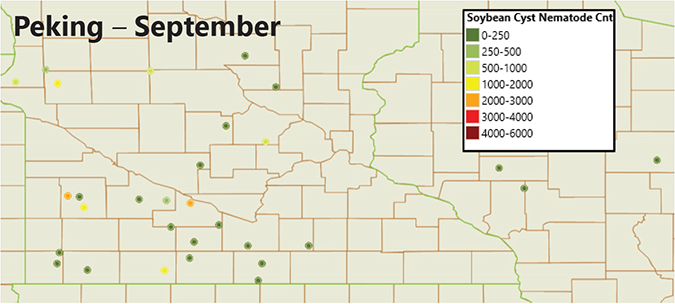
Figure 2. Study locations showing SCN egg counts in June and September on PI88788 and Peking varieties.

The foregoing is provided for informational use only. Please contact your Pioneer sales professional for information and suggestions specific to your operation. Product performance is variable and depends on many factors such as moisture and heat stress, soil type, management practices and environmental stress as well as disease and pest pressures. Individual results may vary. Pioneer® brand products are provided subject to the terms and conditions of purchase which are part of the labeling and purchase documents.