
Country Selector
Please enter a valid location
Soybean Canopy Development and Closure Following Dicamba Injury

Agronomy Research Update
From Pioneer Agronomy Sciences - Written by John Mick, Kevin Keller, Dan Ilten, Garrett Kennedy and Mark Jeschke.
Key Findings
- A study conducted across multiple locations in 2024 examined the impact of low-level dicamba injury on growth and canopy closure of non-dicamba-tolerant soybeans.
- Dicamba-injured soybeans had an initial delay in canopy coverage but were generally able to recover within two to three weeks.
- Dicamba injury tended to trigger development of additional branches lower on the plants, which resulted in a different shape to the soybean canopy with a lower point of closure.
- Background and Objective
- Study Description
- Results
- Reference
Background and Objective
- Dicamba use for post-emergence weed control has increased in both corn and soybeans in recent years to control glyphosate-resistant weeds.
- Soybeans without dicamba tolerance are extremely sensitive to dicamba and can be injured by off-target movement or contaminated spray equipment, which shows up as cupping of newly developed leaves (Figure 1).
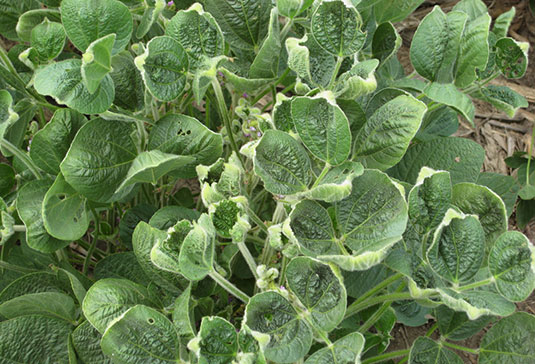
Figure 1. Soybean plants showing upward leaf cupping characteristic of dicamba injury. Symptoms are limited to newer growth, with older leaves unaffected.
- Soybean exposure to dicamba resulting in minor symptoms typically will not impact yield; however, the potential for yield loss increases at higher levels of exposure (Werle et al., 2018). The potential for yield loss depends on the amount of dicamba and the growth stage of soybeans at the time of exposure.
- Soybeans exposed during vegetative growth are more likely to recover and not experience yield loss; however, dicamba injury can cause a delay in canopy closure, particularly for soybeans in 30-inch rows.
- In 2024, canopy measurements were taken at numerous locations across southern Nebraska and northern Kansas where dicamba-tolerant (DT) and non-dicamba-tolerant (non-DT) soybeans were planted adjacent to each other to evaluate the impact of dicamba injury on canopy development in non-DT soybeans.
Study Description
- Canopy measurements were taken at 44 locations in Nebraska and Kansas where DT and non-DT soybeans were planted in adjacent fields and dicamba application resulted in some degree of injury to the non-DT soybeans (Figure 2).
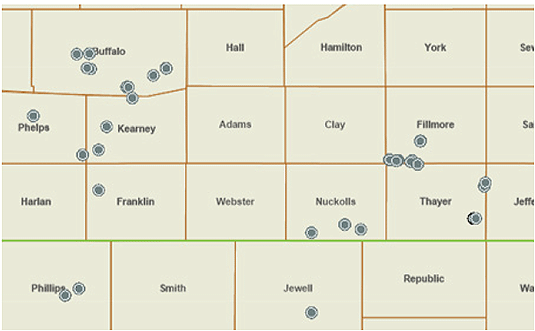
Figure 2. Soybean canopy development study locations in southern Nebraska and northern Kansas in 2024.
- Canopy closure was measured using overhead sUAS imagery with leaf coverage quantified using the Canopeo app developed by Oklahoma State University (Figure 3).
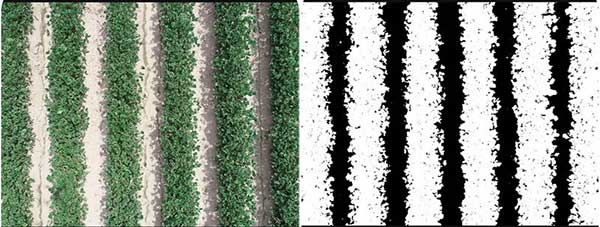
Figure 3. Example of an overhead sUAS image of a soybean field and the same image as processed by the Canopeo app to calculate the percentage of ground area covered by the crop canopy.
- Canopy images were taken approximately weekly from July 2 through July 29, corresponding to the R1/R2 growth stage through R3/R4 growth stage.
- Of the 44 study locations, 33 were under full irrigation, two had limited irrigation, and nine were dryland.
- A total of 18 different DT soybean varieties and 21 different non-DT varieties were used across the study locations.
- Injury symptoms consistent with dicamba exposure were observed in the non-DT soybeans at all locations included in the study.
Results
- Soybean canopy imagery from across all study locations showed an initial reduction in canopy coverage in non-DT varieties compared to DT varieties as a result of dicamba injury.
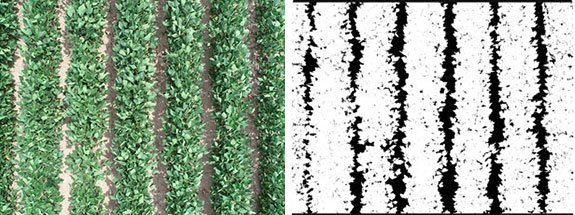
- In imagery taken at the R1 growth stage, non-DT varieties averaged 63% canopy coverage compared to 78% coverage for DT varieties (Figure 4).
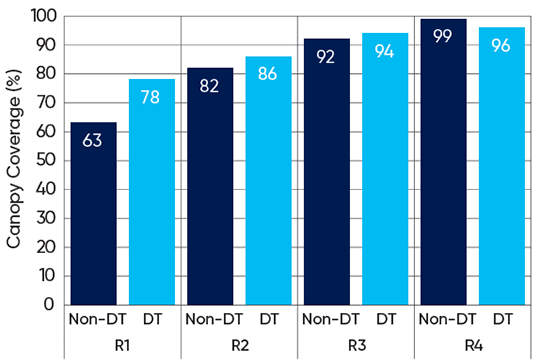
Figure 4. Average canopy coverage of dicamba-injured non-DT soybeans compared to DT soybeans at the R1, R2 and R3 growth stages.
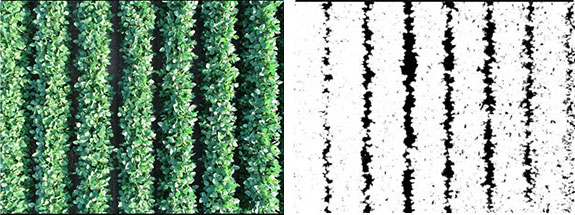
- However, this difference in canopy coverage did not persist. By the R2 stage, the non-DT varieties had largely closed the gap, with an average of 82% canopy coverage compared to 86% for DT varieties (Figure 5).
R1 Non-Dicamba Tolerant - Average Canopy Coverage = 63%
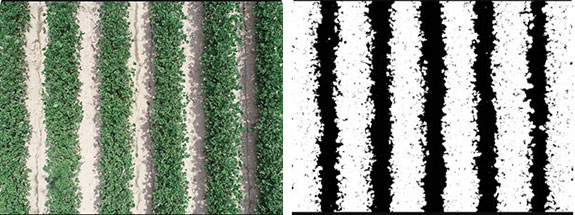
R1 Dicamba Tolerant - Average Canopy Coverage = 78%
R2 Non-Dicamba Tolerant - Average Canopy Coverage = 82%
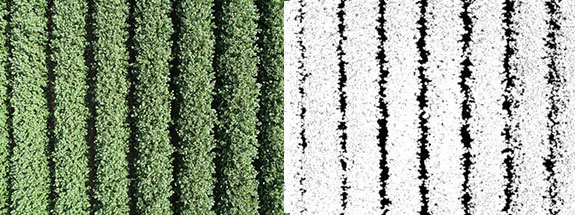
R2 Dicamba Tolerant - Average Canopy Coverage = 86%
R3 Non-Dicamba Tolerant - Average Canopy Coverage = 92%

R3 Dicamba Tolerant - Average Canopy Coverage = 94%
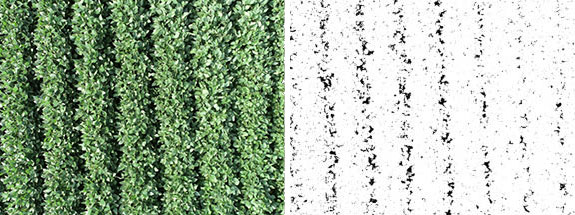
Figure 5. Overhead sUAS imagery and Canopeo-processed imagery showing canopy coverage of dicamba-injured non-DT soybeans compared to DT soybeans at the R1, R2 and R3 growth stages.
- Differences in canopy coverage were further diminished by the R3 stage and were completely gone by the R4 stage.
- Dicamba has been shown to reduce yield of non-DT soybeans in cases where exposure levels are high enough to cause severe injury; however, no effect on yield was generally observed in this study unless another source of significant plant stress was also present.
Secondary Stress Factors
- Results of this study showed that non-DT soybean varieties were able to recover from dicamba injury within two to three weeks unless an additional significant stress factor was also present.
- Soil compaction and drought stress were two stress factors observed at study locations that delayed soybean recovery from dicamba injury and canopy closure (Figure 6).
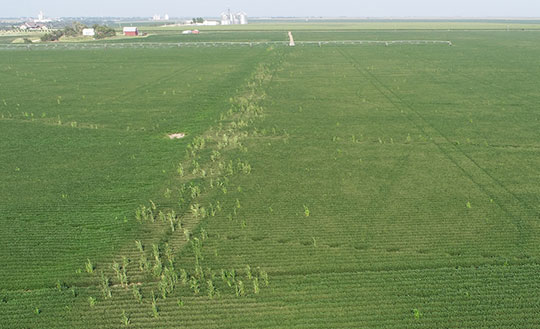
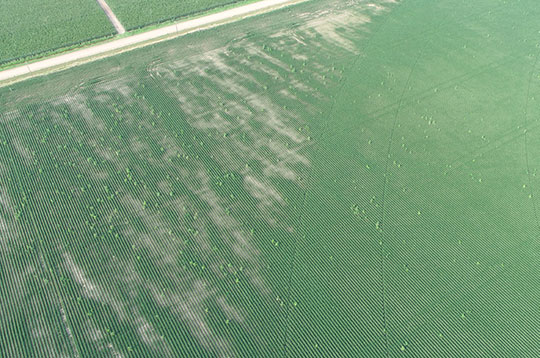
Figure 6. Study locations where soybean recovery from dicamba injury was inhibited by one or more additional stress factors. Top: Recovery inhibited by stress associated with historical soil compaction where a lane once existed in the field. Above: Recovery inhibited by drought stress in the pivot corner, compounded by soil compaction (visible as streaks in the pivot corner), as well as injury from an additional group 4 herbicide (triclopyr).
Canopy Shape
- Dicamba injury can result in a different shape to the soybean canopy compared to non-injured soybeans, even if percent canopy coverage is the same.
- When dicamba enters a soybean plant, it is translocated to the meristematic region at the top of the plant, where it can cause injury to new growth.
- Damage to the apical meristem can trigger development of new branches lower on the plant (Figure 7).
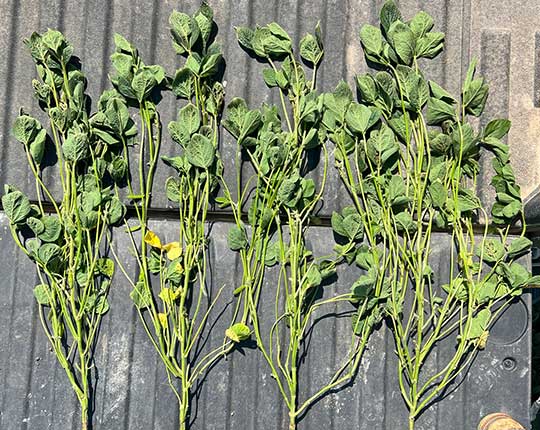
Figure 7. Soybean plants that developed additional branches lower on the plant following dicamba injury to the apical meristem.
- The growth of additional branches lower on the plant can result in a triangular shape to the plants, with a lower point of canopy closure (Figure 8).
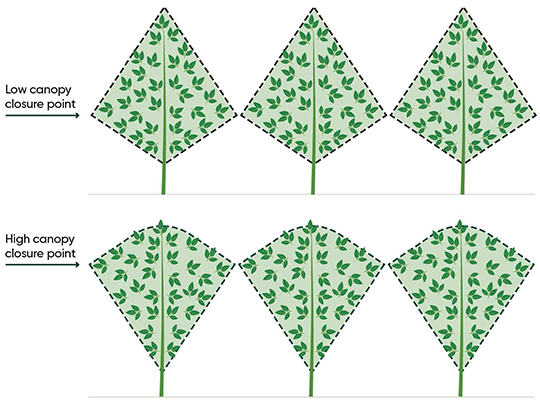
Figure 8. Visual representation of lower and higher soybean canopy closure points resulting from different plant shapes.
- This lower point of canopy closure can create the impression that the impact of dicamba injury on canopy coverage is worse than it actually is. When viewed from the road, soybeans may appear to have not closed canopy yet even though they have.
- A lower point of canopy closure can actually benefit soybean plants by allowing light to penetrate deeper in the canopy and enabling plants to maintain and fill pods lower on the plant.
Reference
Werle, R., R. Proost, and C. Boerboom. 2018. Soybean Injury From Dicamba. A4161. University of Wisconsin Extension.
The foregoing is provided for informational use only. Please contact your Pioneer sales professional for information and suggestions specific to your operation. 2024 data are based on average of all comparisons made in 44 locations through December 1, 2024. Multi-year and multi-location is a better predictor of future performance. Do not use these or any other data from a limited number of trials as a significant factor in product selection. Product responses are variable and subject to a variety of environmental, disease, and pest pressures. Individual results may vary.