
Country Selector
Please enter a valid location
Wheat Stem Maggot in Corn
Crop Focus
Written by Debora Montezano, Pioneer Agronomy Research Manager
Key Points
- The wheat stem maggot (Meromyza americana Fitch) is a sporadic pest of cover crops and corn native to North America.
- Damage typically occurs in patches and can lead to substantial stand loss and yield reduction if infestations are severe.
- Outbreaks in corn have been associated with late termination of rye cover crops and specific environmental conditions.
- Distribution and Pest Status
- Lifecycle
- Identification
- Injury and Crop Impact
- Scouting and Monitoring
- Management Recommendations
- Outbreaks and Contributing Factors
- References
Distribution and Pest Status
- Meromyza americana Fitch, known as the wheat stem maggot (WSM), is a chloropid fly native to North America, distributed throughout the U.S. and southern Canada.
- Although considered a minor pest overall, WSM can cause regionally significant injury to cereal crops — particularly wheat, barley, oats, rye and occasionally corn, resulting in localized yield losses in the Great Plains and Midwest.
- Outbreaks are relatively rare but can lead to severe stand loss and reduced yields when linked to specific agronomic practices.
- Major Nebraska outbreaks occurred in 2017 and 2025, with infestations reaching up to 50% in some fields. These were primarily associated with corn following green cover crops such as rye or with volunteer wheat present.
- Infestation risk is highest when corn is planted before cover crop termination, as living cover creates a “green bridge” that allows larvae to migrate from dying cover plants to young corn seedlings.
Lifecycle
- The wheat stem maggot typically completes two to three generations per year, depending on regional climate.
- In early spring, adults emerge from overwintering pupae. Females begin oviposition two to six days after emergence, laying eggs singly on leaves or at the stem base. Each female deposits one to four eggs per day for about two weeks.
- Larvae hatch and bore into plant stems, feeding internally on developing tissues. They pass through three instars growing from 1 millimeter to 6-7 millimeters in length.
- The larval feeding period lasts about two weeks and produces the characteristic “dead heart” symptom.
- Pupation occurs inside the stem, in soil debris or within volunteer grasses. Adults emerge to start the next generation, continuing the cycle (Figure 1).
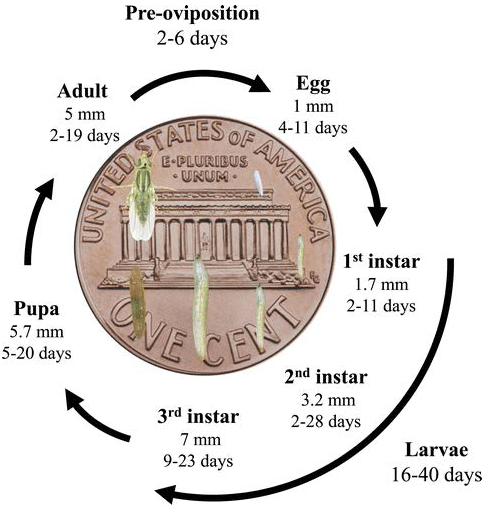
Figure 1. Wheat stem maggot lifecycle. (Image courtesy of University of Nebraska.)
Identification
- Adult WSM flies are small (6 millimeters), slender and greenish yellow with dark thoracic stripes and bright green eyes (Figure 2).
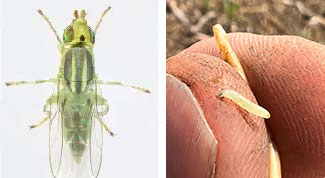
Figure 2. Wheat stem maggot adult (left) and larva (right). (Image on the left courtesy of the University of Nebraska.)
- Larvae are legless, smooth and white to yellowish, reaching 5-8 millimeters in length.
- Pupae are reddish-brown and cylindrical, found within stems or soil residue.
- No external burrowing or root injury occurs, helping differentiate WSM from other corn pests.
Injury and Crop Impact
- Larvae feed internally, severing vascular tissues and destroying the growing point, disrupting nutrient flow and killing the central whorl leaf (Figure 3).
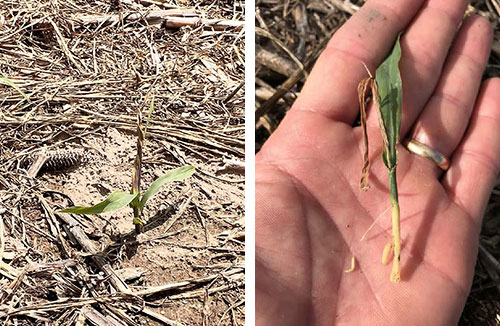
Figure 3. Characteristic “dead heart” symptom caused by wheat stem maggot feeding in the central leaf whorl. (Images courtesy of Pioneer field agronomist John Mick.)
- Injury is typically patchy, with clusters of damaged plants among healthy ones, often linked to fields with grassy cover crops, cereal residue or late-terminated rye (Figure 4).
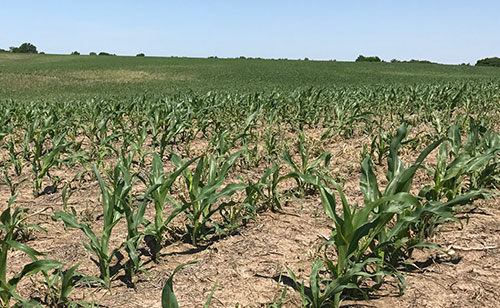
Figure 4. Patches of unevenly sized plants caused by wheat stem maggot feeding. (Image courtesy of John Mick.)
- The central (newest) leaf yellows and dies, forming the characteristic “dead heart.” When pulled, the whorl detaches easily, revealing a hollow or water-soaked stem. (Figure 5).
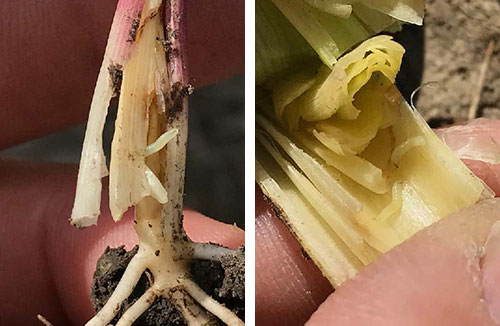
Figure 5. Wheat stem maggot larvae visible inside the stem. (Images courtesy of Pioneer field agronomist John Mick.)
- Upon dissection, small pale larvae or reddish-brown pupae are often visible inside the stem cavity.
- Severe infestations can cause stand loss and yield reductions up to 30 bu/A.
Scouting and Monitoring
- Begin scouting in early spring and continue through the period before cover crop termination and corn emergence.
- Focus on fields with a history of WSM or grassy cover crops such as rye or wheat.
- Sticky traps and sweep nets can detect adult flies, though economic thresholds are not yet established.
- Pull symptomatic plants and split stems to confirm the presence of larvae or pupae.
Management Recommendations
- Scout cover crops for adult WSM activity prior to termination. If numbers are high, terminate cover crops at least 14 days before planting corn to prevent larvae from migrating from dying vegetation into emerging corn seedlings.
- Currently, no established economic threshold exists for wheat stem maggot in corn or other crops. Likewise, no rescue treatment is available once larvae have entered the corn whorl.
- In cases where early termination is not feasible, some researchers recommend a follow-up insecticide application after corn emerges. However, this approach is based on management principles for similar pests such as stalk borers and not specifically validated for wheat stem maggot.
Outbreaks and Contributing Factors
- Heavy infestations occur most often when corn follows grassy cover crops or volunteer wheat.
- The highest risk occurs when corn is planted “green” into living rye that is terminated after emergence, allowing maggots to move into seedlings.
- Drought stress can intensify visible symptoms.
2017 Nebraska Outbreak
- The 2017 WSM outbreak caused severe stand loss and economic damage across central, eastern and southern Nebraska.
- Growers reported dead whorls and tillering in early corn planted after wheat or rye cover crops.
- A survey led by the University of Nebraska documented stand losses of 2–30%, with larvae confirmed inside corn stems, indicating movement from cover crops.
2025 Nebraska Outbreak
- Nebraska experienced another major wheat stem maggot outbreak in 2025. Infestations were reported across 18 counties and ranged from 5% to 50% in severity.
- Infestation levels varied by county and management practices, confirming a strong link between WSM infestations and the use of rye cover crops, particularly when corn was planted “green” into living rye.
References
- Carmona, G. I., Rees, J., Seymour, R., Wright, R., and McMechan, A. J. 2019. Wheat Stem Maggot (Diptera: Chloropidae): An Emerging Pest of Cover Crop to Corn Transition Systems. Misc. Publications No. 477, USDA, Washington, D.C. Accepted for publication 4 June 2019.
- Gilbertson, G. I. 1925. The Wheat-Stem Maggot. Research Bulletin No. 217. South Dakota Agricultural Experiment Station, Brookings, SD.
The foregoing is provided for informational use only. Please contact your Pioneer sales professional for information and suggestions specific to your operation. Product performance is variable and depends on many factors such as moisture and heat stress, soil type, management practices and environmental stress as well as disease and pest pressures. Individual results may vary. Pioneer® brand products are provided subject to the terms and conditions of purchase which are part of the labeling and purchase documents.