
Country Selector
Please enter a valid location
Corn Stunt Disease in the U.S.
Crop Insights
Written by Mark Jeschke, Ph.D., Pioneer Agronomy Manager
Key Points
- Corn stunt is one of the most economically important diseases affecting corn in South America but is less known in the U.S. because it is generally confined to the southernmost parts of the country.
- The primary causal organism for corn stunt disease is Spiroplasma kunkelii, a bacterial pathogen commonly referred to as corn stunt spiroplasma (CSS).
- S. kunkelii is transmitted by corn leafhoppers (Dalbulus maidis), which acquire the pathogen by feeding on infected plants and spread it by feeding on healthy plants.
- Infected plants can have dramatically shortened internodes resulting in the characteristic plant stunting.
- Ears of infected plants are smaller than normal and do not fill properly.
- Management of corn stunt disease is focused on preventing infection by managing the insect vector.

- Corn Stunt: A Major Disease of Corn
- Causal Pathogens
- Disease Symptoms
- Disease Lifecycle
- Corn Leafhoppers
- Management Considerations
- Future Outlook
- References
Corn Stunt: A Major Disease of Corn
Corn stunt is one of the most economically important diseases affecting corn in the Americas and the Caribbean. As the name implies, corn stunt disease is characterized by severely stunted plants that often produce multiple small ears with loose or missing kernels. Yield loss associated with corn stunt disease can be severe — over 70% — and major outbreaks have impacted yields in Brazil and Argentina in recent years.
Corn stunt disease is less known in the U.S. because it is generally confined to the southernmost parts of the country. Outbreaks have occurred previously in the U.S. — in Florida in 1979-1980 and in California in 2001. However, an unprecedented outbreak that impacted corn in several states in 2024 has led to some concern that occurrence of corn stunt disease could become more frequent and widespread.
Causal Pathogens
The primary causal organism for corn stunt disease is Spiroplasma kunkelii, a bacterial pathogen commonly referred to as corn stunt spiroplasma (CSS). Spiroplasma is a genus within Mollicutes, a class of small bacteria that share the common feature of not having a cell wall, unlike most bacteria. Mollicutes are parasites of various animals and plants, living on or in the host’s cells.
S. kunkelii is transmitted by corn leafhoppers (Dalbulus maidis), which acquire the pathogen by feeding on infected plants and spread it as they subsequently feed on healthy plants. This bacterial pathogen is transmitted singly or in combination with maize bushy stunt phytoplasma (MBSP), maize rayado fino virus (MRFV) and/or sugarcane mosaic virus. Because of the multiple pathogens involved, corn stunt disease is often referred to as a disease complex.
Disease Symptoms
The initial symptoms of corn stunt are small chlorotic stripes that develop at the base of the leaves. Over time, these chlorotic stripes expand and coalesce, extending further toward the leaf tips on older leaves. As infected plants age, they may develop a reddish or reddish-purple color, although this can vary by hybrid and environmental conditions (Figure 1). Eventually, leaves on infected plants may die prematurely.
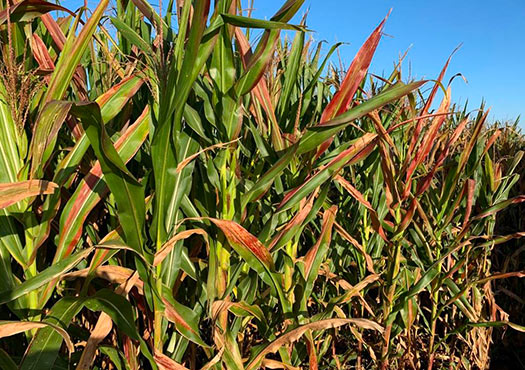
Figure 1. Corn plants exhibiting symptoms of corn stunt disease in Texas in 2024.
Infected plants can have shortened internodes resulting in the characteristic plant stunting. Plants infected early in their development may reach a final height of only 5 feet (1.5 meter) (Figure 2), whereas infection later in the season may cause little or no stunting. Infection can cause a proliferation of secondary shoots in leaf axils, and plants may develop multiple small ears.
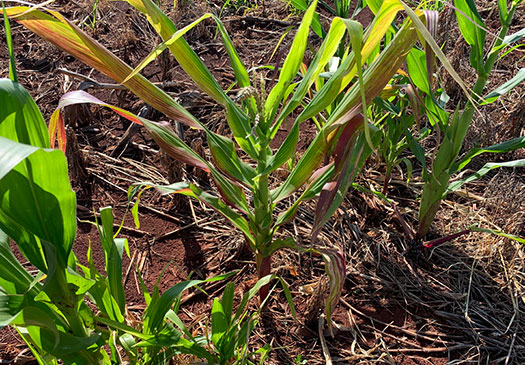
Figure 2. Corn plants in a field in Puerto Rico with severely shortened internodes resulting from corn stunt disease. The degree of stunting indicates that infection occurred early in development.
Ears of infected plants are smaller than normal and do not fill properly. Ears often have blank spaces, and kernels that do develop are loosely attached to the cob, a condition sometimes referred to as “loose tooth ears” (Figure 3).
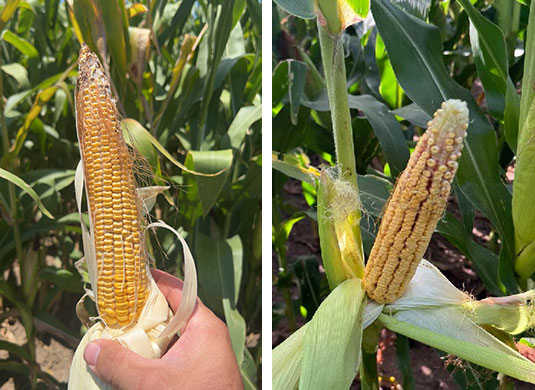
Figure 3. Ears on corn plants infected with corn stunt disease displaying characteristic symptoms — reduced ear size, poor kernel fill and blank spaces.
Symptoms of corn stunt disease observed in the U.S. are generally less severe than those associated with corn stunt disease in South America and the Caribbean due to the timing of infection. Outbreaks of corn stunt in the U.S. are largely driven by leafhopper populations moving northward from Mexico, which results in infection later in the growing season compared to places like Brazil where corn leafhopper populations are present year-round, and infection can occur much earlier.
The corn stunt disease outbreak in Texas and Oklahoma in 2024 was driven by corn leafhopper feeding that likely started during late vegetative growth stages. Infected plants showed foliar symptoms but had little or no stunting since infection occurred after vegetative growth was completed or nearly completed (Figure 4).
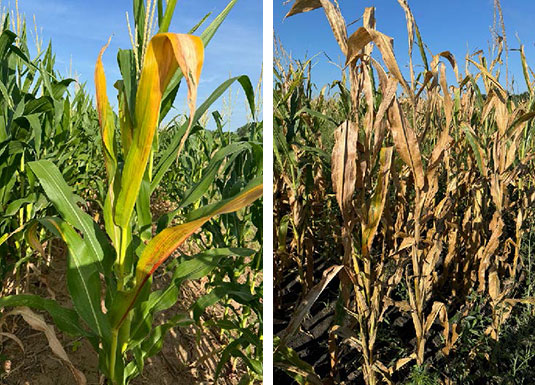
Figure 4. Corn plants in a field in southern Texas in 2024 showing corn stunt symptoms consistent with infection later in the season. Foliar symptoms are present but there is minimal stunting. Foliar symptoms progress from leaf chlorosis and reddish coloration along the midribs (left) to premature death of leaf tissue (right).
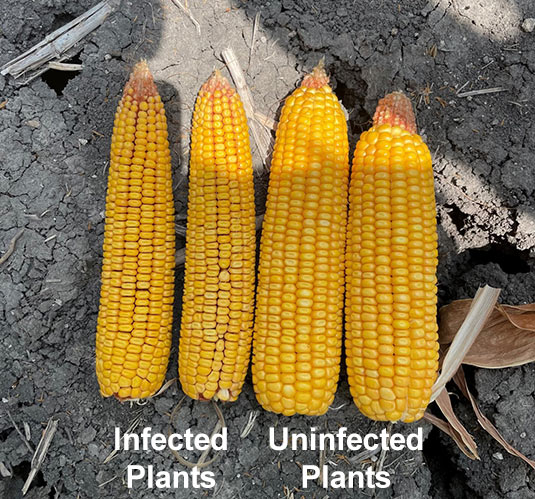
Figure 5. Ears from corn stunt infected and uninfected plants showing poorly filled kernels on the infected plant ears.
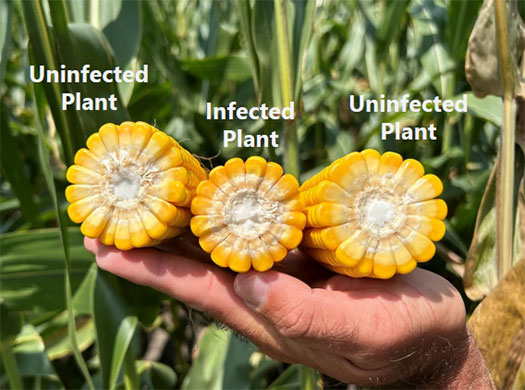
Figure 6. Ears from corn stunt infected and uninfected plants showing reduced kernel depth and ear girth of infected plants.
Disease Lifecycle
Although a complex of pathogens is associated with corn stunt disease, Spiroplasma kunkelii appears to be the major component of this disease. S. kunkelii is transmitted by leafhoppers, mainly corn leafhoppers (D. maidis) but the Mexican corn leafhopper (D. elimatus) has also been reported as a vector. Corn leafhoppers spread the disease by carrying the spiroplasma from diseased corn to healthy corn as they feed on the phloem sap of corn plants. Corn stunt pathogens are not transmitted through seed; the only way for a plant to become infected is through leafhopper feeding.
S. kunkelii lives in the phloem sieve tubes of infected host plants. Disease symptoms appear about three weeks after corn is infected. The exact mechanism or mechanisms by which the pathogens associated with corn stunt disease damage the plant are not fully understood.
Multiplication of the bacterium occurs both in the plant and in the insect hosts. Multiplication ceases when the temperature drops below 64°F (18°C). Spiroplasmas overwinter within adult leafhoppers, and when they resume activity in early spring, they can be infective.
Corn Leafhoppers
Host Species
The most critical factor in the corn stunt disease pathosystem is not the pathogen, but rather the vector — the movement and proliferation of leafhoppers have been shown to drive corn stunt outbreaks. D. maidis has a limited host range, feeding only on corn, its wild relatives in the genus Zea and grasses in the closely related genus Tripsacum. D. maidis likely originated in the high valleys in the central region of Mexico, where it evolved alongside the wild ancestors of corn native to this region.
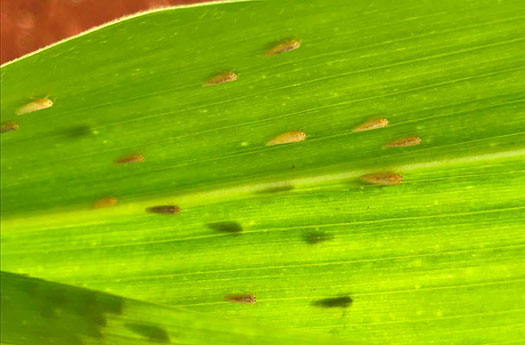
Figure 7. Adult corn leafhoppers (D. maidis) on a corn leaf.
A Corteva Agriscience study of potential alternate hosts — including sorghum, sugarcane, johnsongrass, pearl millet, soybean and several species of pasture grass — found that corn was the only host plant on which leafhopper reproduction occurred. Other grass crops such as wheat and sorghum, as well as Bermudagrass, can serve as a reservoir for leafhopper populations — giving them a place to persist when no corn is available — but reproduction only occurs on corn.
Movement into the U.S.
Outbreaks of corn stunt in the U.S. are likely driven by leafhopper populations moving up from Mexico, where corn is under continuous cultivation. Leafhoppers populations can move with prevailing winds, sometimes over long distances. Previous outbreaks of corn stunt disease in southern Florida are believed to have been caused by leafhopper populations carried in with tropical storms. The spread of leafhoppers further north into the U.S. is limited by cold temperatures and lack of secondary hosts to provide a year-round source of food. Direct plant damage caused by corn leafhopper feeding is rarely significant — the primary economic importance of the corn leafhopper is its role as a disease vector.
Lifecycle
D. maidis begins as an egg and then undergoes five nymphal instars before reaching adulthood (Figure 8).
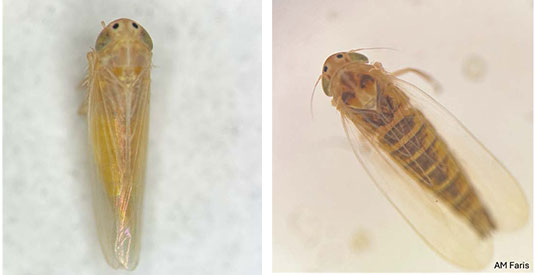
Figure 8. D. maidis adults. (Photos courtesy of and used with permission of Ashleigh M. Faris, Ph.D., Oklahoma State University.)
Females insert eggs into the mesophyll of the upper surface of corn leaves, often in the whorls of corn seedlings. The first nymphal instar will hatch around 8 to 10 days after oviposition. First instars are less than 1 millimeter long and last instars are around 4 millimeters long. Each nymphal stage averages 3 to 4 days, with the total time to adulthood averaging 14 to 16 days.
Adult longevity averages 60 to 80 days. Mature females oviposit an average of 15 eggs per day for most of their adult life. Corn stunt pathogens are not transmitted through leafhopper reproduction.
Corn leafhoppers do not enter any type of overwinter dormancy; populations survive as active adults. Under optimal conditions, corn leafhopper adults can survive without reproducing for up to three months.
Biology and Ecology
The number of corn leafhopper generations per year can vary greatly based on environmental conditions and host availability. Temperature has a significant influence on corn leafhopper development and reproduction. D. maidis requires 648 degree-days above a threshold of 41°F (4.9°C) to complete its lifecycle. The optimum temperature range for corn leafhopper reproduction is 72 to 77°F (20 to 22°C); at temperatures below this range, reproduction sharply declines.
In the least favorable environments, a minimum of two generations of corn leafhoppers will develop on a single corn crop. In areas with favorable temperatures where corn is grown throughout the year — particularly corn under irrigation — corn leafhoppers can go through more than 12 generations per year. In areas with year-round corn production, the corn leafhopper maintains breeding populations throughout the year, which can allow populations to grow very large.
Management Considerations
Leafhopper Control
There are no management tools available to combat the pathogen complex that causes corn stunt disease, so management is focused on preventing infection by managing the insect vector. Field experience with managing corn leafhoppers thus far is largely from South America where corn stunt disease is a much more persistent and serious threat to corn. Yield loss potential depends on growth stage of corn when infected; the earlier infection occurs, the greater the impact on yield.
Outbreaks of corn stunt disease in the U.S. have generally occurred later in the growing season, driven by corn leafhopper populations that moved northward from Mexico. The corn stunt outbreak in California in 2001 was a notable exception, where symptoms appeared earlier in the season. In this case, it was suspected that the mild winter of 2000-2001 allowed local overwintering of a population of corn leafhoppers carrying S. kunkelii. The timing of the 2024 outbreak in Texas and Oklahoma was more typical of U.S. outbreaks, with symptoms appearing later in the season.
Insecticides
Insecticides are commonly used in South America to prevent the spread of corn stunt disease by controlling corn leafhoppers. In Brazil, corn is commonly treated 3 to 6 times per crop for control of corn leafhoppers. Insecticide seed treatments containing clothianidin or imidacloprid can provide control of corn leafhoppers following emergence, but seed treatment efficacy does not last beyond the V3 growth stage. The threshold is for foliar insecticide treatment is the presence of corn leafhoppers. A Corteva Agriscience greenhouse study found that as few as two leafhoppers per plant feeding for just one day was enough to compromise corn yield. Reinfestation can occur quickly, so multiple applications may be necessary if feeding begins early. Feeding often begins along the edges of fields as leafhoppers move in, so treatment may be focused on field margins.
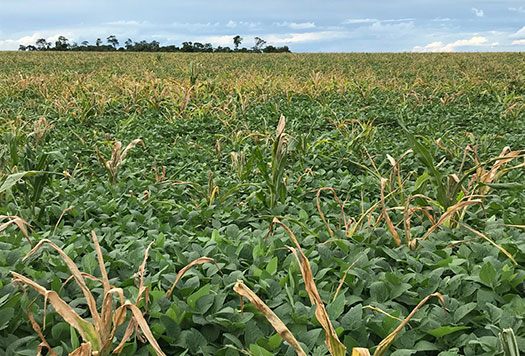
Figure 9. Corn leafhoppers require the presence of living corn plants to feed and reproduce. Volunteer corn can serve as a “green bridge” that allows leafhopper populations to persist in a rotational crop such as soybeans.
Cultural Practices
The key factor for corn leafhopper reproduction is the presence of corn plants on which to feed and reproduce, so cultural control practices are largely focused on eliminating the continuous presence of corn (referred to as a “green bridge”). Crop rotation, narrowing the planting window, and controlling volunteer corn are all practices that have been employed to manage corn leafhopper populations. However, given the mobility of corn leafhoppers, efforts to eliminate green bridges would need to be employed at an area-wide scale to be impactful.
Genetic Resistance
Corn hybrids can differ in their resistance to corn leafhopper feeding. Resistance works via reduced feeding preference (antixenosis) or survival (antibiosis), both of which reduce the duration of insect-plant interaction, which reduces the inoculation efficiency of S. kunkelii. In countries such as Brazil, where corn stunt disease is a persistent threat, hybrids are rated for their resistance to leafhoppers and susceptible hybrids are not advanced to commercial status. Corn hybrids resistant to corn leafhopper feeding have been an important tool for management of corn stunt disease in Brazil; however, experience has shown that hybrid resistance can be overcome by intense leafhopper feeding pressure. Given the infrequency of corn stunt outbreaks in the U.S., no such ratings for corn hybrids have been developed here.
Future Outlook
Corn stunt has historically been a sporadic disease in the U.S. and limited to the southernmost corn production areas of the country; however, it could become a more frequent and widespread occurrence in the future. Prior to 2024, S. kunkelii had rarely been detected in field samples of corn outside of California, Florida and Texas. In 2024, field samples positive for S. kunkelii were confirmed in 12 states, extending as far north as Minnesota, Wisconsin and New York — extending beyond its previously documented range (Duffeck et al., 2025; Corteva Diagnostic Lab). Corn stunt was more limited in 2025 — with field samples testing positive for S. kunkelii in Texas, Arizona, Oklahoma and Kansas — but still beyond its historic range (Table 1).
Table 1. States with positive detections of S. kunkelii by year since 2001 (Duffeck et al., 2025; Corteva Diagnostic Lab).
| Year | State |
|---|---|
| 2001 | California |
| 2014 | Colorado |
| 2015 | Kansas |
| 2016 | Illinois, Kansas, Minnesota, Nebraska |
| 2024 | Alabama, Arkansas, Indiana, Kansas, Minnesota, Missouri, Nebraska, New York, Oklahoma, South Dakota, Texas, Wisconsin |
| 2025 | Arizona, Kansas, Oklahoma, Texas |
The spread of corn stunt disease in 2024 was likely at least partly attributable to the impact of Hurricane Beryl, an unusually early-season hurricane that made landfall in Texas on July 8 and swept up through the Mid-South and Midwest before dissipating over the Northeastern U.S. and Ontario on July 11. Corn leafhoppers are known to spread long distances with prevailing winds and the first documented detection of corn stunt disease in New York would seem to correlate with the path of the storm system.
Expansion in the range of corn leafhopper populations to subtropical and temperate regions may also be a factor in the more frequent occurrence of corn stunt disease in the U.S. Rising temperatures increase the risk of corn leafhopper populations moving north from Mexico and creating more corn stunt outbreaks in the Southern U.S.
Currently, corn stunt disease appears unlikely to pose a persistent threat to corn production in the U.S. Corn Belt. Warm temperatures and the presence of a living host are both critical factors for the survival and reproduction of corn leafhoppers, neither of which are available year-round in the Corn Belt. However, more frequent incursions of corn leafhoppers and corn stunt disease into the Southern Plains could be possible.
References
- Duffeck, M.R., A.M. Faris, A. Wayadande, J. Olson, S. Wallace, A.S. Espindola, L. Muller, J.M. Zambiasi, R.B. Onofre, J. Stack, C. Day, A. Zukoff, T. Faske, M. Bish, P. Tian, L. Zhang, I. Valmorbida, T. Jackson-Ziems, K.C. Broderick, M. Shires, C. Tande, G.C. Bergstrom, M.E. Hunter, M.J. Stanyard, R. Aguiar, B. Hudelson, D. Smith, J.E. Solórzano, D.K. Malvick, D.E.P. Telenko, T. Creswell, J.C. Bonkowski, K.N. Conner, and E.J. Sikora. 2025. Association of the pathogen Spiroplasma kunkelii with corn stunt symptoms - in Oklahoma, Kansas, Missouri, Arkansas, Nebraska, South Dakota, New York, Wisconsin, Minnesota, Indiana, and Alabama during the 2024 growing season. Plant Health Progress.
- Oleszczuk, J.D., M.I. Catalano, L. Dalaisón, J.A. Di Rienzo, M. de la Paz Giménez Pecci, and P. Carpane. 2020. Characterization of components of resistance to corn stunt disease. PLoS ONE 15(10): e0234454.
- Oliveira, C.M., and M.R. Frizzas. 2022. Eight decades of Dalbulus maidis (DeLong & Wolcott) (Hemiptera, Cicadellidae) in Brazil: What we know and what we need to know. Neotrop. Entomol. 51:1-17.
The foregoing is provided for informational use only. Contact your Pioneer sales professional for information and suggestions specific to your operation. Product performance is variable and subject to any number of environmental, disease, and pest pressures. Individual results may vary. Pioneer® brand products are provided subject to the terms and conditions of purchase which are part of the labeling and purchase documents.