
Country Selector
Please enter a valid location
Optimizing Corn Water Use Efficiency in Irrigated Fields
Crop Insights
From Corteva™ Agriscience — Alejo Ruiz, Research Scientist; Dan Ilten, Agronomy Innovation Manager; Matt Essick, Agronomy Innovation Leader; Jessica Garcia, Data Scientist; Brent Myers, Senior Data Science Manager; Darren Vanness, Agronomy Project Leader and Lucas Borrás, Senior Research Scientist
Key Findings
- Field research was conducted in 2023 and 2024 to explore the potential to increase water use efficiency of corn in irrigated production.
- Water use efficiency in irrigated fields in Colorado and Nebraska averaged 7.8 and 10.6 bushels per acre per inch, respectively.
- Differences in water use efficiency across fields were partly explained by over-irrigation during grain filling.
- Within a field, the plant density that maximized grain yield also generally maximized water use efficiency.
- At the yield levels of the study locations, some hybrids required 34,000 plants per acre to maximize yield, while others required up to 40,000 plants per acre.
- The water use efficiency of hybrids across sites ranged from 8.5 to 10 bushels per acre per inch.
- Increasing Water Use Efficiency
- Field Trials
- Water Use Efficiency
- Irrigation Management
- Hybrid Selection and Plant Population
- Conclusions
- Acknowledgements
- References
Increasing Water Use Efficiency
Agricultural irrigation consumes 42% of all freshwater withdrawals in the U.S. (Dieter et al., 2018). In parts of the U.S. Midwest, where potential evapotranspiration significantly exceeds rainfall, crops are irrigated. However, the thickness of the aquifers from which this water is pumped has been declining, raising concerns about future crop production in this region (Whittemore et al., 2023; McGuire and Strauch, 2024; Jasechko et al., 2024).
To achieve stable aquifer water levels and extend its usable life, it is essential to increase the efficiency of water use. Additionally, crop production is threatened by rising temperatures and heat stress, which are exacerbated by limited water availability (Cohen et al., 2020; Kusmec and Schnable, 2024). In this context, there is an urgent need to develop alternative strategies to address the challenge of increasing crop production while conserving fresh water. One key metric for comparing fields or management practices is water use efficiency, or water productivity, which measures bushels of corn produced per inch of water, including both irrigation and precipitation.
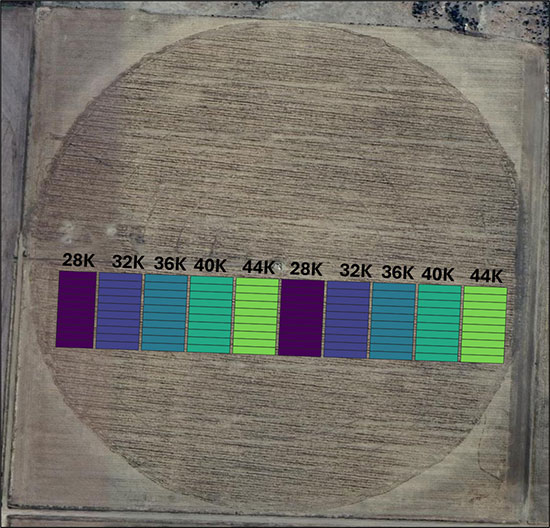
Figure 1. Example plot layout for water use efficiency trials conducted in 2023 and 2024.
Crop and irrigation management can significantly affect how efficiently water is used. Nitrogen fertilizer rate, plant density, row spacing and soil cover all affect water-related processes, which influence corn water use efficiency (Echarte et al., 2023). In addition, hybrid selection can also affect water use efficiency. Newer high-yielding hybrids are significantly more efficient at using water than older ones, especially under limited water availability (Rotundo et al., 2025). Although higher water availability is generally associated with greater yields, similar yields can be obtained with very contrasting water availabilities, resulting in distinct water use efficiencies.
| Newer high-yielding hybrids are significantly more efficient at using water than older ones, especially under limited water availability. |
Corteva Agriscience started an agronomy research program in 2023 to measure the water use efficiency of farmers in their irrigated fields and identify opportunities for optimizing this efficiency. This initiative started in Colorado and Nebraska, and in 2025 was expanded to include locations in Kansas, Oklahoma and Texas. Objectives of this research program were (i) to describe the current water use efficiency farmers have for irrigated fields in Colorado and Nebraska, and (ii) to determine the effect of management options (in this case, hybrid selection and plant density) on water use efficiency.
Field Trials
A total of 36 experiments were conducted in 2023 and 2024 in growers’ irrigated fields in Colorado and Nebraska (Figure 2A).
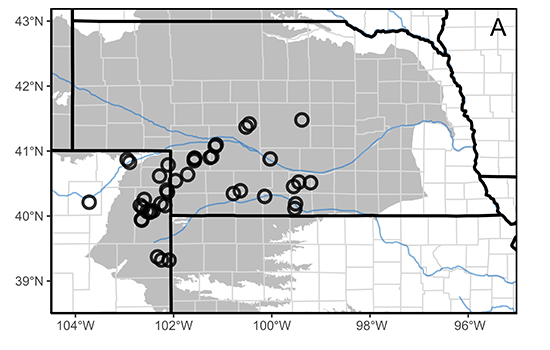
Figure 2A. Location of the 36 field experiments conducted on growers’ fields in Colorado and Nebraska in 2023 and 2024. The shaded grey area in the map shows the Ogallala aquifer.
Each experiment tested between 4 to 19 commercial hybrids across 4 to 10 different plant densities, which ranged from 22,000 to 44,000 plants per acre (Figure 1).
All locations were irrigated, had pivot telemetry, and were enrolled in Water Reporter from Granular Insights. Water Reporter is a digital twin based on a mechanistic model developed by Corteva Agriscience. It considers weather variables, irrigation schedules and volumes, crop information and satellite imagery to generate outputs such as daily evapotranspiration and soil water content.
Water Use Efficiency
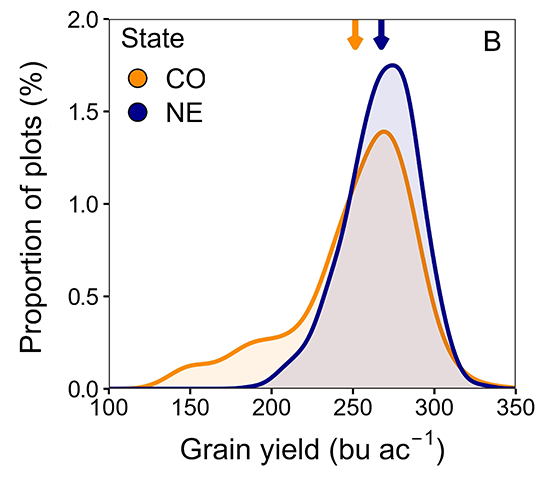
Figure 2B. Grain yield data distribution. Arrows indicate the mean grain yield in Colorado and Nebraska.
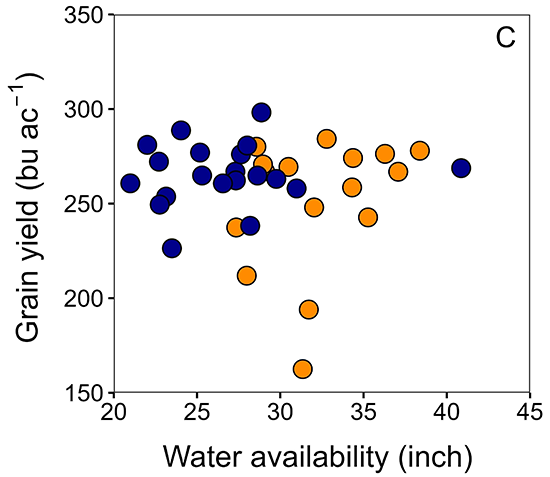
Figure 2C. Association between grain yield and water availability across locations. (Orange - Colorado locations; Blue - Nebraska locations)
Total water availability, which includes both precipitation during the season and irrigation, ranged from 21.0 to 40.9 inches (Figure 2D).
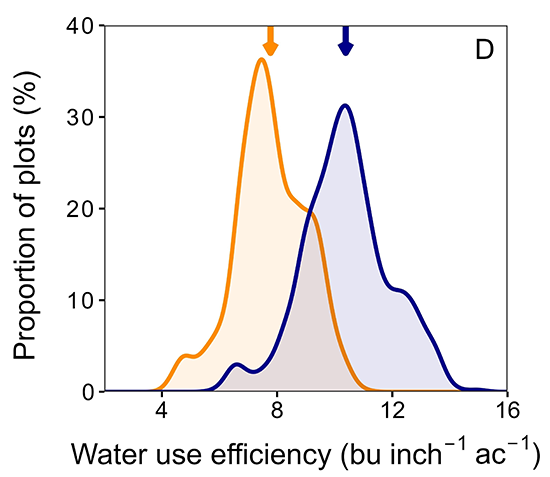
Figure 2D. Water use efficiency data distribution. Arrows indicate water use efficiency in Colorado and Nebraska.
On average, Colorado had higher water availability than Nebraska (32.3 vs. 26.7 inches, respectively), due to different irrigation amounts (21.6 inches in Colorado vs. 13.2 inches in Nebraska (Table 1).
Table 1. Ranges explored for different variables across locations and average values for Colorado and Nebraska.
| Trait | Minimum | Average | Maximum | Colorado | Nebraska |
|---|---|---|---|---|---|
| Irrigation (inch) | 7.0 | 16.8 | 30.7 | 21.6 | 13.2 |
| Rainfall (inch) | 5.9 | 12.4 | 19.6 | 10.6 | 13.8 |
| Water Availability (inch) | 21.0 | 29.2 | 40.9 | 32.3 | 26.7 |
| Evapotranspiration (inch) | 21.3 | 25.5 | 29.5 | 26.0 | 25.1 |
| Yield (bu acre-1) | 163 | 255 | 298 | 245 | 266 |
| Water Use Efficiency (bu acre-1 inch-1) | 5.2 | 9.1 | 12.8 | 7.8 | 10.6 |
| Optimum Plant Density (plants acre-1) | 28,100 | 35,700 | 40,000 | 37,200 | 35,600 |
The differences in grain yield and water availability across locations resulted in contrasting water use efficiencies, which ranged from 5.2 to 12.8 bushels per acre per inch (Figure 2E). On average, locations in Nebraska showed a water use efficiency of 10.6 bushels per acre per inch, higher than the Colorado average, which was 7.8 bushels per acre per inch-(Figure 2D). Despite differences between the states, irrigation practices and crop management significantly impacted water use efficiency for grain production.
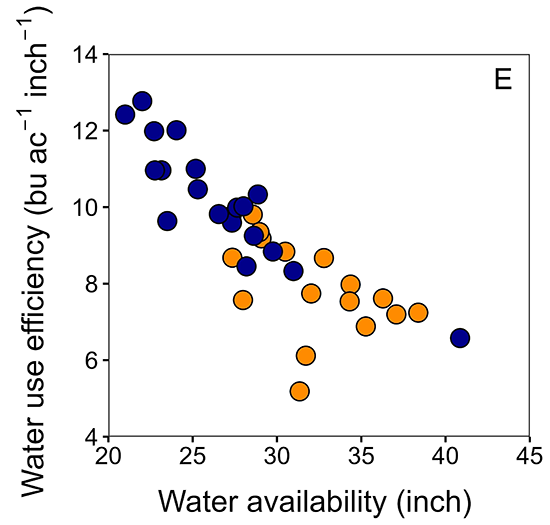
Figure 2E. Association between water use efficiency and water availability across locations. (Orange - Colorado locations; Blue - Nebraska locations)
Irrigation Management
Differences in water use efficiency were driven and explained by changes in water availability rather than by achieved grain yield (Figure 2E). For the analyzed sites there was no correlation between grain yield and water availability (Figure 2C). This lack of association could be related to the lack of severe water-limited growing conditions (less than 15 inches of available water). Fields with higher water availability showed lower water use efficiencies. This is consistent with previous observations in years with varying water availability in the U.S. Midwest (Rotundo et al., 2025).
When analyzing the water balance — the difference between incoming and outgoing water in the crop root zone — fields with significantly greater water availability than the crop’s evapotranspiration exhibited lower water use efficiencies (Figure 3A).
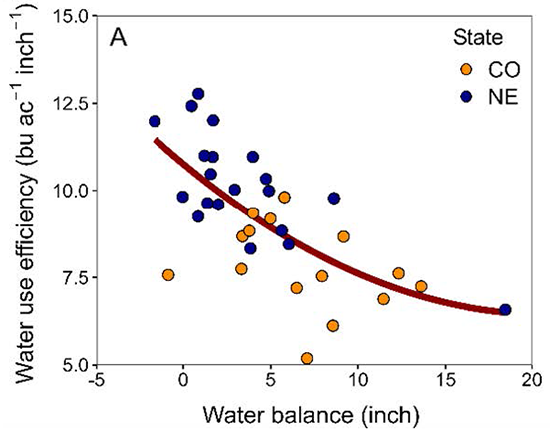
Figure 3A. Irrigation management effect on water use efficiency. Relationship between water balance and water use efficiency across locations.
Water balance ranged from neutral to highly positive, with some fields having up to 18 inches of water applied that was not evapotranspired by the crop. Additionally, experiments located in Colorado tended to show a more positive water balance than those in Nebraska.
| Results showed an opportunity to increase water use efficiency by adjusting irrigation amounts during the grain filling period. |
We further analyzed the water balance across crop stages (Figure 3B).
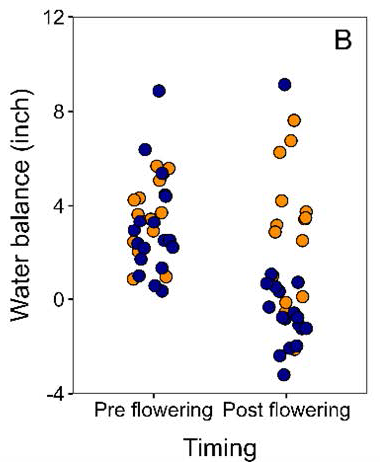
Figure 3B. Water balance before and after flowering across locations. Water balance is the difference between water inputs via rainfall and irrigation and water loss through evapotranspiration. (Orange - Colorado locations; Blue - Nebraska locations)
During the pre-flowering stage, the crop maintained an average positive water balance of 3 inches, which was consistent across both states. However, there were marked differences between the states during the post-flowering stages. In Nebraska, the post-flowering water balance was mostly neutral or slightly negative, while Colorado locations generally had a positive water balance. Based on these findings, there is an opportunity to increase water use efficiency in several locations in Colorado by adjusting irrigation amounts during the grain filling period.
Hybrid Selection and Plant Population
Grain yield response to plant density typically follows a curvilinear pattern, with an optimum plant density that maximizes yield. At low plant densities (below the optimum), yield is limited because not all available resources are captured by the crop, particularly light. With an increase in plant density, the total evapotranspiration remains similar because more water is transpired through the crop and less water is lost by evaporation from the soil surface. Conversely, yield is limited at very high plant densities (above the optimum) due to increased competition among plants. This competition can result in a higher number of barren plants, a reduced harvest index (proportion of biomass allocated into the grain) and an increased risk of lodging.
On average, across all hybrids and locations, the optimum plant density for maximizing yield was 37,000 plants per acre, which achieved an average yield of 259 bushels per acre (Figure 4A).
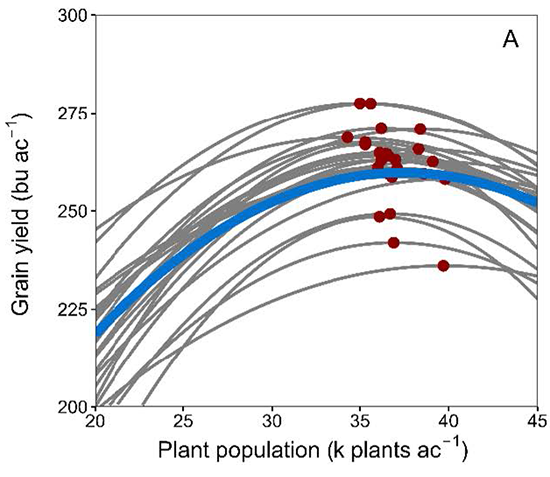
Figure 4A. Plant density effect on grain yield. The blue line represents the average response across hybrids, while grey lines represent the individual responses of each hybrid. The red dots indicate the optimum plant density for each hybrid.
The optimum plant density varied based on the yield target. For a yield target of 210 bushels per acre the optimum density was 34,000 plants acre-1, for a target of 250 bushel per acre it was 36,000 plants acre-1, and for a target of 290 bu acre-1 it was 38,000 plants acre-1. Additionally, there were slight variations in the optimum plant density between states, with locations in Colorado requiring slightly more plants than those in Nebraska to achieve the same yield target.
The response of grain yield to plant density differed among hybrids (Figure 4A). Each hybrid reached its maximum yield at a distinct plant density. Some hybrids required 34,000 plants per acre to maximize their yield, while others needed up to 40,000 plants per acre (Figure 4B).
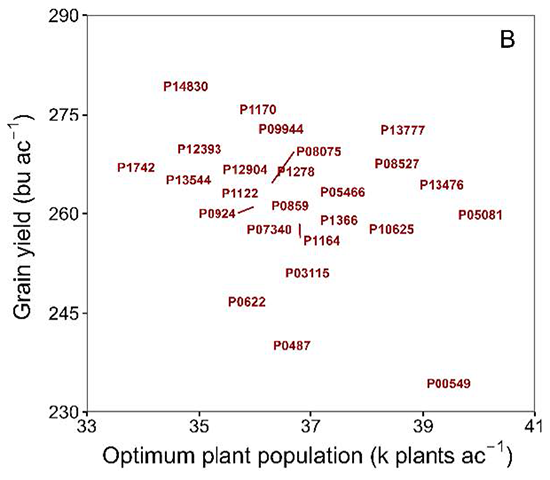
Figure 4B. Hybrid and plant density effects on grain yield and water use efficiency. Plant density that maximized grain yield for each specific hybrid.
Interestingly, hybrids that required a higher number of plants for maximizing yield were not always the ones that produced the highest overall yields. For example, some high-yielding hybrids, such as Pioneer® P14830 and P1742, reached their maximum yield at around 34,500 plants per acre, which was notably lower than the average optimum plant density (37,000 plants per acre).
The plant density that maximized grain yield generally was very similar to the plant density that maximized water use efficiency. On average, across all hybrids and locations, the optimum plant density for maximizing water use efficiency was 36,600 plants per acre. Additionally, there were variations in the maximum water use efficiency attained by different hybrids, as well as in the plant densities that resulted in this maximum efficiency. The optimum plant density ranged from 34,000 to 40,000 plants per acre, while the maximum water use efficiency for hybrids varied from 8.5 to 10 bushels per acre per inch of water. This implies that with 25 inches of available water, a farmer could get a yield from 212 to 250 bushels per acre, depending on the chosen hybrid.
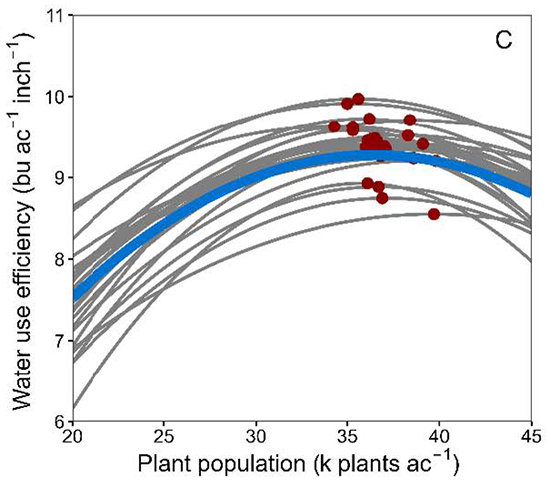
Figure 4C. Plant density effect on water use efficiency. The blue line represents the average response across hybrids, while grey lines represent the individual responses of each hybrid. The red dots indicate the optimum plant density for each hybrid.
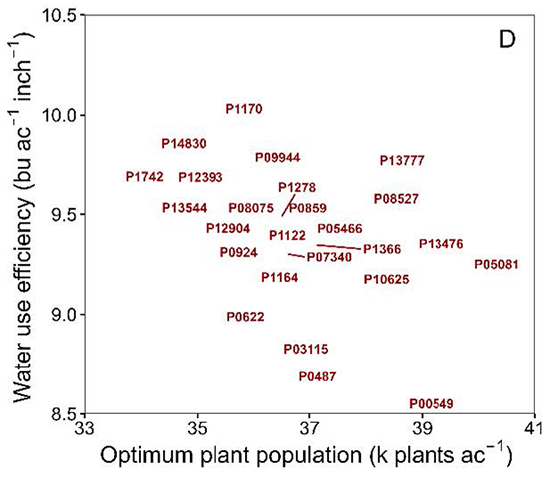
Figure 4D. Hybrid and plant density effects on grain yield. Plant density that maximized water use efficiency for each specific hybrid.
| The plant density that maximized grain yield generally was very similar to the plant density that maximized water use efficiency. |
Conclusions
In the irrigated U.S. Midwest, the thickness of the aquifer from which water is pumped has been declining, posing a risk to crop production. In response, Corteva Agriscience started an agronomy research program to describe the water use efficiency that farmers are getting in their irrigated fields and identify management practices to optimize that efficiency. Between 2023 and 2024, 36 experiments were conducted in growers’ irrigated fields from Colorado and Nebraska, testing commercial hybrids across a range of plant densities. This initiative is ongoing, and in 2025 it was expanded to include 60 more locations, some of which are in Kansas, Oklahoma and Texas.
Water use efficiency in irrigated fields in Colorado and Nebraska averaged 7.8 and 10.6 bushels per acre per inch, respectively. Differences in water use efficiency across fields were explained by irrigation management, with fields that over-irrigated during grain filling showing the lowest efficiencies. Within individual fields, the combination of hybrid and plant density that maximized grain yield also showed the highest water use efficiency. Hybrids differed in the plant density required to maximize yield. Interestingly, hybrids that required a higher number of plants to maximize yield were not always the ones that produced the highest overall yields.
Acknowledgements
Authors wish to thank all growers and agronomists for executing the experiments and collecting the data.
References
- Cohen, I., S.I. Zandalinas, C. Huck, F.B. Fritschi, and R. Mittler. 2021. Meta-analysis of drought and heat stress combination impact on crop yield and yield components. Physiologia Plantarum 171:66-76.
- Dieter, C.A., M.A. Maupin, R.R. Caldwell, M.A. Harris, T.I. Ivahnenko, J.K Lovelace, N.L. Barber, and K.S. Linsey. 2018. Estimated use of water in the United States in 2015. USGS Circular 1441.
- Echarte, L., C.S. Alfonso, H. González, M.D. Hernández, N.A. Lewczuk, L. Nagore, and M.M. Echarte. 2023. Influence of management practices on water-related grain yield determinants. Journal of Experimental Botany 74, 4825-4846.
- Jasechko, S., H. Seybold, D. Perrone, Y. Fan, M. Shamsudduha, R.G. Taylor, O. Fallatah, and J.W. Kirchner. 2024. Rapid groundwater decline and some cases of recovery in aquifers globally. Nature 625:715–721.
- Kusmec, A., and P.S. Schnable. 2024. Phenological adaptation is insufficient to offset climate change-induced yield losses in US hybrid maize. Global Change Biology 30, e17539.
- McGuire, V.L., and K.R. Strauch. 2024. Water-level and recoverable water in storage changes, High Plains Aquifer, predevelopment to 2019 and 2017 to 2019: U.S. Geological Survey Scientific Investigations Report 2023–5143.
- Rotundo, J.L., C. Zinselmeier, N. Hoffman, C. Ferhatoglu, E. Jobbagy, P. Oliver, and L. Borras. 2025. Breeding progress is a major contributor to improved regional maize water productivity. Scientific Reports 15, 13765.
- Whittemore, D.O., J.J. Butler, and B.B. Wilson. 2023 Status of the high plains aquifer in Kansas. Kansas Geological Survey, Technical Series 25.
The foregoing is provided for informational use only. Contact your Pioneer sales professional for information and suggestions specific to your operation. Product performance is variable and subject to any number of environmental, disease, and pest pressures. Individual results may vary. Pioneer® brand products are provided subject to the terms and conditions of purchase which are part of the labeling and purchase documents.