
Country Selector
Please enter a valid location
Field Evaluation of Sidedress Nitrogen Applications in Corn
Agronomy Research Update
Written by Bill Long, Pioneer Field Agronomist and Mark Jeschke, Ph.D., Pioneer Agronomy Manager
Key Findings
- Yield was significantly affected by N management, with the 100 lbs N/A program yielding less than the 150 lbs N/A and 180 lbs N/A rates.
- The four corn hybrids in the study responded similarly to nitrogen management.
- Grain harvest moisture and test weight both differed among hybrids, but neither were affected by nitrogen management.
- Study Objectives
- Study Description
- Results and Discussion
- Reference
Study Objectives
- A field experiment was conducted in Northeast Iowa in 2024 by Heritage Ag Research to evaluate nitrogen management program effects on corn growth and yield.
- The experiment was conducted at two different seeding rates and with four different Pioneer® brand corn products to determine if either hybrid or plant population influenced yield outcomes of different nitrogen management programs.
- Crop canopy biomass and chlorophyll levels were assessed via UAV-based remote sensing at multiple dates during the growing season to evaluate the utility of remote sensing in monitoring crop health and nitrogen status.
Study Description
- Location: Field research site near Readlyn in Northeast Iowa
- Previous Crop: Soybean
- Plot Layout: Four row x 30-ft plots in a split-plot arrangement within a randomized complete block design; 5 replications.
- Seeding Rates: 32,000 and 36,000 seeds/A
Experimental Factors
- Nitrogen Treatment Program
- 100 lbs N/A (50 lbs fb 50 lbs)
- 150 lbs N/A (50 lbs fb 100 lbs)
- 180 lbs N/A (50 lbs fb 130 lbs)
- Hybrid/Brand1
- P00549PCE™ (PW, ENL, RIB) - 100 CRM
- P05737PCE™ (PW, ENL, RIB) - 105 CRM
- P1027AM™ (AM, LL, RR2) - 110 CRM
- P13050AM™ (AM, LL, RR2) - 113 CRM
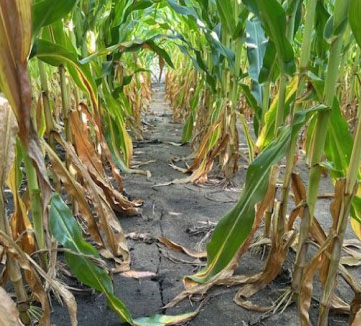
Figure 1. Lower canopy showing symptoms of nitrogen deficiency.
- Corn was planted on May 19, which was later than normal for the location due to above-average rainfall during the spring planting window (Table 1).
Table 1. Cumulative monthly precipitation at the research location near Readlyn, Iowa in 2024 compared to monthly averages.
Month 2024 Average ----- inches ----- April 4.0 3.9 May 10.1 4.7 June 7.2 4.9 July 4.7 4.5 August 2.0 4.1 September 0.4 3.0 - The field study was comprised of two parallel experiments — one planted at 32,000 seeds/A and the other at 36,000 seeds/A. This design allowed comparisons of hybrid and nitrogen management programs at lower and higher seeding rates, but not direct comparisons between seeding rates.
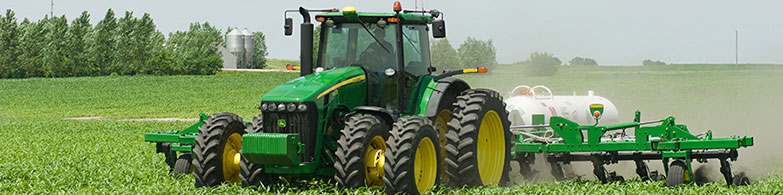
- All nitrogen treatments were applied as sidedress injection of 32% UAN. Initial treatments of 50 lbs N/A were applied on June 14 and follow-up applications of 50, 100 or 130 lbs N/A were applied on June 26.
- Crop canopy data were collected by UAV flights conducted on August 19, September 2, September 20 and October 7.
- Canopy reflectance data from the center two rows of each plot were used to calculate three vegetation indices: normalized difference vegetation index (NDVI), leaf chlorophyll index (LCI) and modified chlorophyll absorption in reflective index (MCARI).
- The study was harvested on October 13 and the center two rows of each four-row plot used to determine yield, grain moisture and test weight.
Results and Discussion
Corn Yield
- Corn yield significantly differed among hybrids at both seeding rates (Figure 3).
- At 32,000 seeds/A, yield of Pioneer® P00549PCE™ brand corn was significantly lower than yield of the other three corn products, an outcome likely at least partly attributable to its shorter relative maturity.
- Yield differences among hybrids were similar at the 36,000 seeds/A rate except for Pioneer P13050AM™, which yielded significantly lower than P05737PCE™ and P1027AM™ at the higher seeding rate.
- Yield was significantly affected by nitrogen management at both seeding rates, with the 100 lbs N/A program yielding less than the 150 lbs N/A and 180 lbs N/A rates (Figure 3).
Corn Yield (bu/A)
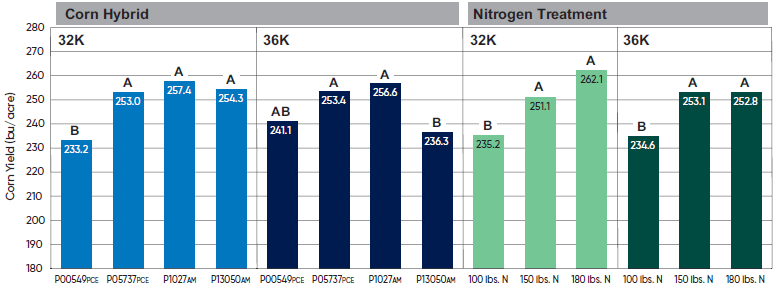
Figure 3. Corn yield by hybrid and nitrogen treatment at 32,000 and 36,000 seeds/A seeding rates. Means with the same letter within each group are not significantly different based on Student’s t test at α=0.05.
- The 180 lbs N/A program did not provide a significant yield advantage over the 150 lbs N/A program and results did not suggest the need for more nitrogen at the higher seeding rate.
- Weather conditions during the 2024 growing season may have factored into the yield results – rainfall was above average early in the season before N was applied but below average following the two application timings.
- A nitrogen experiment using the same total N rates but applied prior to planting may have produced different results, as N applied in April or May would have been at greater risk of loss through leaching and denitrification.
- The lack of a significant interaction between hybrid and nitrogen management at either seeding rate indicates that the hybrids responded similarly to nitrogen management.
- Numerous Pioneer research studies over the years have compared nitrogen rate response of different hybrids (Jeschke and DeBruin, 2016). Differences in hybrid response to N in these studies have generally been relatively minor and inconsistent, which suggests that attempting to tailor nitrogen management programs to individual hybrids is unlikely to improve yield or efficiency.
Harvest Moisture
- Grain moisture at harvest significantly differed among hybrids and was positively correlated with hybrid maturity, an outcome that was to be expected given the relatively wide range hybrid maturities in the study (Figure 4).
Corn Grain Moisture (%)
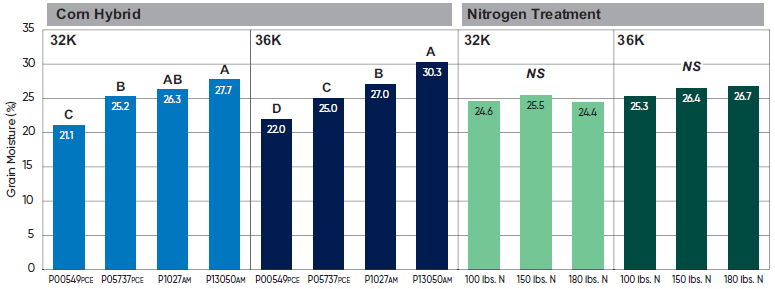
Figure 4. Corn grain moisture at harvest by hybrid and nitrogen treatment at 32,000 and 36,000 seeds/A seeding rates. Means with the same letter within each group are not significantly different based on Student’s t test at α=0.05. NS = no significant difference.
- Grain moisture of hybrids was very similar between seeding rates, except for P13050AM™, which was 2.5 points wetter at the higher seeding rate. The experimental design of this study does not allow any conclusions to be drawn as to whether this was a meaningful difference attributable to seeding rate or not.
- Nitrogen management did not significantly affect grain moisture, nor were there significant hybrid by nitrogen interactions, at either seeding rate.
Test Weight
- Grain test weight significantly differed among hybrids and was inversely correlated with hybrid maturity (Figure 5).
Corn Grain Test Weight (lbs/bu)
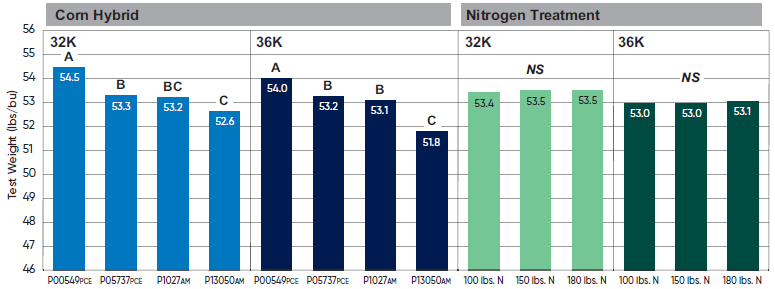
Figure 5. Corn grain moisture at harvest by hybrid and nitrogen treatment at 32,000 and 36,000 seeds/A seeding rates. Means with the same letter within each group are not significantly different based on Student’s t test at α=0.05. NS = no significant difference.
- Nitrogen management did not significantly affect test weight, nor were there significant hybrid by nitrogen interactions, at either seeding rate.
- Test weight was slightly lower across the board at the 36,000 seeds/A seeding rate but, again, it’s unclear given the experimental design if this was a meaningful difference attributable to seeding rate.
- Test weight in this study was likely influenced by the onset of drought stress during the grain filling period, caused by below-average rainfall in August and September.
Vegetation Indices
- There were significant differences among hybrids for all three vegetation indices at all imagery timings (Table 2).
Table 2. Effects of hybrid and nitrogen management on vegetation indices (NDVI, LCI, and MCARI). An ‘x’ indicates that the main effect was significant at α=0.05.
NDVI 8-19 9-2 9-20 10-7 32K Hybrid x x x x Nitrogen x x 36K Hybrid x x x x Nitrogen x x x LCI 8-19 9-2 9-20 10-7 32K Hybrid x x x x Nitrogen x x x 36K Hybrid x x x x Nitrogen x x x x MCARI 8-19 9-2 9-20 10-7 32K Hybrid x x x x Nitrogen 36K Hybrid x x x x Nitrogen - Leaf chlorophyll index (LCI) was the vegetation index most affected by nitrogen management, with significant differences among nitrogen programs in every instance except in the 32,000 seeds/A seeding rate at the final imagery timing.
- NDVI significantly differed among nitrogen programs at the first two imagery timings, only in the higher seeding rate at the third timing and in neither seeding rate at the final timing.
- MCARI was not affected by nitrogen management.
NDVI
- The normalized difference vegetation index (NDVI) is a widely-used metric for quantifying the health and density of vegetation. It is calculated based on reflectance in the red and NIR bands (Figure 6).
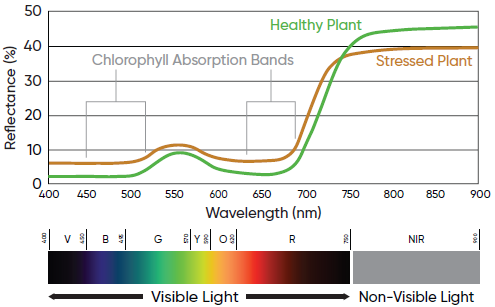
Figure 6. Generalized electromagnetic radiation reflectance profiles of healthy and stressed plants.
- Values near zero indicate bare soil, while higher positive values of NDVI range from sparse vegetation (0.1 - 0.5) to dense green vegetation (0.6 and above).
- NDVI is generally effective at characterizing spatial variability in plant health but it is not as good for tracking changes in crop conditions over time.
LCI
- Leaf chlorophyll index (LCI) is a measure of chlorophyll content in plant leaves in areas of complete leaf coverage. LCI is calculated using reflectance values in the red-edge and near-infrared (NIR) regions.
- The red-edge band is highly sensitive to the light reflected off of the cellular structure of a plant. The NIR region is sensitive to the internal structure of the leaf and its moisture content, which can be used in conjunction with the red-edge band for LCI calculations.
MCARI
- Modified chlorophyll absorption in reflectance index (MCARI) is a vegetation index used to estimate chlorophyll concentration that is sensitive to variations in chlorophyll content and leaf area index (LAI). It’s calculated using reflectance values in the red, green and near-infrared (NIR) spectral bands.
- MCARI is useful when there are high levels of background reflectance from soil and other objects in the imagery. To achieve the highest accuracy of plant health analysis, MCARI should be used together with NDVI or LAI.
- Vegetation index means by hybrid and nitrogen treatment from the August 19 imagery timing are shown in Figure 7, Figure 8 and Figure 9.
- All three vegetation indices showed significant differences among hybrids. NDVI had the greatest degree of statistical separation, with all hybrids differing significantly from each other at both seeding rates (Figure 7).
Normalized Difference Vegetation Index (NDVI)
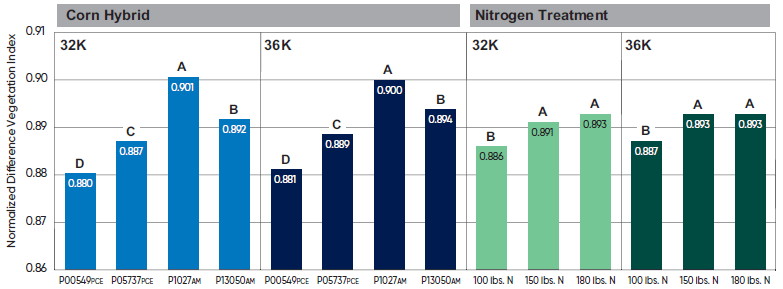
Figure 7. Normalized difference vegetation index (NDVI) by hybrid and nitrogen treatment at 32,000 and 36,000 seeds/A seeding rates on August 19, 2024. Means with the same letter within each group are not significantly different based on Student’s t test at α=0.05.
- LCI showed less statistical separation among hybrids compared to NDVI, but generally similar patterns (Figure 8).
Leaf Chlorophyll Index (LCI)
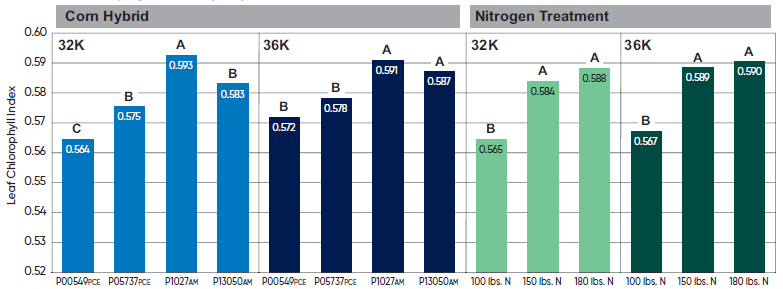
Figure 8. Leaf chlorophyll index (LCI) by hybrid and nitrogen treatment at 32,000 and 36,000 seeds/A seeding rates on August 19, 2024. Means with the same letter within each group are not significantly different based on Student’s t test at α=0.05.
- MCARI differed from the other two indices — at 32,000 seeds/A, P1027AM™ was significantly greater than the other three hybrids, while at 36,000 seeds/A P13050AM™ dropped off compared to the other hybrids (Figure 9).
Modified Chlorophyll Absorption in Reflectance Index (MCARI)
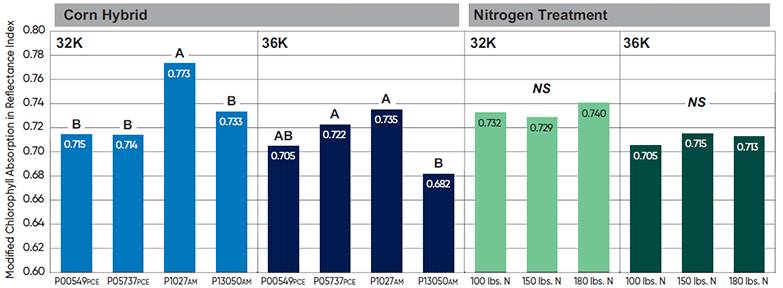
Figure 9. Modified chlorophyll absorption in reflectance index by hybrid and nitrogen treatment at 32,000 and 36,000 seeds/A seeding rates on August 19, 2024. Means with the same letter within each group are not significantly different based on Student’s t test at α=0.05. NS = no significant difference.
- When comparing vegetation indices to yield, hybrid means often ranked in similar order, but significant differences in vegetation indices often occurred where there were no corresponding differences in yield.
- For nitrogen treatments, both NDVI and LCI corresponded with yield results, with values for the 100 lbs N/A treatment significantly lower than the other two rates.
- MCARI did not differ among nitrogen treatments at either seeding rate.
- Figure 10, Figure 11 and Figure 12 show how vegetation indices changed at later imagery timings. All three declined toward the end of the season, with the greatest decline in late-September to early October as the canopy senesced.
- NDVI remained relatively unchanged until the final imagery timing on October 7 (Figure 10), while both LCI and MCARI had noticeable declines by September 20 (Figure 11 and Figure 12).
Normalized Difference Vegetation Index (NDVI)
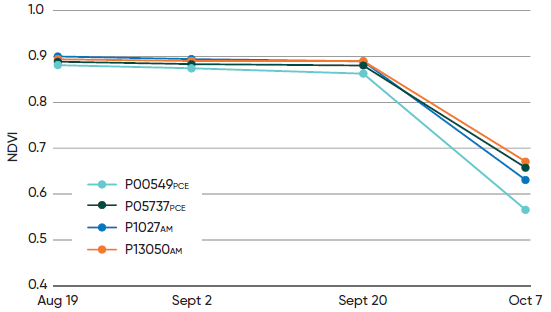
Figure 10. Normalized difference vegetation index (NDVI) by hybrid at 36,000 seeds/A seeding rate.
Leaf Chlorophyll Index (LCI)
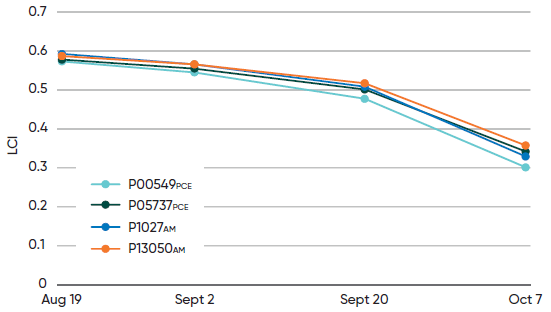
Figure 11. Leaf chlorophyll index (LCI) by hybrid at 36,000 seeds/A seeding rate.
Modified Chlorophyll Absorption in Reflectance Index (MCARI)
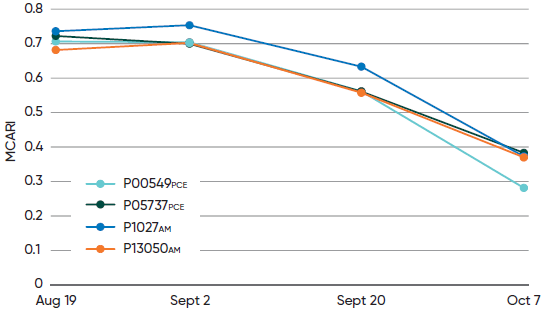
Figure 12. Modified chlorophyll absorption in reflectance index (MCARI) by hybrid at 36,000 seeds/A seeding rate.
- The primary interest in vegetation indices in this study was in their utility for assessing nitrogen status and predicting associated yield outcomes.
- Results suggest that NDVI and LCI could be useful for this purpose, but differences in these indices among hybrids were equal to or greater than those among nitrogen treatments, suggesting the need to calibrate predictions to individual hybrids.
- The effect of hybrid differences in NDVI on nitrogen status assessment is illustrated in Figure 13.
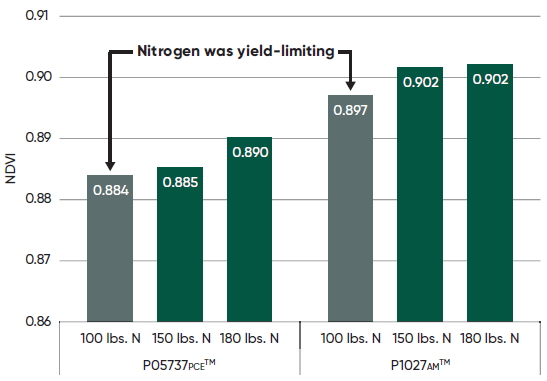
Figure 13. Normalized difference vegetation index (NDVI) by nitrogen treatment for P05737PCE™ and P1027AM™ at 32,000 seeds/A.
- This example shows NDVI values by nitrogen treatment for P05737PCE™ and P1027AM™, two hybrids that had a signficant difference in NDVI values despite no significant difference in yield.
- The NDVI value for P1027AM™ at the lowest nitrogen treatment rate — which was yield-limiting — is greater than the NDVI values for P05737PCE™ at the upper two nitrogen treatment rates, where nitrogen was not yield-limiting.
Reference
Jeschke, M., and J. DeBruin. 2016. Corn Hybrid Response to Nitrogen Fertilizer Pioneer Crop Insights. Vol 26, No. 8. Corteva Agriscience. Johnston, IA.




PCE – Powercore® Enlist® Refuge Advanced® corn products with HX1, VTP, ENL, LL, RR2. Contains a single-bag integrated refuge solution for above-ground insects. In EPA-designated cotton-growing counties, a 20% separate corn borer refuge must be planted with PowerCore Enlist Refuge Advanced products. AM - Optimum® AcreMax® Insect Protection system with YGCB, HX1, LL, RR2. Contains a single-bag integrated refuge solution for above-ground insects. In EPA-designated cotton growing counties, a 20% separate corn borer refuge must be planted with Optimum AcreMax products.
POWERCORE® is a registered trademark of Bayer Group. POWERCORE® multi-event technology developed by Corteva Agriscience and Bayer Group. LibertyLink® and the Water Droplet Design are registered trademarks of BASF. ®Roundup and Roundup Ready are registered trademarks of Bayer Group. Always follow IRM, grain marketing and all other stewardship practices and pesticide label directions. B.t. products may not yet be registered in all states. Check with your seed representative for the registration status in your state.
Following burndown, Enlist Duo® and Enlist One® herbicides with Colex-D® technology are the only herbicides containing 2,4-D that are authorized for preemergence and postemergence use with Enlist® crops. Consult Enlist® herbicide labels for weed species controlled. Enlist Duo and Enlist One herbicides are not registered for use or sale in all states and counties; are not registered in AK, CA, CT, HI, ID, MA, ME, MT, NH, NV, OR, RI, UT, VT, WA and WY; and have additional subcounty restrictions in AL, GA, TN and TX, while existing county restrictions still remain in FL. All users must check “Bulletins Live! Two” no earlier than six months before using Enlist One or Enlist Duo. To obtain “Bulletins,” consult epa.gov/espp/, call 1-844-447-3813, or email ESPP@epa.gov. You must use the “Bulletin” valid for the month and state and county in which Enlist One or Enlist Duo are being applied. Contact your state pesticide regulatory agency if you have questions about the registration status of Enlist® herbicides in your area. ALWAYS READ AND FOLLOW PESTICIDE LABEL DIRECTIONS. IT IS A VIOLATION OF FEDERAL AND STATE LAW TO USE ANY PESTICIDE PRODUCT OTHER THAN IN ACCORDANCE WITH ITS LABELING. ONLY USE FORMULATIONS THAT ARE SPECIFICALLY LABELED FOR SUCH USE IN THE STATE OF APPLICATION. USE OF PESTICIDE PRODUCTS, INCLUDING, WITHOUT LIMITATION, 2,4-D-CONTAINING PRODUCTS NOT AUTHORIZED FOR USE WITH ENLIST CROPS, MAY RESULT IN OFF-TARGET DAMAGE TO SENSITIVE CROPS/AREAS AND/OR SUSCEPTIBLE PLANTS, IN ADDITION TO CIVIL AND/OR CRIMINAL PENALTIES. Additional product-specific stewardship requirements for Enlist crops, including the Enlist Product Use Guide, can be found at www.traitstewardship.com.
The foregoing is provided for informational use only. Please contact your Pioneer sales professional for information and suggestions specific to your operation. 2024 data are based on average of all comparisons made in one locations through Oct 31, 2024. Multi-year and multi-location is a better predictor of future performance. Do not use these or any other data from a limited number of trials as a significant factor in product selection. Product performance is variable and depends on many factors such as moisture and heat stress, soil type, management practices and environmental stress as well as disease and pest pressures. Individual results may vary. Pioneer® brand products are provided subject to the terms and conditions of purchase which are part of the labeling and purchase documents.