
Country Selector
Please enter a valid location
Foliar Fungicide Use in Soybeans
Crop Insights
Written by Mark Jeschke, Ph.D., Pioneer Agronomy Manager

Does It Pay to Spray Soybeans?
Does it actually pay to use foliar fungicides in soybeans? Mark Jeschke breaks down what fungicides can — and can't — do. Sudden death syndrome and red crown rot? Not controlled by fungicides. White mold? That's the bigger threat, and it may call for a foliar fungicide.
Does It Pay to Spray Soybeans?
Does it actually pay to use foliar fungicides in soybeans? Mark Jeschke breaks down what fungicides can — and can't — do. Sudden death syndrome and red crown rot? Not controlled by fungicides. White mold? That's the bigger threat, and it may call for a foliar fungicide.
- Key Points
- Soybean Diseases Controlled by Fungicides
- Yield Response to Fungicide Treatment
- Application Timing
- Plant Health Effects
- When to Use Fungicides in Soybeans
- Fungicides
- Fungicide Stewardship
- References
Key Points
- Foliar fungicides have proven effective in helping to manage several common foliar diseases in soybeans.
- University fungicide trials have commonly found average fungicide yield responses in the 1.5 to 2.0 bu/A range.
- Fungicides applications are most likely to be profitable when utilized in situations with a higher-than-normal risk of disease development.
- Research has generally found that foliar fungicide treatments provide the greatest benefit in soybeans when applied at the R3 growth stage.
- The most important factors influencing risk of disease development in soybeans are the amount of rainfall received during the period leading up to R3 and the genetic susceptibility of the soybean variety to diseases.
- Pathologists recommend mixing or rotating fungicide modes of action to slow the development of resistance in pathogens.
Soybean Diseases Controlled by Fungicides
Foliar fungicides have proven effective in helping to manage several common foliar diseases in soybean. Around 22% of U.S. soybean acres currently receive a foliar fungicide treatment (USDA-NASS, 2024).
When considering the potential value foliar fungicide use in soybeans, it is important to understand which diseases can be controlled with fungicides, because some of the most important ones are not. Fungicide treatments only control fungal diseases, so are ineffective against bacterial and viral diseases. Fungicides also will not control fungal diseases that infect the plants in the roots and stems, which includes the most economically important fungal disease of soybeans in the U.S., sudden death syndrome (Fusarium virguliforme). Despite the distinctive foliar symptoms associated with this disease that can appear later in the season, the actual fungal infection takes place earlier in the season in the roots. Red crown rot (Calonectria ilicicola) and brown stem rot (Cadophora gregata) are not controlled by foliar fungicides for the same reason — infection occurs early through the roots.
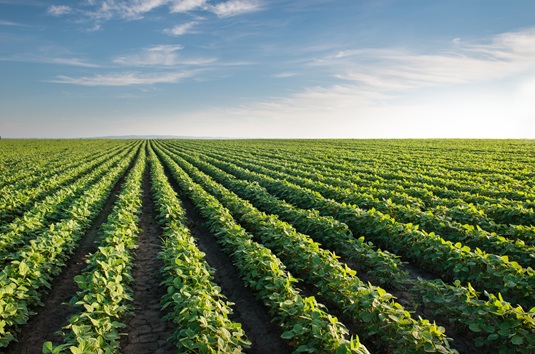
Economically important diseases of soybeans that are controlled by foliar fungicides include septoria brown spot, frogeye leaf spot, cercospora leaf blight, target spot and white mold.
Septoria Brown Spot (Septoria glycines)
Septoria brown spot is widely distributed across the country and is especially prevalent in agricultural systems in which soybeans are grown continuously. Although it is the most common foliar disease of soybeans, it rarely causes significant yield loss.
Disease starts in the lower canopy early in the season and will progress to the upper canopy if conditions are favorable. Yield impact depends on how far up the canopy the disease progresses during grain fill. Warm temperatures (60-85ºF) and humid conditions that allow extended periods of leaf wetness are conducive for disease development. Septoria can become an issue with heavy and frequent rainfall later in the season.
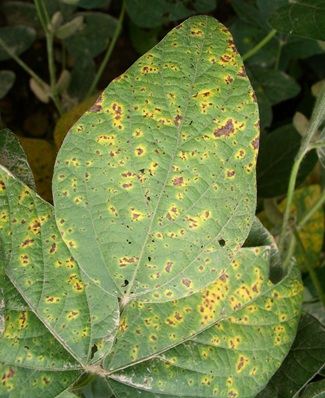
Figure 1. Septoria brown spot
Frogeye Leaf Spot (Cercospora sojina)
The frogeye leaf spot pathogen infects the leaves, stems and pods of soybeans in areas with warm, humid conditions and frequent rain. It is most common in the mid-south, Mississippi Delta and Southeastern soybean growing areas..
The risk of yield loss from frogeye leaf spot depends on the disease severity and varietal susceptibility. Timely fungicide application can preserve green leaf material and prevent disease spread by sporulation. Strains resistant to Group 11 quinone outside inhibitor (QoI) fungicides (also known as strobilurins) have been documented in numerous states, so it is important to use a fungicide product with effective modes of action.
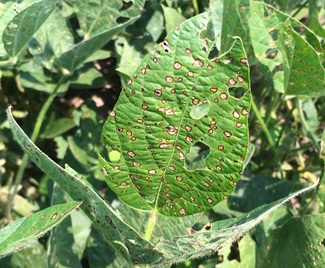
Figure 2. Frogeye leaf spot
Cercospora Leaf Blight (Cercospora kikuchii)
Cercospora leaf blight can be found throughout the US and Canada and is favored by hot and humid conditions. The leaf blight phase of the disease generally begins in August at the start of pod fill on late planted soybeans.
Defoliation may reduce yield if disease occurs early relative to pod fill. Significant yield loss is more common in southern states than in northern and central states. Purple seed stain caused by the disease may reduce quality and marketability of soybeans.
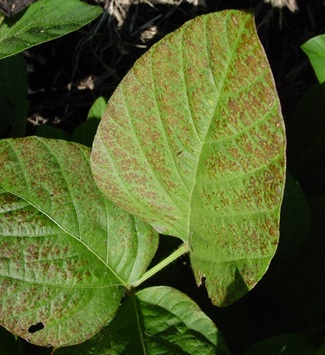
Figure 3. Cercospora leaf blight
Target Spot (Corynespora cassiicola)
Target spot is a common pathogen of soybeans in the mid-south and southern states; however, yield loss associated with this disease is rare. Symptoms of target spot will appear in the lower canopy first as spores spread from residue, typically around canopy closure.
Infection humidity requires high and extended periods of moisture on tissue surfaces. Multiple consecutive days of rainfall can increase disease incidence, especially when dense canopies limit air flow. A fungicide treatment may be justified when weather conditions are highly favorable for disease development.
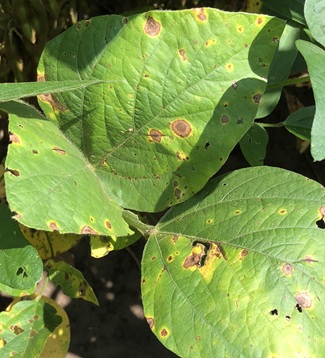
Figure 4. Target Spot
White Mold ((Sclerotinia sclerotiorum)
White mold is a fungal disease that can attack hundreds of plant species. White mold can infect soybeans across a wide geography with favorable climatic conditions for disease establishment, including several northern and near-northern states in the U.S., and Ontario and Quebec in Canada.
Infection is favored by wet and cool conditions during flowering. Dense canopies with high moisture and temperatures ranging from 68-78ºF (20-25ºC) are conducive for disease development. Fungicide treatments generally will not provide complete control of white mold. Reduction of disease in university field trials has ranged from 0 to 60% (Mueller et al., 2015). Consequently, chemical treatments need to be used as part of an integrated management strategy for white mold.
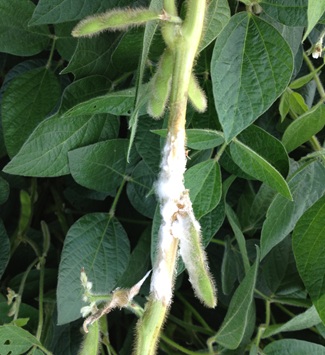
Figure 5. White Mold
Yield Response to Fungicide Treatment
| "University fungicide trials have commonly found average fungicide yield responses in the 1.5 to 2.0 bu/A range." |
Some of the first Pioneer research on foliar fungicides in soybeans, conducted from 2004 to 2008 in small plot trials located in Illinois, Indiana, Minnesota and Nebraska, found an average yield benefit of 3.3 bu/A with R3 applications across 100 comparisons (Trybom and Jeschke, 2009). Treatments in this study were all single mode of action fungicides (either pyraclostrobin or azoxystrobin). Subsequent research suggests that results from this study represent the high end of the yield response range that can generally be expected with foliar fungicides in soybean under typical levels of disease pressure. An analysis of 378 Pioneer on-farm side by- side strip trials conducted from 2007 to 2023 found an average yield response to foliar fungicide treatment of 2.5 bu/A.
University fungicide trials have commonly found average fungicide yield responses in the 1.5 to 2.0 bu/A range. A large meta-analysis of 240 university foliar fungicide trials conducted from 2005 to 2018 across 10 states/provinces (IA, IL, IN, MI, MN, ND, NE, SD, WI and ON) found an average yield response of 1.8 bu/A (Kandel et al., 2021). Field trials conducted by the University of Missouri from 2018 to 2024 found an average fungicide yield response of 1.8 bu/A across 64 locations (Bish, 2024). On-farm trials conducted by North Carolina State University in 2022 and 2023 found an average yield response of 2.0 bu/A (Berryhill and Vann, 2024).
A yield response to foliar fungicide application of 2 bu/A or less is unlikely to cover the cost of treatment in most cases (Table 1); consequently, university pathologists generally do not recommend routine use of foliar fungicides in soybeans unless there is a reason to expect that disease pressure will be higher than normal.
Table 1. Yield response necessary to cover the cost of fungicide and application over a range of costs and soybean prices.
| Fungicide + Application Cost/Acre | Soybean Price ($/bu) | ||||||
|---|---|---|---|---|---|---|---|
| 8 | 9 | 10 | 11 | 12 | 13 | 14 | |
| ------------- bu/A ------------- | |||||||
| 20 | 2.5 | 2.2 | 2.0 | 1.8 | 1.7 | 1.5 | 1.4 |
| 22 | 2.8 | 2.4 | 2.2 | 2.0 | 1.8 | 1.7 | 1.6 |
| 24 | 3.0 | 2.2 | 2.7 | 2.4 | 2.0 | 1.8 | 1.7 |
| 26 | 3.3 | 2.9 | 2.6 | 2.4 | 2.2 | 2.0 | 1.9 |
| 28 | 3.5 | 3.1 | 2.8 | 2.5 | 2.3 | 2.2 | 2.0 |
| 30 | 3.8 | 3.3 | 3.0 | 2.7 | 2.5 | 2.3 | 2.1 |
| 32 | 4.0 | 3.6 | 3.2 | 2.9 | 2.7 | 2.5 | 2.3 |
| 34 | 4.3 | 3.8 | 3.4 | 3.1 | 2.8 | 2.6 | 2.4 |
| 36 | 4.5 | 4.0 | 3.6 | 3.3 | 3.0 | 2.8 | 2.6 |
| 38 | 4.8 | 4.2 | 3.8 | 3.5 | 3.2 | 2.9 | 2.7 |
| 40 | 5.0 | 4.4 | 4.0 | 3.6 | 3.3 | 3.1 | 2.9 |
In instances with high disease pressure, however; foliar fungicide treatments can provide a substantial return on investment. In the University of Missouri study, the highest individual location yield response was over 12 bu/A (Bish, 2024). In the NC state study, individual location yield responses were as high as 10 and 11 bu/A (Berryhill and Vann, 2024). Corteva Agriscience research trials conducted at locations with high white mold pressure in 2017 found a 9 bu/A yield response with a single pass fungicide treatment and 13 bu/A with a two-pass treatment (Jeschke, 2026) (Figure 6).
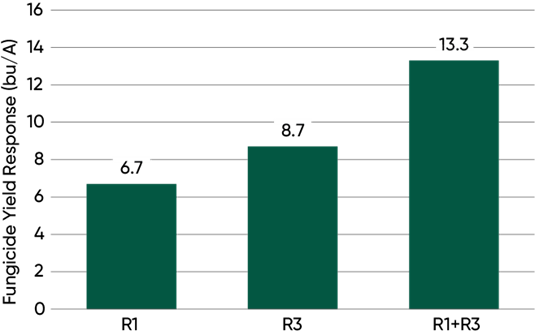
Figure 6. Soybean yield response to fungicide treatments in on-farm trials with heavy white mold pressure in Wisconsin and Nebraska in 2017.
Application Timing
Research has generally found that foliar fungicide treatments provide the greatest benefit in soybeans when applied at the R3 growth stage. The R3 stage represents beginning pod and is defined by the presence of a pod at least 3/16-inch long at one of the four uppermost nodes on the main stem with a fully developed leaf. Pioneer small plot research found a 3.3 bu/A average yield advantage with R3 application compared to 2.3 bu/A at R1 and 2.2 bu/A at R5 (Trybom and Jeschke, 2009) (Figure 7).
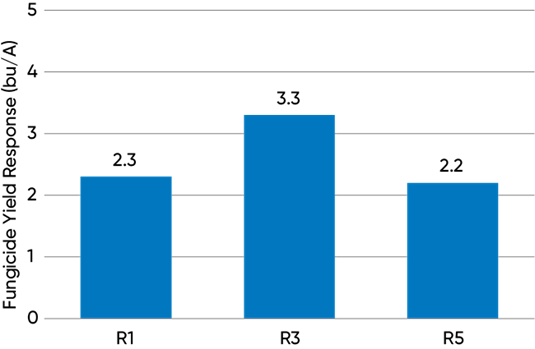
Figure 7. Average soybean yield response to foliar fungicides applied at the R1, R3, and R5 growth stages in Pioneer Agronomy Sciences research (2004-2008).
The one exception to this recommendation has typically been for applications specifically targeting white mold. The most frequently recommended fungicide application timing for white mold control in soybeans is the R1 to R2 growth stage, also known as the beginning flowering and full flowering stages, respectively (Mueller et al., 2015). Applying earlier than R3 can allow for better spray penetration into the canopy to protect flowers lower on the plant.
Fungicides applied up to the R3 stage have proven beneficial in reducing white mold, and more recent research has led some pathologists to recommend shifting white mold treatments later to the R3 stage while still emphasizing the importance of good spray penetration (Smith, 2025). Corteva Agriscience on-farm trials in Wisconsin that compared R1 and R3 applications for control of white mold found that both application timings provided a good return on investment but the R3 timing had a greater yield benefit than the R1 timing (Jeschke, 2026) (Figure 7).
Fields with high white mold pressure are also one of the few instances in which a two-pass fungicide program may be justified in soybeans. Fungicides have little activity on established disease and must be applied prior to white mold invasion of senescing flowers. Because soybeans normally flower for 30 days or more (R1 to R5), a second application may be necessary if conducive environmental conditions persist into mid-summer.
Plant Health Effects
Physiological “plant health” effects of fungicide treatments have often been touted as providing a yield benefit even in the absence of disease pressure. These benefits may include reduced ethylene production, improved CO2 assimilation, increased water use efficiency, increased stress tolerance during flowering and pod fill and delayed plant senescence. Significant beneficial physiological effects of fungicide treatments have been documented (Zhang et al., 2010); however, field research results in soybeans indicate that whatever plant health benefits a fungicide treatment may provide, they are unlikely to pay for the cost of treatment.
When to Use Fungicides in Soybeans
Research results generally do not support routine use of foliar fungicides across all acres in soybean, as the average increase in yield is unlikely to exceed the cost of the treatment. Fungicide applications are more likely to be profitable when selectively utilized in situations with a higher-than-normal risk of disease development. The United Soybean Board developed a scorecard to help soybean growers assess the risk for disease development in a soybean field, aiding the decision of whether or not to apply a fungicide. Factors that can influence disease risk included on the scorecard are weather conditions, variety disease susceptibility, crop rotation, tillage, irrigation and soybean planting date.
Weather Conditions
One of the most important factors influencing risk of disease development in soybeans is weather conditions – specifically, the amount of rainfall in the period leading up to the reproductive growth period. Foliar diseases are generally favored by extended periods of leaf wetness, so repeated rain events can elevate the risk of disease development.
Variety Disease Susceptibility
In addition to weather conditions, the other most important factor influencing disease risk in soybeans is the genetic disease susceptibility of the soybean variety. Soybean varieties can differ in their level of genetic resistance to foliar diseases, and a susceptible variety can greatly increase the risk of economic levels of disease development. Pioneer® brand soybean varieties are rated for their genetic resistance to white mold, frogeye leaf spot and cercospora. Ratings are assigned on a 1 to 9 scale, with 1 to 3 indicating a susceptible variety, 4 to 5 moderately resistant, 6 to 7 resistant and 8 to 9 highly resistant.
Crop Rotation
Soybeans are not usually planted multiple years in a row in the same field; however, in cases where they are, the increased inoculum load in crop residue from prior seasons can increase the risk of disease development. Pathogens causing frogeye leaf spot, septoria brown spot, cercospora leaf blight and target spot overwinter in soybean residue. White mold overwinters as sclerotia in the soil, quantities of which can build up when multiple host crops are grown in succession.
Tillage
Since common foliar disease pathogens overwinter in crop residue, tillage systems that leave more residue on the surface can elevate the risk of disease development.
Irrigation
Overhead irrigation systems can increase the risk of soybean disease development if irrigation applications create prolonged period of leaf wetness.
Planting Date
The meta-analysis by Kandel et al (2021) found a greater fungicide yield response with timely planting of soybeans (up to May 21) compared to late planting (after May 21). This could be due to earlier canopy closure with earlier-planted soybeans.
Fungicides
As foliar fungicide use in soybeans has become more common, the number of products in the marketplace has increased. Older fungicides typically only had one active ingredient, but many newer ones have two, or even three, active ingredients with different modes of action. Fungicides inhibit fungal growth by disrupting critical processes in fungal cells. Fungicide mode of action (MOA) refers to the cellular process inhibited by a fungicide. Fungicide target site (or site of action) refers to the specific enzyme involved in a cellular process to which a fungicide binds.
Target site is the basis for FRAC codes, which are group numbers assigned by the Fungicide Resistance Action Committee that are shown on fungicide product labels (Figure 8).
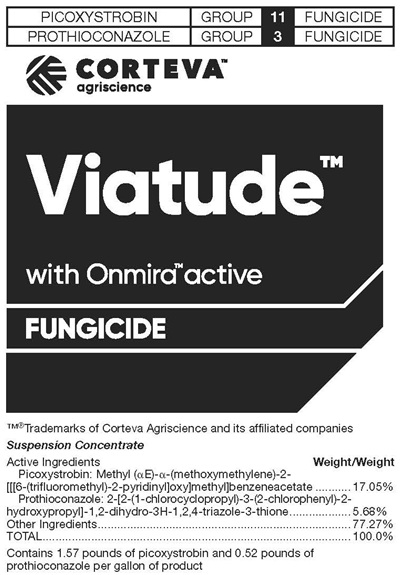
Figure 8. Example of a fungicide product label showing the names of FRAC groups and the active ingredients.
A pathogen that develops resistance to a specific fungicide will generally also be resistant to other fungicides that share the same target site, a phenomenon known as cross resistance. Consequently, from a resistance management standpoint, target site is the most important distinguishing factor for categorizing fungicides. FRAC currently recognizes 12 different known fungicide modes of action. Of these, four are currently utilized in foliar fungicide products used in soybeans: inhibition of cellular respiration, inhibition of sterol biosynthesis in cell membranes, cytoskeleton and motor protein disruption and biologicals with multiple modes of action. This includes six different FRAC groups (target sites), three of which share the same mode of action:
- Group 1: Methyl Benzimidazole Carbamates (MBC) — cytoskeleton and motor protein
- Group 3: Demethylation Inhibitors (DMI) — sterol biosynthesis
- Group 7: Succinate Dehydrogenase Inhibitors (SDHI) — cellular respiration
- Group 11: Quinone Outside Inhibitors (QoI) — cellular respiration
- Group 29: Uncouplers of Oxidative Phosphorylation (2,6-dinitro-anilines) — cellular respiration
- Group BM-01: Plant Extracts — biologicals with multiple modes of action
The majority of fungicide products labelled for use in soybeans contain some combination of active ingredients from Groups 3, 7 and 11, which are the same groups used in corn.
Fungicide Stewardship
Development of pathogen resistance to fungicides is an issue with soybean diseases and offers another reason to avoid widespread, indiscriminate use. Fungicide groups with high resistance risk include Group 11 (QoI) and Group 1 (MBC). Group 7 (SDHI) is considered medium to high risk, Group 3 (DMI) has a medium resistance risk, and Group 29 (2,6-dinitro-anilines) is low risk (FRAC 2024). Frogeye leaf spot resistance to Group 11 fungicides has been confirmed in numerous states (Mathew et al. 2019; Neves et al. 2020; Piñeros-Guerrero et al. 2023; Zhang et al. 2018). Resistance to Group 11 fungicides has also been confirmed in septoria brown spot (Neves et al., 2022) and cercospora leaf blight (Price et al., 2015).
In the mid-2000s, when foliar fungicides started to come into common usage in soybeans, most fungicide products available to growers only included one active ingredient. Today, many fungicide products have multiple active ingredients. Numerous Group 11 + Group 3 products are available and Group 11 + Group 3 + Group 7 products have become more common in recent years.
Pathologists recommend mixing or rotating fungicide modes of action to slow the development of resistance in pathogens. By using fungicides with different modes of action, growers can reduce the selection pressure on fungal populations, slowing down the development of resistance to specific fungicide types (van den Bosch et al., 2014).
This is important for preserving the effectiveness of fungicides, especially products considered high risk for resistance development. Fungicides with multiple modes of action can also provide more effective disease control by targeting a broader range of fungal diseases and pathogens and providing more comprehensive protection for the soybean crop. The meta-analysis by Kandel et al (2021) found a greater average yield response to fungicides with multiple modes of action (Figure 9).
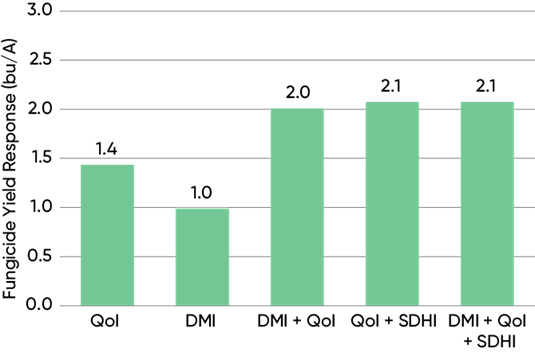
Figure 9. Average difference between fungicide treated and nontreated plots by fungicide group (Kandel et al., 2021).
References
- Berryhill, M. and R. Vann. 2024. Soybean On-Farm Trial Results: Foliar Fungicide Use. NC state University Extension.
- Bish, M. 2025. Study Finds Fungicide Use on Soybeans Often Costs Farmers More Than It Pays. Missouri Soybeans.
- Fungicide Resistance Action Committee (FRAC). 2024. FRAC Code List 2024: Fungal control agents sorted by cross resistance pattern and mode of action (including coding for FRAC groups on product labels).
- Jeschke, M. 2026. White mold management in soybeans. Pioneer Crop Insights Vol. 36 No. 9. Corteva Agriscience. Johnston, IA.
- Kandel, Y.R., C. Hunt, K. Ames, N. Arneson, C.A. Bradley, E. Byamukama, A. Byrne, M.I. Chilvers, L.J. Giesler, J. Halvorson, D.C. Hooker, N.M. Kleczewski, D.K. Malvick, S. Markell, B. Potter, W. Pedersen, D.L. Smith, A.U. Tenuta, D.E.P. Telenko, K.A. Wise, and D.S. Mueller. 2021. Meta analysis of soybean yield response to foliar fungicides evaluated from 2005 to 2018 in the United States and Canada. Plant Disease 105:1382-1389.
- Mathew, F.M., E. Byamukama, D.L. Neves, and C.A. Bradley. 2019. Resistance to quinone outside inhibitor fungicides conferred by the G143A mutation in Cercospora sojina (causal agent of frogeye leaf spot) isolates from South Dakota soybean fields. Plant Health Prog. 20:104-105.
- Mueller, D., C. Bradley, M. Chilvers, P. Esker, D. Malvick, A. Peltier, A. Sisson, and K. Wise. 2015. White Mold. Soybean Disease Management CPN-1005. Crop Protection Network.
- Neves, D.L., M.I. Chilvers, T.A. Jackson-Ziems, D.K. Malvick, and C.A. Bradley. 2020. Resistance to quinone outside inhibitor fungicides conferred by the G143A mutation in Cercospora sojina (causal agent of frogeye leaf spot) isolates from Michigan, Minnesota, and Nebraska soybean fields. Plant Health Prog. 21:230-231.
- Neves, D.L., A. Wang, J.D. Weems, H.M. Kelly, D.S. Mueller, M. Farman, and C.A. Bradley. 2022. Identification of Septoria glycines isolates from soybean with resistance to quinone outside inhibitor fungicides. Plant Dis. 106:2631-2637.
- Piñeros-Guerrero, N., D.L. Neves, C.A. Bradley, and D.E.P. Telenko. 2023. Determining the distribution of QoI fungicide-resistant Cercospora sojina on soybean from Indiana. Plant Dis. 107:1012-1021.
- Price, P.P., III, M.A. Purvis, G. Cai, G.B. Padgett, C.L. Robertson, R.W. Schneider, and S. Albu. 2015. Fungicide resistance in Cercospora kikuchii, a soybean pathogen. Plant Dis. 99:1596-1603.
- Smith, D. 2025. Hello White Mold, My Old Friend… Badger Crop Network. University of Wisconsin-Madison Extension.
- Trybom, J. and M. Jeschke. 2009. Foliar fungicide and insecticide effects on soybean yield. Pioneer Crop Insights Vol. 19 No. 1 Corteva Agriscience. Johnston, IA.
- United States Department of Agriculture – National Agricultural Statistics Service (USDA-NASS). 2024. 2023 Agricultural Chemical Use Survey - released May 10, 2024.
- van den Bosch, F., N. Paveley, F. van den Berg, P. Hobbelen, and R. Oliver. 2014. Mixtures as a fungicide resistance management tactic. Phytopathology 104:1264-1273.
- Zhang, G., T.W. Allen, J.P. Bond, A.M. Fakhoury, A.E. Dorrance, L. Weber, T.R. Faske, L.J. Giesler, D.E. Hershman, B.S. Kennedy, D.L. Neves, C.A. Hollier, H.M. Kelly, M.A. Newman, N.M. Kleczewski, S.R. Koenning, L.D. Thiessen, H.L. Mehl, T. Zhou, M.D. Meyer, D.S. Mueller, Y.R. Kandel, P.P. Price III, J.C. Rupe, E.J. Sikora, J.R. Standish, M. Tomaso Peterson, K.A. Wise, and C.A. Bradley. 2018. Widespread occurrence of quinone outside inhibitor fungicide-resistant isolates of Cercospora sojina, causal agent of frogeye leaf spot of soybean, in the United States. Plant Health Prog. 19:295-302.
Sprayer images courtesy of CNH.
The foregoing is provided for informational use only. Please contact your Pioneer sales professional for information and suggestions specific to your operation. Product performance is variable and subject to any number of environmental, disease, and pest pressures. Individual results may vary. Pioneer® brand products are provided subject to the terms and conditions of purchase which are part of the labeling and purchase documents.