
Country Selector
Please enter a valid location
6/24/2025
Fungicide Application Timing in Corn
Crop Focus
Written by Mark Jeschke, Ph.D., Pioneer Agronomy Manager
Key Points
- The onset and progression of foliar disease in corn is heavily dependent on environmental conditions, which can make timing a fungicide application challenging.
- Research has shown that VT/R1 is generally the most consistently effective fungicide application timing for disease control and yield protection.
- Applications as late as R3 may be optimal in some cases with later flushes of disease. Applications after R3 are less likely to be economically beneficial as the crop gets closer to physiological maturity.

- Optimizing Fungicide Application Timing
- Fungicide Application Timing Research
- Vegetative Stage Applications
- References
Optimizing Fungicide Application Timing
- Application timing of a foliar fungicide treatment in corn is important for maximizing disease control and yield.
- There are three main factors that influence optimal fungicide application timing in corn:
- Duration of fungicide activity
- Timing of disease onset and progression
- Critical period for protecting corn yield
Duration of Fungicide Activity
- If one fungicide application could provide season-long disease protection, application timing would be far less important, but fungicides have a limited window of efficacy.
- Foliar fungicides generally have around 21 days of activity, with some newer products as long as 35 days.
- The total duration of the reproductive growth period in corn, from silking to black layer, is typically around 65 days, so a fungicide application will only provide disease protection for around half of that period at most.
Timing of Disease Onset and Progression
- A fungicide needs to be present on the plant prior to pathogen infection or in the very early stages of infection to be effective (Mueller and Robertson, 2008).
- Ideally, the best time to apply a fungicide would be right when foliar disease is beginning to proliferate within the crop canopy – aligning the window of maximum fungicide activity with the phase of disease progression when it would have the greatest impact.
- In practice, this is challenging to do because the onset and progression of foliar disease is heavily dependent on environmental conditions.
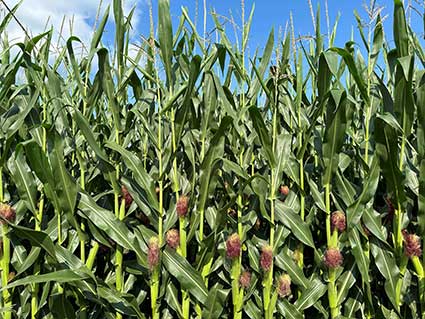
- Foliar diseases are generally most active during the latter part of the season when corn is in the reproductive growth stages.
- Environmental conditions tend to be more favorable for foliar disease development during this time – temperatures are more conducive for disease development and the shading of the crop canopy helps preserve moisture on the lower leaves.
- Additionally, as the plants begin shifting resources toward the developing ear, the leaves have less capacity to defend against fungal infection.
Critical Period For Corn Yield
- The reproductive stages are the period that is the most critical for protecting corn yield.
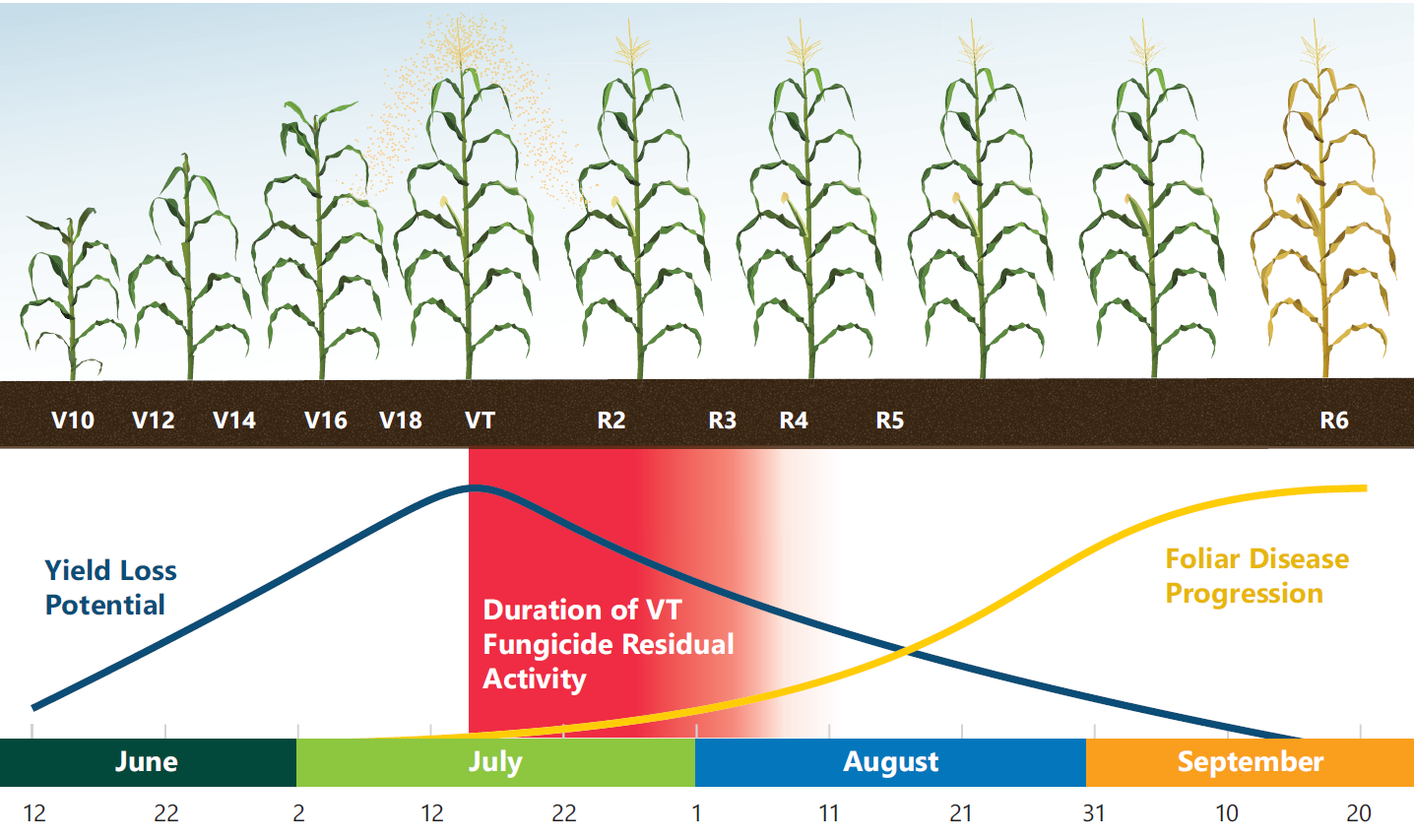
- Foliar diseases impact yield by reducing the amount of functional photosynthetic leaf area during grain fill. The yield impact associated with lost leaf area peaks at the VT/R1 stage and then gradually declines as the plant gets closer to physiological maturity (Figure 1).
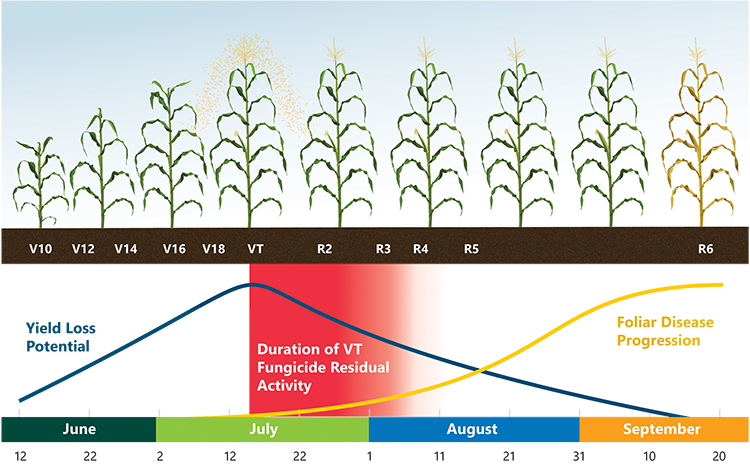
Figure 1. Generalized model of corn foliar disease progression and yield loss potential by growth stage. Click here or on the image above for a larger view.
- The leaves in the upper part of the canopy – from the ear leaf up – account for the majority of photosynthate flowing into the ear during grain fill, so these leaves are the most important to protect from foliar disease.
- Fungicides have limited mobility in plant tissue, so only leaves that receive a fungicide treatment are protected.
- If a fungicide is applied before the uppermost leaves have emerged, those leaves will not be directly protected by the fungicide.
Fungicide Application Timing Research
- Research has generally shown that VT/R1 is the most effective application timing for disease control and yield protection (Paul et al. 2011; Wise and Mueller 2011; Wise et al. 2019).
- Optimal timing can vary depending on the timing and rate of disease progression.
- A University of Nebraska study that compared multiple fungicide timings found that VT to R3 applications provided the best results (Jackson-Ziems et al., 2016), with yield response declining with later application timings.
- Applications as late as R5 (dent) still significantly improved yield in some cases, but not as much as the earlier applications.
- A University of Arkansas study comparing VT, R3, and R5 fungicide applications for southern rust control found that the R3 application provided better disease control in one year when southern rust came on later but did not improve yield over the VT timing, and that the VT timing was generally best for yield protection (Faske and Emerson, 2021).
- Diseases such as southern rust or tar spot, which can come on late and spread quickly, may justify a later R stage application but, in general, the closer the crop is to physiological maturity, the less impact a fungicide treatment is likely to have on yield.
Vegetative Stage Applications
- Earlier applications during vegetative growth stages have been explored as a way to simplify field logistics.
- Application around the V5-V6 stage would allow a fungicide to be tank mixed with a post-emergence herbicide application.
- Applications around the V10-V14 timing have also been evaluated, as they could more easily be performed using a ground sprayer rather than aerial application.
- Applying fungicide at the V5-V6 stage puts it on the crop wellahead of the onset of most foliar diseases, and residual activity would be gone by the time the crop reached grain fill.
- A V10-V14 application would put the window of fungicide efficacy closer to peak foliar disease activity but may leave the door open for a late flush of disease.
- A meta-analysis of research studies conducted over two years in the U.S. and Canada found an average yield increase of 2.0 bu/acre with V6 applications.
- The limited studies that have been done on later vegetative stages applications have shown that a V12 application can provide similar disease suppression to a VT/R1 application in some cases, particularly when disease pressure is low.
- An Iowa State study found better suppression of gray leaf spot with a V12 application in one year when conditions were conducive to earlier disease (Robertson and Shriver, 2018).
- A 3-year Purdue University study found that V12 and VT applications provided similar levels of gray leaf spot protection when pressure was low, but VT applications had a significant advantage under higher disease pressure (Telenko et al., 2020).
References
- Faske, T.R., and M. Emerson. 2021. Multiyear Evaluation of Fungicide Efficacy and Application Timing for Control of Southern Rust in Hybrid Corn in Arkansas. Plant Disease 105:1108-1114.
- Jackson-Ziems, T.A., L.J. Giesler, R.M. Harveson, S.N. Wegulo, K. Korus and A.O. Adesemoye. 2016. Fungicide Application Timing and Disease Control. Papers in Plant Pathology. University of Nebraska – Lincoln.
- Mueller, D., and A. Robertson. 2008. Preventative vs. Curative Fungicides. ICM News. July 29, 2008. Iowa State University.
- Paul, P.A., L.V. Madden, C.A. Bradley, A.E. Robertson, G.P. Munkvold, G. Shaner, K.A. Wise, D.K. Malvick, T.W. Allen, A. Grybauskas, P. Vincelli, and P. Esker. 2011. Meta-analysis of yield response of hybrid field corn to foliar fungicides in the U.S. Corn Belt. Phytopathology 101:1122-1132.
- Robertson, A. and J Shriver. 2018. Should we be spraying corn at V12? Iowa State University Integrated Crop Management News.
- Telenko, D.E.P, J.D. Ravellette, and K.A. Wise. 2020. Assessing Late Vegetative and Tasseling Fungicide Application Timings on Foliar Disease and Yield in Indiana Corn. Plant Health Progress 21:224-229.
- Wise, K., and D. Mueller. 2011. Are fungicides no longer just for fungi? An analysis of foliar fungicide use in corn. APSnet Features. doi:10.1094/APsnetfeature-2011-0531.
- Wise, K.A., D. Smith, A. Freije, D.S. Mueller, Y. Kandel, T. Allen, C.A. Bradley, E. Byamukama, M. Chilvers, T. Faske, A. Friskop, C. Hollier, T.A. Jackson-Ziems, H. Kelly, R. Kemerait, P. Price III, A. Robertson, and A. Tenuta. 2019. Meta-analysis of yield response of foliar fungicide-treated hybrid corn in the United States and Ontario, Canada. PLoS One 14:e0217510.
Protect Your Field and Your Yield
Prevent against and defeat even the most resistant diseases with fungicide solutions from Corteva Agriscience.


The foregoing is provided for informational use only. Contact your Pioneer sales professional for information and suggestions specific to your operation. Product performance is variable and subject to any number of environmental, disease, and pest pressures. Individual results may vary. Pioneer® brand products are provided subject to the terms and conditions of purchase which are part of the labeling and purchase documents.