
Country Selector
Please enter a valid location
The Pioneer Seed Corn Bag
Crop Insights
Written by Lance Gibson, Ph.D., Pioneer Agronomy Training Manager and David Bowen, Ph.D., Staff Analyst, Pioneer Research and Development
Introduction
The Pioneer seed bag is far more than simple packaging — it is a symbol of agricultural innovation, brand identity, and the evolution of modern seed technology. From its beginnings in the 1920s with the Hi-Bred Corn Company to today’s multi-crop, color-coded system, Pioneer seed bags reflect decades of progress in hybrid seed development and farming practices.
Older Pioneer seed corn bags have become antiques and popular collector items, often displayed in frames on office and interior walls of Pioneer seed sheds. Their lasting appeal reflects not only nostalgia, but also the important role they played in the advancement of agriculture and the Pioneer brand.
Over time, changes in bag materials, labeling, and design mirrored advances in agronomy and the increasing scale of agriculture. What began as hand-tied cotton cloth bags evolved into durable, engineered packaging designed to protect seed quality and communicate important product information.
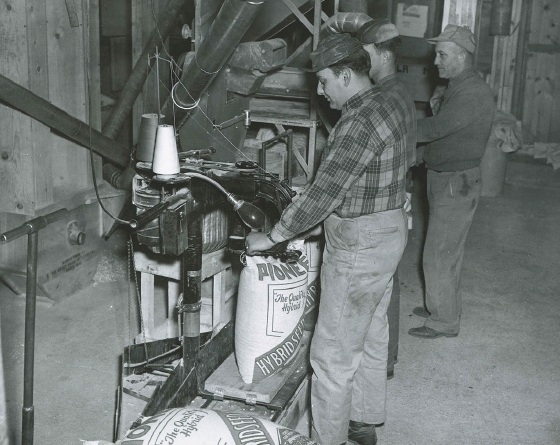
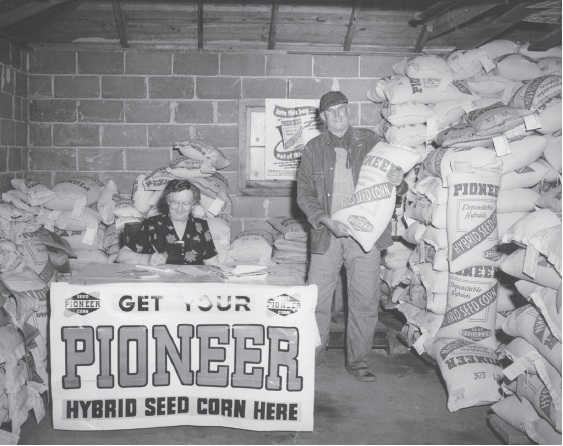
In the 1930s through the 1950s, regional variation in bag types, seed amounts, and labeling practices contributed to noticeable differences in design. This variability can make it difficult to confidently determine when specific changes were adopted, as some overlap clearly existed. Historical photos even show multiple bag designs present within the same warehouse, underscoring the lack of uniformity during this period.
This article provides a chronological look at the development of Pioneer seed bags using available documentation and collector insights. While it highlights major changes and milestones, it is not all-inclusive — some variations may not be captured, and some details likely remain unknown to the authors.
Some information in this article was sourced from “The Pioneer Seed Bag,” written by Irv Deihl in 1986. Irv was one of the first Pioneer agronomists, beginning in 1962 with the formation of the Technical Service Department, the forerunner to the modern Agronomy Sciences group.
- Hi-Bred Corn Company — Late 1920s
- Hi-Bred Corn Company — Early 1930s
- Pioneer Hi-Bred Corn Company — 1935-1939
- Pioneer Hi-Bred of Indiana — Late 1930s
- Pioneer Hi-Bred — 1939-1948
- Pioneer Hi-Bred of Canada — 1940s
- Pioneer Hi-Bred — 1948-1950
- Pioneer Hi-Bred — 1950-1964
- Caldera Hybrid Maize — Early 1950s
- Paper Bags — 1957-1964
- Plastic Bags — 1959-1960
- 1965 to Present
- 100th Anniversary Commemorative Bags
- Other Crops
- Smaller Seed Bags
- Miniature Sweet Corn Bags
- Transparent Plastic Bags for Store Displays
- Corn Product Names
- Kernel Sizes and Bag Codes
- Conclusion
- Top Three Hybrids by Year in North America (1979 - 2023)
- Life Span of Hybrids
Hi-Bred Corn Company — Late 1920s
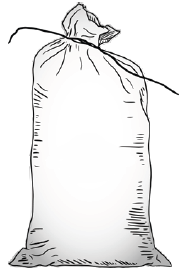
The Hi-Bred Corn Company, founded in 1926, first marketed hybrid seed corn using tightly woven cotton Bemis bags. Manufactured by the Bemis Brothers Bag Company one of the largest bag producers in the United States at the time — these cloth bags were made from durable, breathable cotton fabric and were commonly used for timothy and other grass seeds. Typically holding about two bushels of seed corn, they were sewn construction bags designed for bulk handling and general farm use. In the early years, the bags were tied shut with white cord using amiller’s knot, later replaced by wire ties for improved efficiency.
These early Bemis bags were known for their wide availability, strength, and reusability, allowing them to withstand handling, transport, and storage while helping reduce moisture buildup in the seed. At the time, functionality was prioritized over branding or printed information. By 1929, the Hi-Bred Corn Company transitioned to standardized 56-pound bags and began treating seed with a mercury compound to protect emerging seedlings.
Hi-Bred Corn Company — Early 1930s
In the early 1930s, the Hi-Bred Corn Company of Grimes, Iowa, introduced its first trademarked seed bags, marking an important step in the company’s early growth and identity. These bags typically held 56 pounds of seed corn, though certain large round (LR) kernel varieties were packaged at slightly higher weights — 60 to 65 pounds — to account for their lower kernel count per unit of weight. Constructed from durable osnaburg fabric, a coarse, breathable textile made from low-grade cotton, the bags were designed for practical agricultural use. Their sturdy weave allowed airflow to help prevent mold and spoilage, while their reusability made them valuable household materials during the economic hardships of the Great Depression. The bags were sewn shut by machine, reflecting a blend of practicality and emerging industrial efficiency in agricultural production.
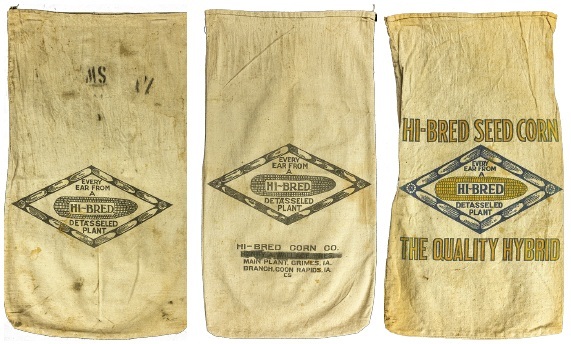
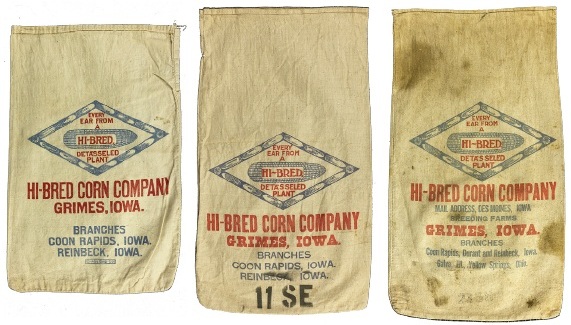
The printed design on these early seed bags evolved rapidly as the company expanded. Initially simple, the imprinting was frequently updated to reflect new facilities coming online. The 1932 bags listed Henry A. Wallace as president and identified the Main Plant in Grimes, Iowa, along with a branch location in Coon Rapids, Iowa (in partnership with Garst & Thomas Seed Co.) By 1933, Reinbeck had been added, and by 1934, locations such as Durant, Iowa; Galva, Illinois; and Yellow Springs, Ohio appeared on the bags. During this time, the company’s facilities were identified as being located at Grimes, as Johnston, Iowa, (not incorporated until 1969) had not yet established its own post office. These updates to the bag printing not only conveyed logistical information but also illustrated the rapid geographic growth of the company during its formative years.
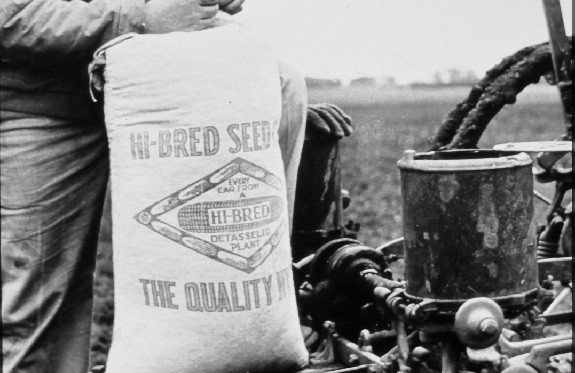
A defining feature of the Hi-Bred seed bags was the distinct diamond-shaped logo printed near the lower center. This emblem was framed by a decorative border resembling linked corn ears, with cross-sections of ears marking the left and right points of the diamond. Inside, the text proclaimed, “EVERY EAR FROM A HI-BRED DETASSELED PLANT,” reinforcing the company’s core message about the reliability and scientific breeding of its hybrid seed. At the center of the design, the word “HI-BRED” was prominently displayed within a large ear of corn, creating a clear visual focal point. Printed in dark ink against the natural, unbleached cotton background of the fabric, the design emphasized clarity and practical communication with farmers. Initially, printed in black, blue and yellow colors were introduced for a short period, followed by a rapid transition to blue and red.
Pioneer Hi-Bred Corn Company — 1935-1939
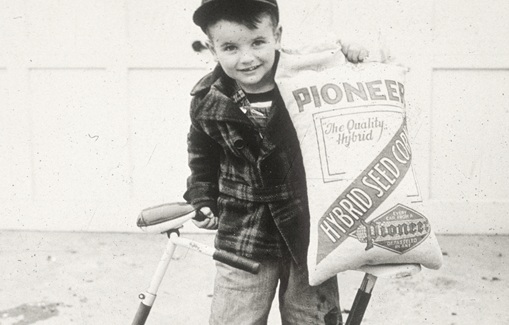
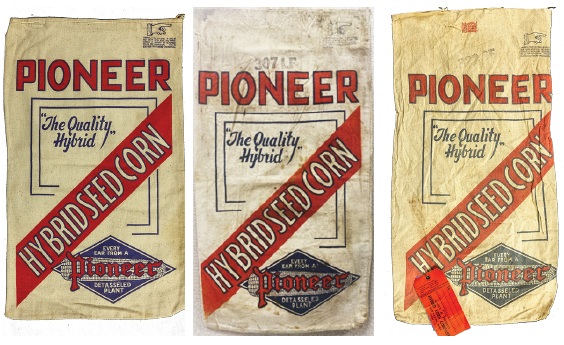
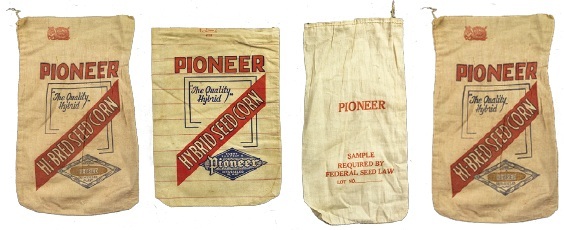
In July 1935, the name “Pioneer” was added to the company name to distinguish it from the growing number of hybrid seed corn companies across the Corn Belt. Early Pioneer Hi-Bred Corn Company bags prominently featured “PIONEER” in large red letters outlined in blue across the top, with the phrase “The Quality Hybrid” printed beneath this in blue. A bold red diagonal stripe ran across the center of the bag, displaying “Hi-Bred Seed Corn” in white lettering outlined in blue. Near the bottom appeared the original diamond logo carried over from earlier Hi-Bred Corn Company bags. These bags were made from osnaburg cotton fabric.
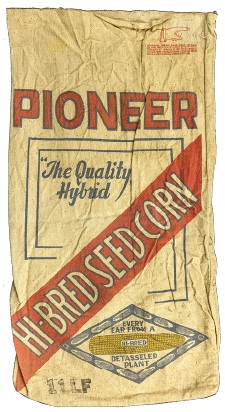
Additional design details included a printed hand with a pointing finger in the upper right corner to guide opening. Beneath this symbol was the instruction: “UNRAVEL FROM THE END. IF BAG IS NOT SEWN WITH BLUE AND WHITE THREAD IT SHOULD BE RETURNED TO US FOR INSPECTION. THIS IS FOR OUR CUSTOMER’S PROTECTION.” Beginning in the late 1930s, bags were also stamped at the top with the hybrid designation and seed size. Seed shape was identified as Flat (F) or Round (R), and sizes were categorized as Large (L), Medium (M), Small (S), and occasionally Extra Small (XS).
Pioneer Hi-Bred of Indiana — Late 1930s
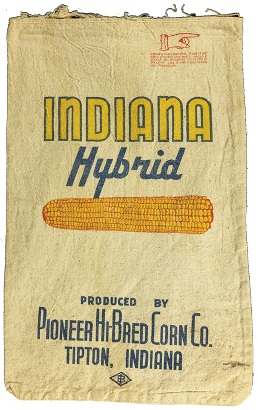
In 1936, Flora, Indiana was established as a parent-seed production site. The following year, the first commercial crop of hybrid seed corn was planted at Flora for sale to Indiana farmers. Also in 1937, the Pioneer Hi-Bred Corn Company of Indiana was formed. In 1938, it built a production plant in Tipton, Indiana, and expanded its sales territory to Michigan and Kentucky. In 1945, Pioneer of Indiana assumed management of the Eastern Pioneer Hybrid Corn Company of Yellow Springs. By the late 1940s, the Eastern Pioneer Hybrid Corn Company was closed, and all eastern U.S. corn-growing states came under the direction of Pioneer of Indiana.
Pioneer Hi-Bred — 1939-1948
In 1939, the lettering in the diagonal red strip was updated from “Hi-Bred Seed Corn” to “Hybrid Seed Corn”. The diamond logo on the lower portion of the bag was redesigned, replacing “Hi-Bred” with “Pioneer” in large script lettering across a corn ear at the center of the diamond. This Pioneer lettering was white from 1939 to 1941 and red from 1942 to 1948. “PIONEER” continued to be prominently featured in large red letters outlined in blue across the top, with “The Quality Hybrid” printed beneath it in blue.
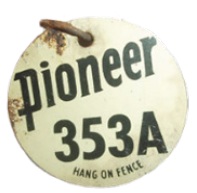
By the late 1940s, additional features were introduced to improve safety and usability. Clay coatings and paper linings were added to the osnaburg bags to protect against the toxic mercury dust used at the time, which was discontinued after 1947. Around this same period, round metal discs were attached to the bags using hog rings, along with identification tags. These discs were intended for farmers to mark field locations of specific hybrids on fences, with the hybrid number painted directly on the disc.
Pioneer Hi-Bred of Canada — 1940s
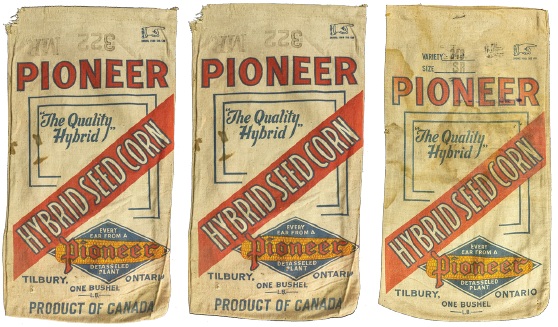
The origins of Pioneer of Canada began with James Jubenville, a young farmer from Tilbury, Ontario. In 1936, Jubenville obtained a sample and tested Pioneer 322 on his farm, repeating the test the following year. Recognizing the potential, Jubenville became an associate producer and distributor for Pioneer in 1938, growing 14 acres and selling 300 bushels of Pioneer hybrid 322 to friends and neighbors. Jubenville sold his corn seed plant to Pioneer in 1946. The company moved its facilities to a more advanced, larger site near Chatham, in 1967.
Pioneer Hi-Bred — 1948-1950
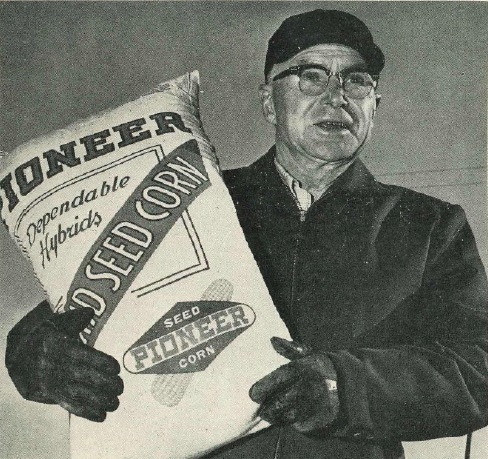
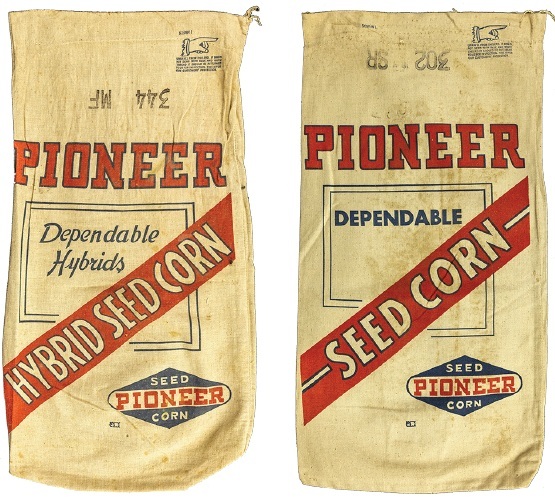
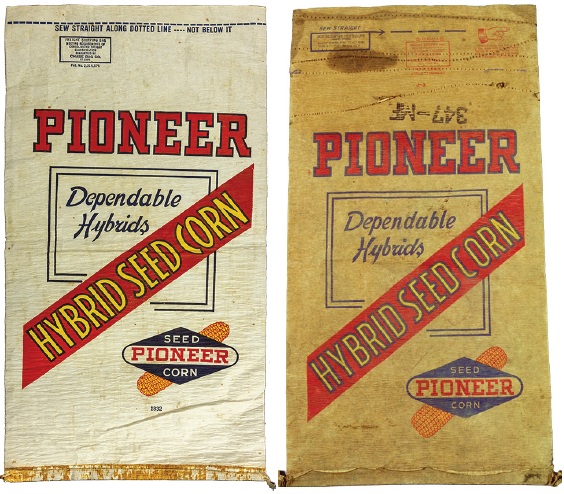
In 1948, the bag design was updated to reflect new branding. The phrase “Dependable Hybrids” replaced “The Quality Hybrid” beneath the large “PIONEER” lettering. The diamond logo at the bottom was also redesigned into a simpler form, featuring a blue diamond with a white crossbar containing the word “Pioneer” in red. “Seed Corn” appeared in white within the blue field, and the left and right corners of the diamond were rounded for a more streamlined look. The prominent red diagonal stripe with the words “Hybrid Seed Corn” remained unchanged in the center of the bag. During the 1940s, 50s, and 60s, Pioneer in the United States was organized into four regional companies for seed marketing and distribution, which likely led to variations in seed bag design among the different regions.
Pioneer Hi-Bred — 1950-1964
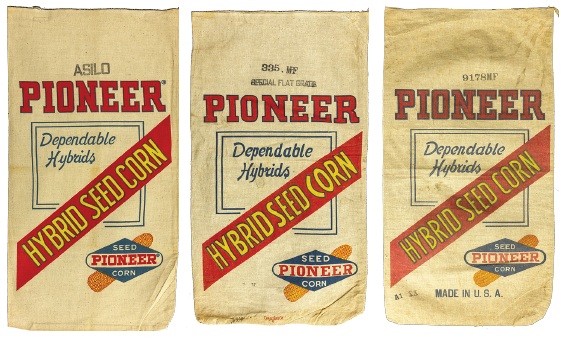
In 1950, the “Hybrid Seed Corn” lettering within the red diagonal stripe was changed from white to yellow. At the same time, a yellow corn ear was added diagonally behind the diamond logo in the lower left of the bag to enhance its visual appeal. This design was used for a decade and a half. As Pioneer expanded its seed business internationally, some bags were labeled “MADE IN U.S.A.”, presumably to meet country of origin requirements for export to other countries.
The first sale of single-cross hybrids occurred in 1962. Prior to this, hybrids were predominantly double-crosses, created by crossing two single-cross hybrids that combined the genetics of four distinct inbred parent lines. Although their yield potential was lower than single-crosses, double-cross hybrids produced higher seed yields, making them more affordable for farmers. By the early 1960s, the grain yield of single-cross hybrids and the seed yield of female inbred parents made production and sale of single-crosses economically attractive. In 1960, the hybrid numbers for new hybrids were increased to four digits.
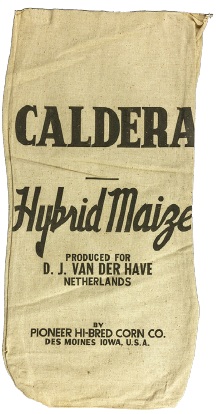
Caldera Hybrid Maize — Early 1950s
Pioneer expanded its international reach through joint ventures, helping introduce U.S. hybrid maize to Europe in the early 1950s. In the Netherlands, this effort included Caldera hybrid maize produced for the Dutch seed company D.J. van der Have. Following World War II, European countries such as the Netherlands sought to boost agricultural productivity, adopting hybrid maize technologies introduced under the Marshall Plan. Caldera played a key role in the transition from traditional open-pollinated corn to more efficient hybrid varieties.
Paper Bags — 1957-1964
In 1957, Pioneer began experimenting with its first paper seed bags. The earliest versions were tube-style bags with a very rough, ribbed exterior, which made them difficult to sew and required heavier-duty sewing machines. They were also abrasive, causing discomfort to both skin and clothing. With time, smoother bags with gussets, like the bags used today, were developed. The gussets — folded sections along the sides — allowed the bag to expand and be easily filled with seed.
Plastic Bags — 1959-1960
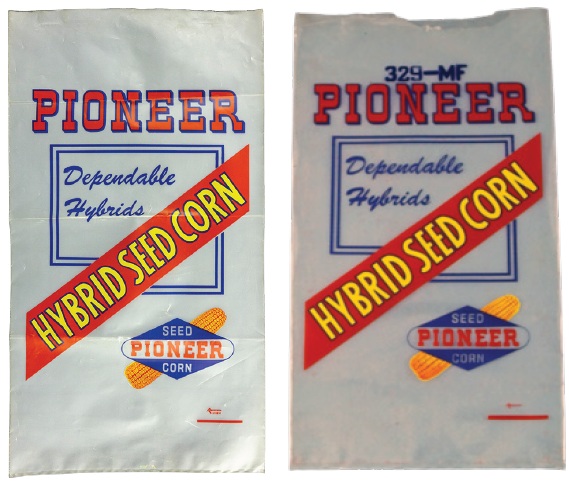
In 1959, Pioneer conducted a small pilot program to test plastic bags for packaging corn seeds. Plastic was expected to improve seed presentation and provide better moisture protection than cloth or paper. However, in practice the bags proved more prone to punctures, and feedback from both sales representatives and farmers was largely unfavorable. The trial was discontinued after only a few years. Some plastic bags are clear and others are white.
1965 to Present
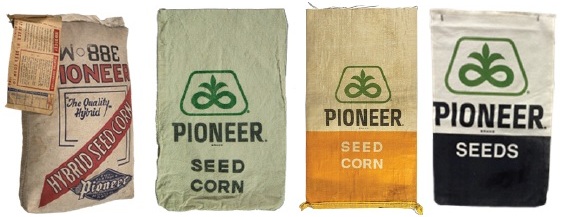
Beginning in the 1930s, Pioneer products were marketed through five regional companies, each managing their own brand identity. As a result, trademarks lacked uniformity, even though all hybrids originated from a single research organization managed by the Iowa company with breeders working at a regional level for focused product development. Expansion into crops such as sorghum and alfalfa underscored the need for a consistent brand. In 1965, Pioneer introduced a unified trademark — the green trapezoid — symbolizing scientific progress and plant growth, with elements suggesting seeds, infinity, and crop diversity. More than 60 years later, it remains a defining feature of the Pioneer brand.
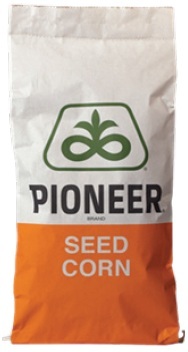
With this new identity, Pioneer launched a gold-and-white paper gusseted seed bag. Single-cross seed was sold in 50-pound bags, while other crosses used 56-pound bags. Because single-cross hybrids require fewer kernels per acre than double-cross hybrids, each bag contained roughly 11% fewer seeds, helping reduce costs while improving production efficiency and sales consistency. By 1968, all bags were standardized to 50-pound units, completing the transition from cloth to paper packaging. Typical bags measured about 14½ × 32½ inches, with 2- to 4-inch gussets accommodating 60,000 to 105,000 kernels per unit, weighing 41 to 56 pounds.
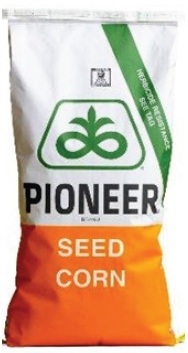
During the 1980s, Pioneer shifted from weight-based packaging to fixed kernel-count units, standardizing the 80,000-seed unit. This change improved planting accuracy and enabled more precise population management.
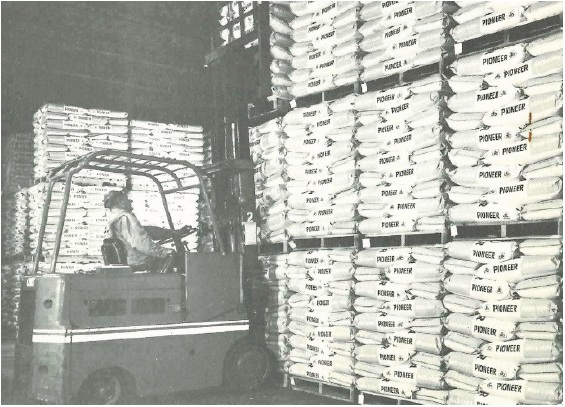
In later decades, bag designs evolved to reflect advances in biotechnology. In the mid-1990s, distinct color-coded vertical stripes — such as green, blue, and red — were introduced to indicate herbicide tolerance and insect protection traits, allowing farmers to quickly match products with crop protection systems. As trait combinations became more complex, this visual system became less practical. Pioneer gradually phased out color-coded striping, consolidating packaging into a more uniform design. Trait details, refuge requirements, and stewardship information shifted to seed tags and labeling rather than the printed bag. Color-coded trait striping was fully discontinued in 2021.
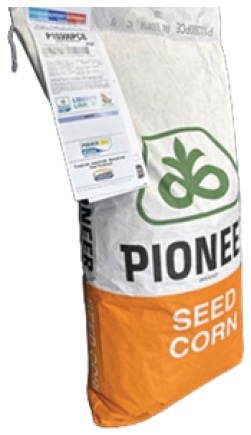
Pioneer’s corporate structure also evolved during this period. Pioneer Hi‑Bred International, Inc. was formed in 1973 and the five companies selling Pioneer seed became subsidiaries as part of a corporate reorganization and expansion into global markets. DuPont acquired Pioneer Hi-Bred International in 1999. In 2017, DuPont merged with Dow to form DowDuPont, combining Pioneer with Dow AgroSciences and DuPont Crop Protection. In June 2019, the agriculture division was spun off as Corteva Agriscience, with Pioneer serving as its flagship seed brand. These ownership transitions are reflected on the reverse of seed bags from each era.
Today, Pioneer packaging emphasizes consistent brand appearance, with detailed product information provided through the seed tag, Pioneer Product Use Guide, and Pioneer Seed Guide.
100th Anniversary Commemorative Bags
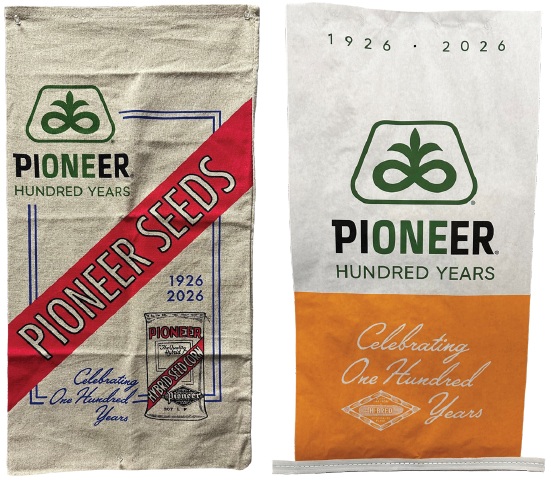
In 2026, commemorative seed bags — in both cloth and paper versions — were produced to mark Pioneer’s 100th anniversary.
Other Crops
The same basic design for the front of Pioneer-branded seed bags has been used across multiple crops, each identified by a distinct color to ensure easy recognition and product clarity. Yellow is used for canola and mustard, gold/orange for corn, blue for soybean, green for alfalfa, dark green for forage grasses, bright orange for sunflower, burnt orange for sorghum and millet, purple for cotton, and red for wheat and hybrid rice.

Smaller Seed Bags
Half-bushel cloth and paper bags were produced until 1967, when they were discontinued due to the shift toward larger planters and increased corn acreage. Each salesman received a few half-bushel bags — typically 3% of each regular hybrid — in their delivery pool shipment, comprising a small portion of the total. Some requested additional half-bushel bags as part of their extra corn allocation, but even if not requested, a limited number were still included by the plants.
Seven- and 14-pound bags — both cloth and paper — were commonly distributed to farmers and vocational agriculture departments to compare Pioneer hybrids with open-pollinated corn or other hybrids. Beginning in the late 1940s, thousands of vocational agriculture students received enough seed of two Pioneer hybrids to plant an acre of each, which they grew side by side alongside another variety grown on their farm. Students worked to achieve the highest yields while evaluating hybrid performance and were required to conduct weighed yield tests in the fall. From the 1970s through the early 2000s, these smaller bags were used primarily for strip-trial hybrid comparisons and product knowledge plots.
Miniature Sweet Corn Bags
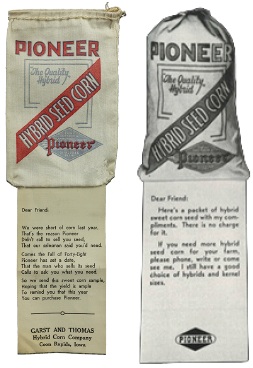
Miniature Pioneer cloth bags, filled with ¼-lb of sweet corn, were provided free to sales representatives to mail to farmers in 1948 and 1949. Each bag included a message encouraging farmers to connect for their seed needs, along with space for the salesperson’s contact information. By sending these samples, sales representatives could build relationships, generate goodwill, and drive additional sales.
Transparent Plastic Bags for Store Displays
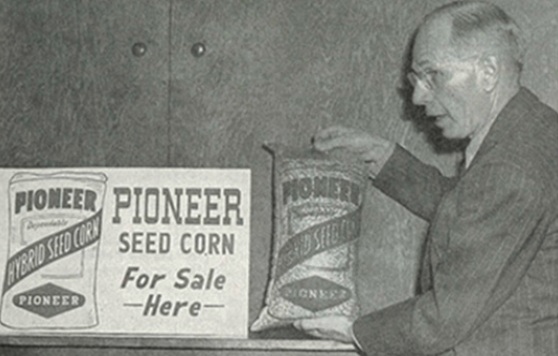
In the late 1940s, transparent plastic bags were introduced for sales representatives to use in storefront displays. At the same time, each salesman was encouraged to partner with a store dealer in every town to maintain a small supply of Pioneer corn seed at planting season.
Corn Product Names
As Pioneer expanded, its corn hybrid naming system evolved from simple three‑digit identifiers to increasingly detailed combinations of letters and numbers designed to convey more information about each product.
Between 1926 and 1930, hybrid names used a three‑digit format in which the first two digits represented the year of seed production (for example, “26” for 1926), and the third digit indicated seed shape — odd numbers for flat seed and even numbers for round seed. While this system distinguished products, it tied names to production year rather than genetics, making it difficult to compare hybrids across years.
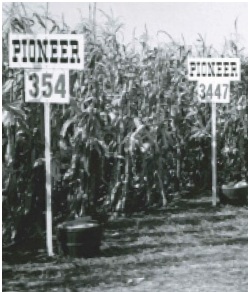
In 1931, the company revised the system to emphasize genetic identity rather than year of production. The digits were redefined to represent genetics and seed shape, while the “30” prefix was retained for continuity. Over time, seed shape was removed from the naming convention, and the numbers increasingly reflected genetic differences. Hybrids retained a leading “3,” making them identifiable as Hi‑Bred products, and letters were sometimes added to denote modifications. Three‑digit identifiers remained in use for new hybrids until 1961.
As the number of hybrids increased and single‑cross hybrids were introduced, the shortcomings of the three‑digit system became apparent. Number reuse was prohibited by seed regulations, leaving too few available combinations, and some hybrids were assigned numbers that did not accurately reflect their maturity. To resolve this, Pioneer introduced a four‑digit naming system for 1962, enabling more precise grouping by maturity. In this system, the first two digits identified the hybrid type and general maturity class, while the last two digits indicated relative maturity within that class. Four‑way crosses used even-numbered prefixes (32, 34, 36, and 38), whereas other crosses used odd-numbered prefixes (31, 33, 35, 37, or 39). Within each group, higher ending numbers signified earlier maturity. Existing hybrids retained their original three‑digit names until they were phased out.
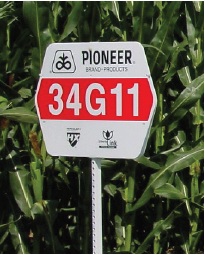
In the late 1990s, the naming system expanded to five characters by adding a letter within the hybrid name. This change accommodated the growing number of hybrids that occurred with the introduction of biotech traits.
A major update came in September 2008, when Pioneer introduced a new naming structure based on maturity, genetic platform, and trait information. All hybrids began with the letter “P,” followed by four numbers — where the first two digits indicated comparative relative maturity and the last two digits were randomly assigned — and ending with letters that identified specific traits.
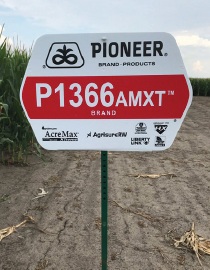
Only the last two numbers were used for the first two digits on the name for maturities greater than 100. As an example, a new corn hybrid named P9516XR was a 95 CRM hybrid containing Herculex XTRA insect protection (X), and Roundup Ready Corn 2 trait (R). The random number component of corn hybrid names was expanded from two digits to three in 2023, ensuring sufficient unique identifiers as the product portfolio continued to grow.
Kernel Sizes and Bag Codes
In the early years, kernel sizing included edge drop (flats) and hill drop (rounds), with small-seeded hybrids offered in large and small sizes and large-seeded hybrids in large and medium sizes. By 1938, four standard sizes — LF, LR, SF, and SR — were established, occasionally including XSF and XSR, and by 1939 this expanded to six labeled sizes: LF, MF, SF, LR, MR, and SR. In 1948, the system grew to eight sizes as medium categories were split (MF/MF1 and MR/MR1), and packaging symbols were added to identify plants, later replaced after 1957 by letter codes integrated into seed tag lot numbers. In 1959, MF1 and MR1 were eliminated, and sizing evolved into a broader set of codes until 1972, when a shift to column number designations (F11, F17, R21, R27) occurred. Further changes followed with the introduction of the first PL size in 1973, and later CD sizing in 1982, with PL transitioning to CD6 in 1983. (Source: former Pioneer agronomist Irv Deihl, 1986.)
Contributors to Irv Deihl’s 1986 Article
Raymond Baker, Perry Collins, Wayne Skidmore, Robert Dahlberg, Emma Borrell, Joe Davis, Dale Karsten, Webbie Orton, Don Porter, Wilbur Curran, Bill Bruere, Red Atwood, Cliff Klein, Marion Charlet, Curt Maas, Scott Sinclair, Dave Knau
Conclusion
The history of the Pioneer seed bag reflects far more than changes in packaging — it mirrors a century of innovation in hybrid seed development, agronomic practices, and the growth of a global agricultural enterprise. From the early cotton Bemis bags of the 1920s to modern, standardized, multi-crop packaging, each evolution captured advances in seed technology, distribution systems, branding and farmer needs.
Changes in materials — from cloth to paper to limited plastic trials — and the shift from weight-based to kernel-count packaging illustrate the industry’s focus on efficiency, seed quality, and planting precision. At the same time, developments in hybrid naming systems, kernel sizing, and bag labeling demonstrate the increasing complexity and sophistication of plant breeding and product differentiation.
Efforts such as small sample bags, yield contests and storefront displays highlight Pioneer’s long-standing commitment to education, product evaluation and farmer engagement. The transition to a unified brand identity under the modern Pioneer logo in the mid-1960s was further reinforced by the consolidation of the separate Pioneer Hi-Bred Corn companies into Pioneer Hi-Bred International, Inc. This evolution continued through its alignment with DuPont, the formation of Corteva Agriscience, and most recently Vylor, underscoring the company’s ongoing adaptation within a rapidly advancing agricultural landscape.
Top Three Hybrids by Year in North America (1979 - 2023)
1979 — 2001
| Year | Hybrid | ||
|---|---|---|---|
| 1 | 2 | 3 | |
| 1979 | 3780 | 3541 | 3184 |
| 1980 | 3780 | 3541 | 3732 |
| 1981 | 3780 | 3541 | 3732 |
| 1982 | 3780 | 3732 | 3541 |
| 1983 | 3732 | 3377 | 3780 |
| 1984 | 3732 | 3747 | 3377 |
| 1985 | 3732 | 3377 | 3747 |
| 1986 | 3475 | 3732 | 3737 |
| 1987 | 3475 | 3737 | 3732 |
| 1988 | 3475 | 3737 | 3377 |
| 1989 | 3475 | 3379 | 3737 |
| 1990 | 3379 | 3475 | 3751 |
| 1991 | 3379 | 3751 | 3417 |
| 1992 | 3417 | 3394 | 3751 |
| 1993 | 3394 | 3417 | 3751 |
| 1994 | 3394 | 3751 | 3417 |
| 1995 | 3394 | 3751 | 3489 |
| 1996 | 3394 | 3489 | 3563 |
| 1997 | 3394 | 3489 | 3335 |
| 1998 | 3489 | 3730 | 33A14 |
| 1999 | 33A14 | 33G26 | 34R07 |
| 2000 | 33A14 | 33G26 | 34B23 |
| 2001 | 33G26 | 34B23 | 33B51 |
2002 — 2023
| Year | Hybrid | ||
|---|---|---|---|
| 1 | 2 | 3 | |
| 2002 | 33P67 | 33B51 | 34M94 |
| 2003 | 33P67 | 33B51 | 34H31 |
| 2004 | 33B51 | 34H31 | 33P67 |
| 2005 | 34H31 | 33B51 | 36B08 |
| 2006 | 34A16 | 33B54 | 33B51 |
| 2007 | 34A20 | 33B54 | 34A16 |
| 2008 | 37Y14 | 34R67 | 33D14 |
| 2009 | 35F44 | 33D49 | 33W84 |
| 2010 | 35F44 | 33D49 | 33W84 |
| 2011 | P1498HR | P9917AM1 | 33D47 |
| 2012 | P1498HR | P9917AM1 | 33D47 |
| 2013 | P1151AM | P1498HR | P0533AM1 |
| 2014 | P1151AM | P1498AM | P0533AM1 |
| 2015 | P1151AM | P0157AMX | P1498AM |
| 2016 | P1197AM | P0157AMX | P1151AM |
| 2017 | P1197AM | P0157AMX | P1151AM |
| 2018 | P1197AM | P1197AMXT | P1151AM |
| 2019 | P1197AM | P1366AM | P1138AM |
| 2020 | P1197AM | P1108Q | P1366AM |
| 2021 | P1197AM | P1108Q | P9492AM |
| 2022 | P1185AM | P1185Q | P1197AM |
| 2023 | P1185AM | P0953AM | P0924Q |
| Year | Hybrid | ||
|---|---|---|---|
| 1 | 2 | 3 | |
| 1979 | 3780 | 3541 | 3184 |
| 1980 | 3780 | 3541 | 3732 |
| 1981 | 3780 | 3541 | 3732 |
| 1982 | 3780 | 3732 | 3541 |
| 1983 | 3732 | 3377 | 3780 |
| 1984 | 3732 | 3747 | 3377 |
| 1985 | 3732 | 3377 | 3747 |
| 1986 | 3475 | 3732 | 3737 |
| 1987 | 3475 | 3737 | 3732 |
| 1988 | 3475 | 3737 | 3377 |
| 1989 | 3475 | 3379 | 3737 |
| 1990 | 3379 | 3475 | 3751 |
| 1991 | 3379 | 3751 | 3417 |
| 1992 | 3417 | 3394 | 3751 |
| 1993 | 3394 | 3417 | 3751 |
| 1994 | 3394 | 3751 | 3417 |
| 1995 | 3394 | 3751 | 3489 |
| 1996 | 3394 | 3489 | 3563 |
| 1997 | 3394 | 3489 | 3335 |
| 1998 | 3489 | 3730 | 33A14 |
| 1999 | 33A14 | 33G26 | 34R07 |
| 2000 | 33A14 | 33G26 | 34B23 |
| 2001 | 33G26 | 34B23 | 33B51 |
Life Span of Hybrids
| Hybrid | First Year | Last Year |
|---|---|---|
| 261-262# | 1926 | 1926 |
| 271-272# | 1927 | 1927 |
| 281-282# | 1928 | 1928 |
| 291-292# | 1929 | 1929 |
| 293-294# | 1929 | 1929 |
| 300 | 1940 | 1963 |
| 300A | 1944 | 1947 |
| 301# | 1930 | 1933 |
| 301* | 1950 | 1959 |
| 301A | 1950 | 1963 |
| 301B | 1952 | 1963 |
| 301C | 1950 | 1960 |
| 302# | 1932 | 1939 |
| 302* | 1947 | 1963 |
| 302A | 1939 | 1941 |
| 302B | 1957 | 1967 |
| 303# | 1930 | 1931 |
| 303* | 1943 | 1956 |
| 304# | 1932 | 1939 |
| 304* | 1940 | 1952 |
| 305 | 1935 | 1936 |
| 305A | 1936 | 1939 |
| 306 | 1933 | 1937 |
| 306# | 1952 | 1954 |
| 306B | 1955 | 1959 |
| 307 | 1936 | 1963 |
| 307A | 1934 | 1936 |
| 308 | 1935 | 1939 |
| 308B | 1936 | 1937 |
| 308C | 1936 | 1937 |
| 308D | 1936 | 1939 |
| 309 | 1933 | 1935 |
| 309* | 1951 | 1956 |
| 309A | 1953 | 1963 |
| 309B | 1957 | 1962 |
| 310 | 1936 | 1937 |
| 310* | 1962 | 1963 |
| 311# | 1931 | 1941 |
| 311A | 1934 | 1948 |
| Hybrid | First Year | Last Year |
|---|---|---|
| 311B | 1935 | 1936 |
| 312# | 1931 | 1939 |
| 312* | 1952 | 1956 |
| 312A | 1953 | -- |
| 313 | 1937 | 1945 |
| 313A | 1938 | 1939 |
| 313A* | 1949 | 1957 |
| 313B | 1944 | 1959 |
| 313D | 1943 | 1959 |
| 313E | 1941 | 1946 |
| 313F | 1941 | 1947 |
| 314 | 1936 | 1950 |
| 314* | 1960 | 1966 |
| 315 | 1935 | 1943 |
| 315* | 1952 | 1954 |
| 315A | 1937 | 1937 |
| 315C | 1935 | 1936 |
| 316 | 1937 | 1939 |
| 316* | 1946 | 1947 |
| 316** | 1955 | 1963 |
| 316A | 1960 | 1963 |
| 317 | 1937 | 1950 |
| 317A | 1955 | 1963 |
| 318 | 1934 | 1940 |
| 318* | 1946 | 1947 |
| 318A | 1939 | 1940 |
| 318A* | 1957 | 1966 |
| 319 | 1938 | 1945 |
| 319* | 1958 | 1963 |
| 319E | 1960 | 1963 |
| 320 | 1938 | 1941 |
| 320* | 1959 | 1962 |
| 320A | 1957 | 1960 |
| 321 | 1937 | 1939 |
| 321* | 1946 | 1949 |
| 321** | 1959 | 1975 |
| 322 | 1936 | 1955 |
| 322A | 1937 | 1939 |
| 323# | 1932 | 1939 |
| Hybrid | First Year | Last Year |
|---|---|---|
| 324# | 1932 | 1940 |
| 325 | 1935 | 1936 |
| 325* | 1950 | 1960 |
| 325A | 1960 | 1966 |
| 326 | 1935 | 1936 |
| 326* | 1942 | 1947 |
| 327 | 1935 | 1936 |
| 328 | 1938 | 1939 |
| 328* | 1959 | 1966 |
| 329 | 1938 | 1940 |
| 329* | 1954 | 1966 |
| 330 | 1939 | 1940 |
| 330A | 1938 | 1939 |
| 330B | 1945 | 1954 |
| 331 | 1939 | 1941 |
| 331* | 1942 | 1949 |
| 332 | 1939 | 1963 |
| 332A | 1938 | 1941 |
| 332A* | 1947 | 1963 |
| 333 | 1939 | 1950 |
| 334 | 1939 | 1950 |
| 334A | 1944 | 1947 |
| 335 | 1936 | 1940 |
| 335* | 1946 | 1963 |
| 336 | 1940 | 1960 |
| 337 | 1940 | 1941 |
| 337* | 1950 | 1957 |
| 338 | 1946 | 1956 |
| 339 | 1942 | 1963 |
| 340 | 1941 | 1954 |
| 341 | 1942 | 1948 |
| 342 | 1943 | 1949 |
| 342A | 1949 | 1963 |
| 342B | 1959 | 1962 |
| 343 | 1944 | 1949 |
| 344 | 1945 | -- |
| 345 | 1953 | 1963 |
| 346 | 1949 | -- |
| 347 | 1950 | 1963 |
# Odd Numbered Hybrid = Edge Drop (Flat) # Even Numbered Hybrid = Hill Drop (Round) | * Hybrid number assigned for second time. ** Hybrid number assigned for third time. | L = High-lysine hybrid. W = Waxy hybrid. |
Documented by former Pioneer agronomist Irv Diehl in 1986.
The foregoing is provided for informational use only. Contact your Pioneer sales professional for information and suggestions specific to your operation. Product performance is variable and subject to any number of environmental, disease, and pest pressures. Individual results may vary. Pioneer® brand products are provided subject to the terms and conditions of purchase which are part of the labeling and purchase documents.